
Thistle
Cirsium vulgare
At a Glance
| Botanical name | Cirsium vulgare |
|---|---|
| Common name(s) | Thistle |
| Family | Asteraceae |
| Plant type | biennial (Tall biennial or short-lived monocarpic thistle; sometimes functions as an annual, flowering in the first year.) |
| Height × Spread | 100–180 cm × — |
| Position | Full sun |
| Soil | Moist but well-drained; Chalk, Clay, Loam, Sand; Acid, Alkaline, Neutral pH |
| Flowering | — |
| Toxicity | — |
| Native range | Europe (north to 66°N, locally 68°N), Western Asia (east to the Yenisei Valley), and northwestern Africa (Atlas Mountains) |
The spear thistle (Cirsium vulgare) is the tall, spiny, purple-headed biennial found along British road verges, waste ground and overgrazed pasture. Native to the UK and widespread across all of Britain and Ireland, it is one of the most recognisable members of the daisy family and a magnet for late-summer pollinators. Whether regarded as a determined weed or a welcome component of a wildlife meadow, it is an ecologically valuable native that has shaped British countryside management for centuries.
Overview
Cirsium vulgare belongs to the Asteraceae and follows a classic biennial life cycle. In its first year the plant produces a low rosette of deeply lobed, fiercely spiny leaves, drawing on a stout taproot to build reserves through the autumn and winter. In the second year it sends up a tall, branched flowering stem that can reach 1.5 m, sets seed in late summer, and dies. A small proportion of individuals behave as short-lived perennials, particularly where the flowering stem is cut or damaged before seed is set.
Spear thistle is a vigorous coloniser of disturbed ground and one of the most widely distributed native weeds of lowland Britain. It thrives on road verges, set-aside land, neglected pasture, coastal cliffs and waste ground, and it tolerates a wide pH range from moderately acidic to slightly alkaline soils. The same vigour that makes it a successful wild plant also makes it problematic in agricultural and amenity settings, where a single plant can produce thousands of wind-borne seeds in a single season. In the garden it is generally treated as a weed, but in wildlife plantings, meadow restorations and naturalistic schemes it is deliberately encouraged for the nectar, pollen and seed it provides.
Appearance
In the rosette stage, spear thistle forms a flat, open circle of leaves pressed against the soil. The leaves are lance-shaped to oblong, 10–30 cm long, deeply and irregularly lobed, with each lobe tipped by a stiff yellow spine. The upper surface is mid-green and sparsely hairy; the underside is paler with a conspicuous thick white midrib that runs the full length of the leaf. Smaller spines bristle along the leaf margins and even along the midrib itself, making the rosette uncomfortable to handle without gloves.
In the second year the bolted stem is erect, branched in the upper half, and distinctly ridged with spiny wings — narrow strips of leaf tissue that run down from the leaf bases. The stem is tough, pale green and lightly woolly. The leaves on the flowering stem are smaller and less lobed than the rosette leaves but just as spiny.
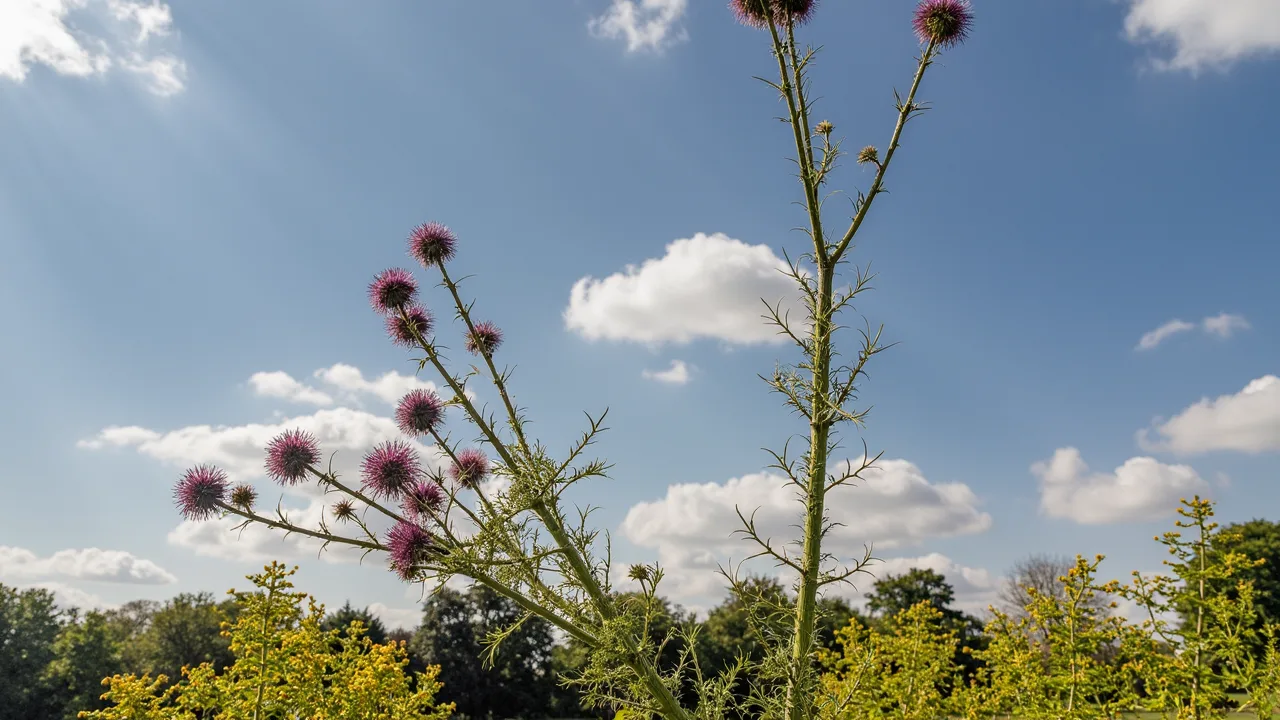
The flower heads are the species' most distinctive feature. Each head is a dense, roughly spherical to ovoid composite of small tubular purple-pink florets, 2–4 cm across, with no conspicuous outer ray florets — the colour comes entirely from the central disc. Beneath each head sits a tight involucre of overlapping green bracts (phyllaries), each one tipped with a short, stiff, yellowish spine. On mature heads the outer bracts press downward and the spines stand out, giving the seed head a slightly star-shaped silhouette. The flowers open in sequence from the top of the plant downward between July and September and are highly attractive to bees, hoverflies and butterflies.
After pollination each floret develops into a small pale achene, 3–5 mm long, topped by a tuft of feathery hairs called a pappus. The pappus is 15–25 mm long and acts as a parachute, carrying seeds on the wind for tens to hundreds of metres. A large, well-grown plant can produce several thousand seeds in a single season.
Growing Conditions
Cirsium vulgare is fully hardy throughout the UK, rated RHS H7 (hardy to below −20 °C) and equivalent to USDA hardiness zone 6. It tolerates the cool, wet winters and mild summers of the British maritime climate extremely well, and is rarely damaged by UK weather.
In cultivation it prefers a well-drained, moderately fertile soil in full sun. It accepts a broad pH range of roughly 5.5 to 7.5, growing happily on neutral to slightly alkaline loams as well as on lighter, sandier substrates. It will colonise thin, stony soils and disturbed ground where many garden perennials struggle, which is partly why it appears so readily on building sites, road works and abandoned plots. In partial shade the plant still grows but flowering is noticeably reduced and stems tend to lean towards the brightest light.
In the UK, sow seed in either autumn (September to October) or spring (March to May). Autumn sowings germinate promptly, establish a rosette before winter, and typically flower the following summer a few weeks ahead of spring-sown plants. The species has no special pretreatment requirements; the seed germinates readily once it has contact with bare, moist soil and a little light.
Planting and Care
Spear thistle is not normally planted as a deliberate ornamental, so routine care is mainly a question of either encouraging it (in a meadow or wildlife planting) or restricting it (in a cultivated border or pasture).
Watering. Once established the plant is drought-tolerant and only needs additional water during prolonged dry spells in its first year. Mature plants in the UK climate generally find all the moisture they need from rainfall.
Feeding. Spear thistle thrives in poor to moderately fertile soil and does not require supplementary feeding. Over-rich soils produce lush growth at the expense of flower numbers and can encourage rank, leafy plants that collapse in summer.
Pruning and control. In garden and amenity settings, remove bolted flowering stems before the seed heads fully ripen — once the pappus is fluffy and dry, seeds disperse at the slightest disturbance. Cut the stem at or just below ground level; do not rotovate or strim established plants, because fragments of the taproot readily regenerate into new rosettes. Hand-digging of rosettes in autumn or winter, removing the full taproot, is the most reliable non-chemical control. In agricultural settings, repeated cutting before flowering over several seasons progressively weakens populations, and grazing by cattle or sheep keeps seedlings in check.
Propagation. The species is propagated by seed only. Sow direct onto cleared, weed-free ground and press the seed lightly into the soil surface — light is required for germination, so do not bury the seed deeply. For wildlife plantings, broadcast at roughly 1–2 g per square metre and rake in. For more controlled sowings, station-sow two or three seeds at 30–60 cm spacings and thin to the strongest seedling.
Ecological role. Spear thistle is one of the most valuable late-season nectar sources in the British flora. Bumblebees, honey bees, hoverflies, small tortoiseshell and painted lady butterflies visit the flowers in large numbers from July into September. Goldfinches and linnets feed heavily on the ripe seed in autumn, often clinging to the seed heads to extract the achenes.
Common Problems
Spear thistle has very few pest and disease problems in the UK. Its spines and tough leaves deter most grazing animals once it has bolted, and the deep taproot lets it survive drought and mechanical damage that would kill many garden perennials. Rust fungi (Puccinia species) are occasionally seen on the leaves in damp summers but rarely cause serious harm. Aphids can colonise flowering stems in dry years but do not normally warrant treatment.
The single biggest problem associated with Cirsium vulgare in the UK is its invasiveness. A mature plant produces several thousand wind-dispersed seeds, and a single neglected flowering plant can establish a dense patch within two to three seasons. In unimproved grassland and meadow restorations it can quickly dominate if mowing or grazing is relaxed, displacing more desirable forbs and reducing sward diversity.
Control is straightforward but requires persistence. Hand-digging of rosettes, removing the entire taproot, is effective in gardens and small areas. Spot treatment with a systemic herbicide containing triclopyr, applied in spring when plants are in active rosette growth, is the standard approach on agricultural land and is permitted under UK regulations when used as directed. Repeated cutting or topping before flowering reduces vigour over several seasons but rarely eliminates a population on its own.
Popular Varieties
Cirsium vulgare is a wild species and, in the strict horticultural sense, has no named clonal cultivars in general UK trade. The plant is normally grown from wild-collected or commercially multiplied seed, and most stock offered by native plant suppliers is sold simply as Cirsium vulgare or under the common name "spear thistle". Breeders have not selected ornamental cultivars of this species, and the brief explicitly warns against inventing any.
What the gardener can choose between, however, is the species itself and a small number of closely related native thistles that fill a similar ecological role. Cirsium arvense (creeping thistle) is the creeping, colony-forming relative that spreads by rhizomes and is the thistle most often associated with arable land; it is the species depicted on the badge of the Scottish Order of the Thistle. Cirsium palustre (marsh thistle) is a biennial of damp meadows and ditches with smaller, darker flower heads. Cirsium acaule (dwarf thistle) is a stemless perennial of chalk and limestone grassland, with flower heads sitting almost on the ground. Cirsium rivulare 'Atropurpureum' is a popular garden thistle with deep crimson flower heads, although it is not a native UK species and is grown purely as an ornamental.
For anyone wanting the authentic spear thistle for a wildlife meadow or naturalistic planting, the most reliable approach is to source seed of Cirsium vulgare from a reputable UK native plant supplier, sow it onto prepared bare ground in autumn or spring, and allow the biennial rosette-and-bolt cycle to establish itself naturally over the first two seasons.
Pests and Diseases
| Problem | Symptoms | Management |
|---|---|---|
| Seed dispersal | Numerous new seedlings appear in surrounding areas after flowering. | Deadhead flower heads promptly before seeds ripen to prevent spread. |
| Root fragmentation | New shoots emerge from broken root pieces left in the soil. | Dig out entire root systems carefully, ensuring no fragments remain. |
| Slugs and snails | Irregular holes chewed into young leaves and seedlings. | Use physical barriers like copper tape or apply iron phosphate pellets. |
| Thistle weevil | Notching on leaf margins and larvae feeding inside stems. | Tolerate as a natural biological control agent for thistle populations. |
| Powdery mildew | White, dusty fungal growth on leaves in humid conditions. | Improve air circulation and avoid overhead watering to reduce humidity. |
As an Amazon Associate, GardenWizz earns from qualifying purchases made through the links above. This does not affect the price you pay. See our disclaimer for details.