
Chickweed
Stellaria media
The Gardening Year
Best months in UK gardens · full planting calendar →
At a Glance
| Botanical name | Stellaria media |
|---|---|
| Common name(s) | Chickweed |
| Family | Caryophyllaceae |
| Plant type | annual |
| Height × Spread | 40 cm × — |
| Position | Full sun, Partial shade |
| Soil | moist but well-drained; pH Acid, Alkaline, Neutral |
| Flowering | January–December |
| Toxicity | Contains saponins which can be toxic to some species (notably fish); not advised during pregnancy or while breastfeeding |
| Native range | Eurasia |
Chickweed (Stellaria media) is one of the most familiar small-flowered annuals in British gardens, lawns, allotments and arable fields. It is also one of the most productive: a single plant can set well over a thousand seeds in a season, and the seedbank can persist in cultivated soil for several years. Although most gardeners treat it as a nuisance, chickweed has a long history as a salad and pot herb, an early-season nectar source for pollinators, and a useful ground-cover or green-manure species in no-dig systems.
Overview
A member of the carnation family (Caryophyllaceae), chickweed is a low-growing annual herb that germinates through the cool months and flowers almost year-round in mild weather. It colonises any bare, moist, fertile ground, including vegetable beds, newly seeded lawns, path edges and the borders of cultivated plots. The plant is fully hardy across the UK, tolerating frost and continuing to grow slowly through winter in southern and western regions.
The Royal Horticultural Society does not currently award Stellaria media an Award of Garden Merit, as it is treated as a weed rather than an ornamental, and it does not appear in the principal RHS plant-finder listings of cultivated varieties. Its importance to UK gardeners is therefore primarily as a volunteer species to be recognised and managed, rather than chosen. Where it is wanted — in wildlife borders, edible lawns, or as a living mulch — it can be left to self-seed freely with very little intervention.
Appearance
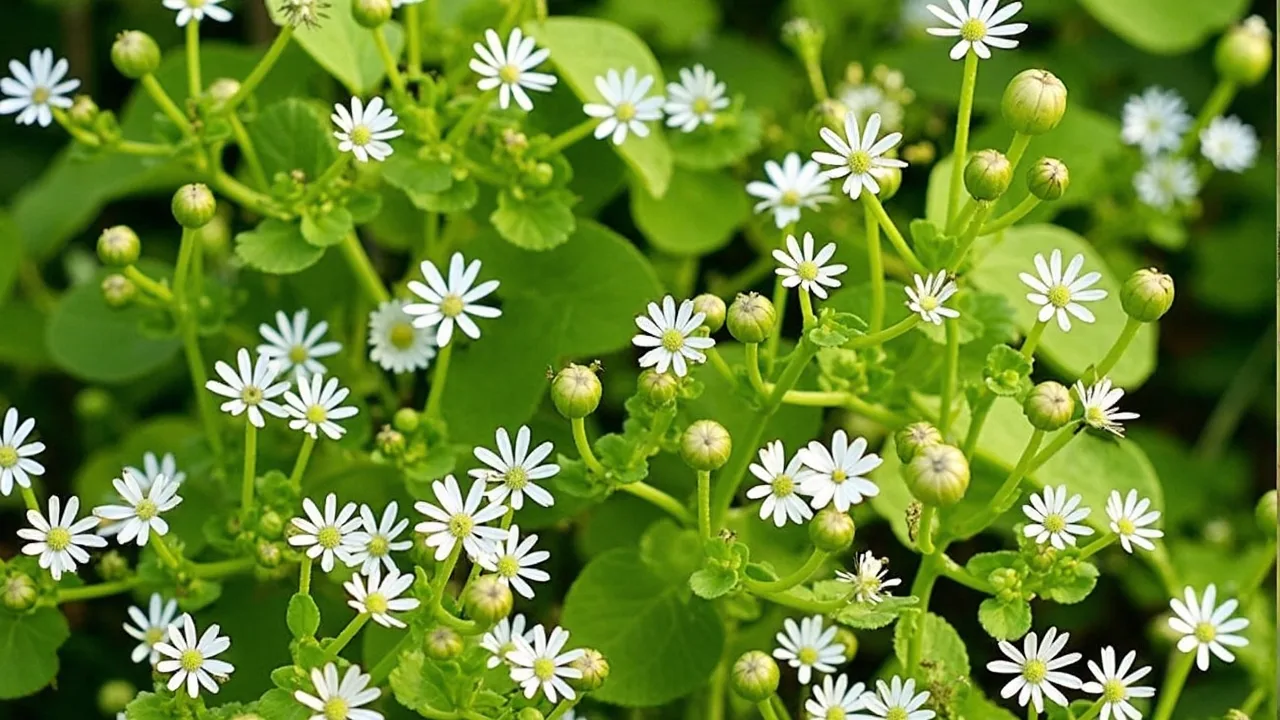
Chickweed forms a sprawling, mat-like plant rather than an upright one. Stems are slender, weak and cylindrical, branching freely and rooting from the lower nodes where they touch bare soil. The whole plant typically reaches 5–40 cm in height and can spread considerably further along the ground.
The leaves are small, oval to broadly egg-shaped, 1–2.5 cm long, smooth-edged and bright fresh green. They are arranged in opposite pairs along the stem, with the upper pairs clasping the stem directly (sessile), a useful identification feature that distinguishes chickweed from several similar-looking speedwells and scarlet pimpernel seedlings.
Flowers are produced in loose clusters at the stem tips. Each flower is 5–10 mm across with five white petals so deeply cleft that they appear to be ten. The petals are shorter than the green sepals beneath them, another diagnostic trait. Flowering is virtually continuous in suitable weather, peaking from late winter through late spring (roughly February to May) and again in early autumn.
Seed pods are small, ovoid capsules that split to release numerous tiny, kidney-shaped seeds. The root system is shallow and fibrous, which is why the plant is easy to pull or hoe out when young.
Growing Conditions
Chickweed thrives in the cool, moist maritime climate that dominates most of the UK. It grows actively at temperatures between about 5 °C and 20 °C, slowing or going dormant in prolonged summer heat and resurgent drought. Light frosts are tolerated and rarely kill established plants.
Soil preferences are broad but consistently favour fertility and moisture. The species does best on loams, clay loams and improved garden soils that retain moisture without waterlogging. A pH range of roughly 5.5 to 7.5 covers almost all UK garden situations, including the slightly acidic conditions common in woodland-edge beds and the neutral conditions typical of vegetable plots. It is rarely found on dry, sandy soils or on heavily compacted, impoverished ground.
Light requirements are flexible. Full sun suits plants in moisture-retentive soil, but chickweed is most vigorous in light or dappled shade, particularly in borders shaded by hedges, fruit canes, or taller vegetables. In dense shade under evergreen canopies growth is thinner and flowering reduced.
Seasonal behaviour follows a recognisable UK pattern. The bulk of germination takes place in late summer and autumn (August to October), producing the overwintering rosettes that flower earliest the following spring. A second flush of germination occurs in early spring (March to April), which flowers into early summer. After setting seed in late spring or early summer, plants die back in dry conditions but new cohorts quickly replace them.
Planting and Care
Chickweed is rarely, if ever, deliberately planted; it arrives on its own and persists as long as conditions suit it. Where the goal is control, the simplest approach is to deny it the bare, moist seedbed it prefers.
Watering and feeding. In cultivated beds chickweed is itself an indicator of fertile, moisture-retentive soil, and the best cultural control is to avoid over-watering and to keep fertility targeted at the crop plants rather than the whole bed. In lawns, reducing surface moisture by improving drainage and avoiding late-autumn nitrogen feeds reduces chickweed pressure.
Pruning and grooming. Because the plant is prostrate and herbaceous, no pruning is needed. Hand-roguing or hoeing is the practical equivalent: small plants are easily severed just below the crown and left to wither on the surface in dry weather. Mowing will not eliminate chickweed from a lawn because the plant grows flat below the cutting height of most rotary mowers; instead, raise the cutting height slightly, scarify in autumn to lift creeping stems, and overseed thin patches with desirable grasses in early autumn.
Propagation. Chickweed self-seeds so freely that no propagation technique is normally required. Where the plant is wanted — for example as a winter-green edible ground cover or as bee forage in an ornamental corner — simply stop weeding one area and allow an existing seeding population to expand. Seeds are not commercially sold in the UK as a named crop, but they can be collected from a healthy local patch by shaking ripe capsules into a paper bag in midsummer.
Seasonal care in the UK. The main flush should be hoed or hand-pulled before flowering finishes in late spring, ideally between April and early May in southern England and a week or two later in the north and in Scotland. Mulching bare soil with a 5–7 cm layer of composted bark or garden compost in late autumn suppresses the autumn germination flush. In vegetable plots, covering beds with black polythene or heavy mulch through winter prevents both autumn and spring germination.
Encouraging chickweed where useful. In wildlife-friendly or edible gardens, leaving an unmown strip or a corner bed undisturbed lets chickweed provide continuous nectar for solitary bees and hoverflies from late winter onwards — earlier than almost any other flowering annual in the British climate.
Common Problems
As a weed, chickweed competes strongly with seedlings of vegetables, herbs and ornamental annuals for light, moisture and nutrients. Its mat-forming habit smothers low-growing crops such as lettuce, carrots, onions and newly germinated lawn seed, and it can establish in the crowns of established herbaceous perennials if these are left undivided for many years.
Pests. Greenfly and other aphids sometimes cluster on the soft growing tips, particularly during mild autumns. Slugs and snails graze the foliage, especially in damp shaded borders, though chickweed is rarely their preferred target. In most cases the damage is cosmetic.
Diseases. Downy mildew (Peronospora spp.) and powdery mildew can affect leaves in prolonged humid weather, producing grey-white or powdery coatings respectively. Leaf-spot fungi, including Cercospora and Ramularia species, occasionally cause small brown spots on the foliage. None of these conditions are economically serious in garden contexts.
In lawns. Chickweed is one of the most common broad-leaved weeds of fine UK lawns, particularly in moist, partly shaded sites and in lawns cut too short. It forms dense, low mats that out-compete desirable grass species, especially in winter and early spring when the grass is dormant.
Allelopathy and soil effects. Chickweed is not strongly allelopathic, but its dense mats can physically shade out slower-germinating seeds beneath them. As a green-manure or smother crop, however, the same trait is an asset, suppressing weed seedlings while the chickweed rots back into the surface soil.
Popular Varieties
Stellaria media is a wild species with no widely grown ornamental cultivars, and named seed-raised varieties are not generally available in UK horticulture. Gardeners interested in chickweed are usually interested in the species itself or in its close relatives, several of which are also native or naturalised in Britain.
- Stellaria media var. media. The typical form, with bright green leaves, well-developed petals and abundant seed production. By far the most common variant in gardens, allotments and arable fields.
- Stellaria media var. pallida. A smaller, paler variant with petals reduced or absent and a more upright habit. It flowers less conspicuously and is easily overlooked, which can make it a hidden source of weed pressure on light, dry soils.
- Stellaria neglecta (greater chickweed). A closely related annual or short-lived perennial with larger leaves and flowers; found in similar habitats and sometimes confused with common chickweed.
- Stellaria holostea (greater stitchwort). A native woodland-edge perennial in the same genus, much taller (to 60 cm) with larger white flowers in spring; useful in wildlife and naturalistic plantings rather than as an edible or lawn plant.
For UK gardeners, recognising the species and its close relatives is more useful than selecting cultivars, which simply do not exist in commercial horticulture.
Pests and Diseases
| Problem | Symptoms | Management |
|---|---|---|
| Slugs and snails | Irregular holes in leaves and stems, with slimy trails visible on foliage. | Use physical barriers like copper tape or hand-pick at night to reduce populations. |
| Vine weevil | Notched leaf margins during the day and wilting plants due to root damage underground. | Check pots for grubs and apply nematodes in warm soil to control larvae. |
| Powdery mildew | White, dusty fungal growth on leaves and stems, potentially causing distortion. | Improve air circulation and spray with a fungicide or bicarbonate solution if severe. |
| Aphids | Clusters of small soft-bodied insects on new growth, often accompanied by sticky honeydew. | Squash by hand or blast off with water; introduce ladybirds for biological control. |
| Rapid seed spread | Dense mats of plants appearing quickly in bare soil after flowering and seeding. | Remove before flowering to prevent seed set and mulch heavily to suppress germination. |
As an Amazon Associate, GardenWizz earns from qualifying purchases made through the links above. This does not affect the price you pay. See our disclaimer for details.