
Bearberry
Arctostaphylos uva-ursi
At a Glance
| Botanical name | Arctostaphylos uva-ursi |
|---|---|
| Common name(s) | Bearberry |
| Family | Ericaceae |
| Plant type | shrub (Evergreen) |
| Height × Spread | 5–30 cm × 90–180 cm |
| Hardiness | H7 (to -20.0 °C) |
| Position | Full sun, Partial shade |
| Soil | Moist but well-drained, moderately fertile, lime-free, acidic to neutral |
| Flowering | May–June |
| Toxicity | Fruit are ornamental - not to be eaten. Potentially harmful. |
| Native range | Circumboreal regions of the subarctic Northern Hemisphere; Europe (Iceland, Norway, Spain, Italy, Greece), Asia (Siberia, Turkey, Caucasus, Levant, Himalaya), North America (Alaska, Canada, Greenland, California, New Mexico, Appalachian Mountains) |
A tough, mat-forming evergreen of the heather family, bearberry is one of the most reliable groundcovers for acid soils in cooler parts of the UK. It hugs the ground with leathery paddle-shaped leaves, lights up April and May with clusters of tiny pink-white bells, and carries a crop of glossy red berries well into winter. It is hardy throughout the British Isles, drought-tolerant once established, and well suited to the kind of free-draining, lime-free ground that defeats so many other shrubs.
Overview
Arctostaphylos uva-ursi is a prostrate evergreen shrub in the family Ericaceae, the same family as heather, rhododendron and blueberry. In the wild it ranges across the northern hemisphere — boreal and Arctic zones of Europe, Asia and North America — colonising heathland, mountain slopes, sand dunes and thin rocky soils. In the UK it is native to Scotland and parts of northern England, where it grows on moorland and acid scree, often alongside heather and crowberry.
The plant spreads by underground runners to form a dense, weed-suppressing mat only 10–30 cm tall. It is fully cold-hardy (RHS H7, hardy anywhere in the UK) and tolerates exposure, poor soils and salt-laden winds, which makes it especially valuable for coastal and upland gardens. It will not, however, tolerate chalk or limestone; on neutral or alkaline ground the leaves quickly turn yellow and the plant declines. Given an acid, free-draining soil and a position in full sun, it is one of the most low-maintenance evergreen shrubs a UK gardener can grow.
Quick-Care Table
Appearance
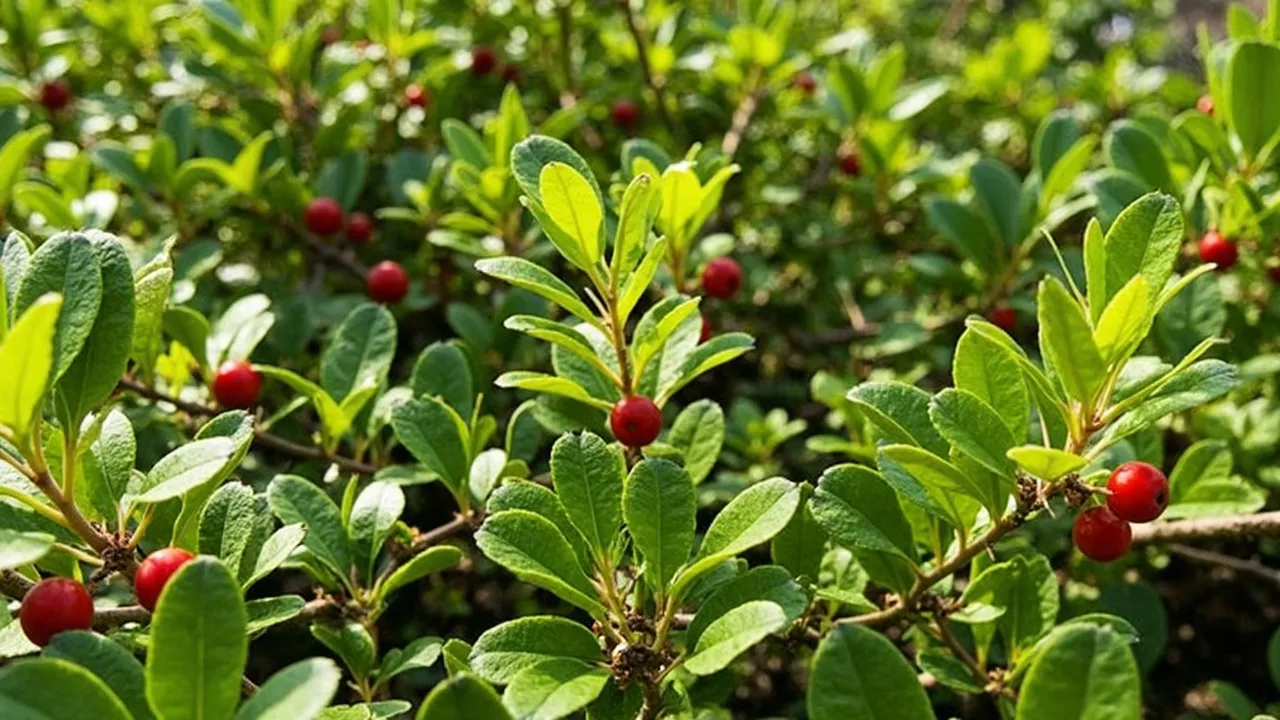
Bearberry forms a low, creeping mat of woody stems that root where they touch the soil. In time, a single plant can cover a square metre or more, though the canopy rarely rises more than a hand's breadth above the ground.
The leaves are the most distinctive feature. They are leathery, paddle-shaped (technically obovate), and 2–4 cm long, with a glossy deep-green upper surface and a slightly paler underside. In mild winters they stay green; in colder weather, or on poor exposed sites, the foliage takes on attractive reddish-bronze and purple tones that persist until spring.
Flowers appear from April to June in small, nodding clusters at the shoot tips. Each flower is a tiny urn- or bell-shaped bloom, white to pale pink with a deeper pink rim, about 5 mm long. They are borne in such profusion on a well-grown plant that the whole mat looks freckled with pink for several weeks.
The fruit that follows is a bright scarlet, smooth, rounded drupe, 7–10 mm across, with a mealy flesh and a small stone. It ripens in late summer and clings to the plant well into winter, providing one of the most reliable flashes of red in the dormant garden. The berries are eaten readily by birds, especially grouse, thrushes and blackbirds, but are unpalatable and mildly toxic to humans in any quantity, owing to their high tannin content.
Growing Conditions
Bearberry's natural range gives strong clues to its preferences in cultivation. It thrives in conditions that mimic upland heath and dune systems: acid, humus-rich but sharply drained soil, plenty of light, and a climate that does not bake hot in summer.
Soil pH is the single most important factor. The plant needs a pH in the region of 4.5–6.0. On chalk or limestone the leaves develop interveinal chlorosis, the plant becomes stunted, and it usually dies within a few seasons. If your garden soil is neutral or alkaline, grow bearberry in a raised bed of ericaceous compost, in a container, or alongside other acid-lovers such as rhododendrons, camellias and heathers in a dedicated peat bed.
Texture matters as much as pH. Sandy, gritty, humus-poor soils are ideal; heavy clay is not, because waterlogging around the roots quickly leads to Phytophthora root rot. Incorporating sharp sand, grit and well-rotted leaf mould at planting time gives a plant the loose, aerated root run it needs.
Light should be full sun for the best flowering and berry set. Light dappled shade is tolerated, but in deeper shade the plant becomes leggy and flowers sparsely. Aspect is otherwise flexible — north-facing slopes, exposed hill sites and seaside gardens all suit it.
In UK gardens bearberry is reliably hardy everywhere, from the Highlands to the south coast. It tolerates exposure, salt-laden coastal winds, and winter temperatures well below -20 °C. The one condition it dislikes is summer drought combined with alkaline soil, which is a combination that simply should not occur if the plant is sited correctly.
Planting and Care
Plant container-grown bearberry at any time of year when the ground is workable, although autumn and early spring are ideal because soil moisture is plentiful and the plant can establish before summer stress. Space plants 30–45 cm apart if the aim is to knit a continuous groundcover; they will fill the gaps within two to three growing seasons.
Prepare the planting area thoroughly. On any soil that is not already acid and gritty, dig in ericaceous compost, pine bark or well-rotted conifer leaf mould, and add generous sharp sand or horticultural grit on heavier ground. After planting, mulch with 5–8 cm of pine bark, bracken or similar acidic organic matter. This both suppresses weeds and slowly acidifies the surface layer.
Water regularly through the first full growing season, particularly during dry spells in May, June and July. Once the plant is established — usually by the second summer — supplementary watering is rarely needed except in containers.
Feeding is generally unnecessary. If the leaves begin to yellow on an acid soil (a sign of iron or manganese lock-out), apply a dose of sequestered iron and top up the acidic mulch. Avoid lime, bonemeal or general-purpose fertilisers, all of which push the pH upwards.
Pruning is minimal. The plant naturally forms a dense, tidy mat. If growth becomes open or leggy after many years, trim lightly with shears, or set a mower to a high setting and run it over the patch in early spring. Avoid cutting into old wood, which may not reshoot.
Propagation is straightforward. Bearberry layers itself naturally where stems touch the soil; these rooted pieces can be detached and replanted in autumn or spring. Semi-ripe cuttings taken in July or August root readily in a 50:50 mix of peat-free ericaceous compost and perlite, given bottom heat of about 18–21 °C. Mature clumps can also be divided in autumn.
Seasonal care is light. In March or April, top up the acidic mulch and remove any weeds that have colonised the mat. In late summer, watch for chlorosis on sites close to neutral — a yellowing of the youngest leaves is the earliest warning sign that the soil pH is creeping up.
Common Problems
Bearberry is largely trouble-free when its basic needs are met, but a handful of issues recur on unsuitable sites.
Chlorosis is the most common problem. Yellow leaves with green veins indicate that the plant cannot access iron or manganese because the soil is too alkaline. The cure is to mulch with acidic organic matter, water with sequestered iron, and on bad sites to lift the plant and replant into fresh ericaceous compost.
Phytophthora root rot appears in heavy or waterlogged soils. Plants suddenly wilt, the foliage turns dull grey-green, and the roots are blackened and soft. There is no chemical cure; the affected plants should be removed and the site improved with grit and organic matter, or bearberry replaced with a more tolerant species.
Fungal leaf spot, caused by Exobasidium species and related fungi, may produce pale pink or whitish raised spots on the leaves in damp seasons. It is largely cosmetic and rarely serious; improving air movement by light trimming usually keeps it in check.
Aphids occasionally colonise the soft shoot tips and flower buds in late spring. A sharp spray of water, encouragement of natural predators, or — if numbers are high — a single application of insecticidal soap is sufficient.
The single most common failure mode is poor establishment on limy soil. Bearberry planted in unprepared alkaline ground will struggle for a year or two and then collapse. The remedy is prevention: acidify the soil before planting, or grow it in containers of ericaceous compost where the surrounding soil is unsuitable.
Popular Varieties
Arctostaphylos uva-ursi is a species in which named cultivars are scarce, and many plants sold simply as the species are perfectly satisfactory. Where cultivars do exist, selection has mainly been for compact habit, good berry display or attractive winter foliage.
'Vancouver Jade' (sometimes sold as 'Vancouver') is a low, very dense form with glossy dark-green leaves and abundant red berries; it is widely available in the UK and is perhaps the most reliable garden selection.
'Massachusetts' is a particularly hardy, vigorous clone with neat mat-forming habit and heavy berry crops, often recommended for groundcover on a larger scale.
'Point Reyes' is a Californian selection that forms a dense, fast-spreading mat with smaller, finer leaves; it does well in milder UK gardens and is popular in coastal plantings.
'Wood's Red' is grown for its particularly vivid berry colour and slightly more upright habit, making it a good choice where winter display is the priority.
'Radiant' has somewhat larger leaves than the type and a slightly more open habit, with bright scarlet fruit in autumn.
Beyond these, most specialist nurseries offer the species raised from wild-collected or horticultural seed. These are variable but generally robust, and seed-raised plants are often the best choice for naturalising on a large rock garden or heath border. Buyers should be wary of cultivar names not listed in the RHS Plant Finder or a reputable ericaceous-plant nursery, as the range is small and mislabelling is common.
---
Pests and Diseases
| Problem | Symptoms | Management |
|---|---|---|
| Leaf spot | Small, dark or brown spots appear on the evergreen leaves, potentially causing them to yellow or drop. | Improve air circulation and remove affected foliage; avoid wetting leaves when watering. |
| Vine weevil | Notched edges on leaves above ground and root damage below, leading to wilting or plant collapse. | Check pots for grubs before planting and apply biological nematodes or systemic insecticides if infested. |
| Slugs and snails | Irregular holes chewed in leaves and silvery slime trails on foliage and surrounding soil. | Use physical barriers like copper tape, hand-pick at night, or apply iron phosphate pellets. |
| Root rot | Plant wilts despite moist soil, leaves turn yellow or brown, and stems may become soft. | Ensure well-drained, lime-free soil and avoid overwatering to prevent waterlogging. |
| Lime-induced chlorosis | Yellowing of leaf tissue between green veins due to iron deficiency in alkaline soils. | Plant only in acid to neutral soil and avoid using lime or hard water for irrigation. |
Quick Care Summary
| Sunlight | Full sun, Partial shade |
|---|---|
| Soil | Moist but well-drained, moderately fertile, lime-free, acidic to neutral |
| Hardiness | H7 (-20.0 °C) |
| Sow | September–November |
| Plant | — |
| Prune | March–May |
As an Amazon Associate, GardenWizz earns from qualifying purchases made through the links above. This does not affect the price you pay. See our disclaimer for details.