
St John's Wort
Hypericum perforatum
The Gardening Year
Best months in UK gardens · full planting calendar →
At a Glance
| Botanical name | Hypericum perforatum |
|---|---|
| Common name(s) | St John's Wort |
| Family | Hypericaceae |
| Plant type | perennial |
| Height × Spread | 30–100 cm × — |
| Position | Full sun, Partial shade |
| Soil | moist but well-drained |
| Flowering | — |
| Toxicity | toxic |
| Native range | Europe, West and Central Asia, parts of Africa and China |
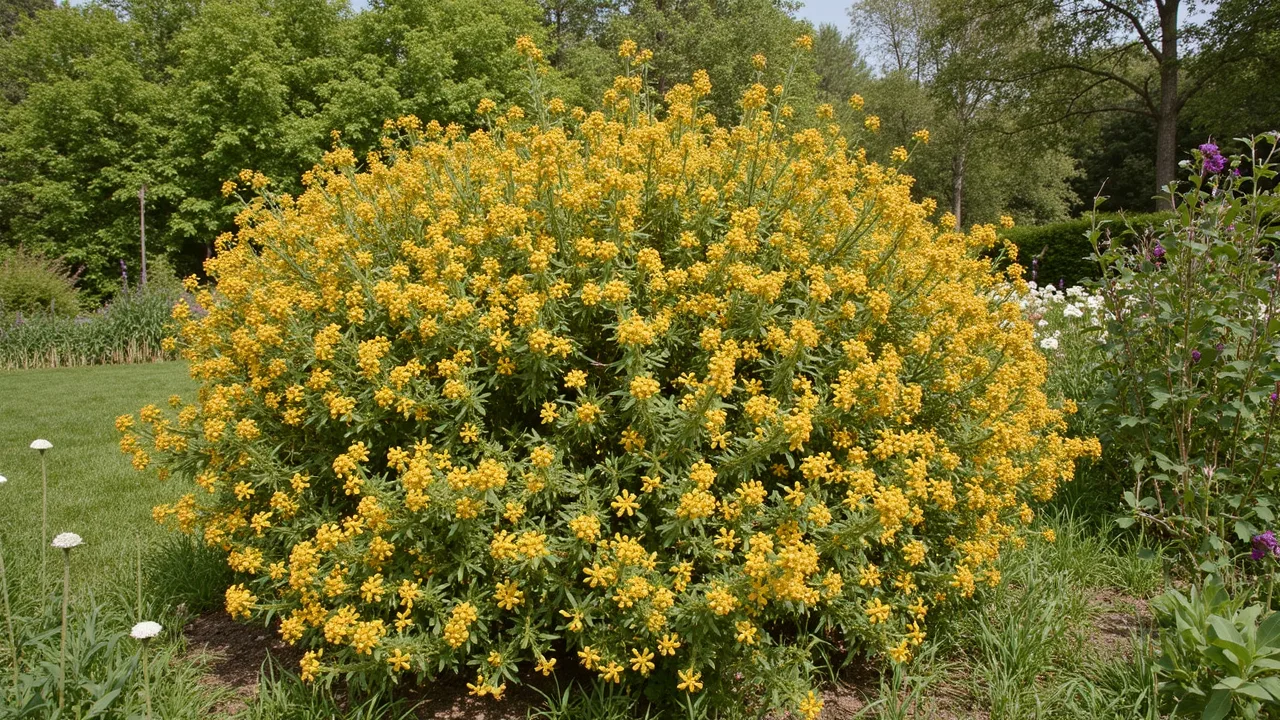
St John's Wort is a vigorous herbaceous perennial native to Europe, western Asia and North Africa, widely naturalised across the UK and valued both as a hardy garden plant and a long-standing herbal remedy. Its bright yellow, star-shaped flowers appear in profusion from midsummer, lighting up informal borders, wildlife plantings and rough meadow turf at a time when many border plants are past their first flush. Few perennials ask so little of the gardener while giving back so much in colour, pollinator value and historical resonance.
Overview
Hypericum perforatum belongs to the family Hypericaceae and is the best-known member of a genus that contains several hundred species of shrubs, perennials and annuals distributed across temperate regions worldwide. In the British Isles it grows wild in grasslands, hedge banks, woodland edges, scrub and waste ground, and has been recorded as a native species for centuries. Its common name derives from the traditional harvest date of 24 June, St John's Day, when the plant comes into flower and the conspicuous stamens release a blood-red sap when crushed, a feature once associated in Christian folklore with the martyrdom of St John the Baptist.
Beyond its folkloric associations, St John's Wort carries real garden value. It tolerates thin, stony soils that defeat fussier perennials, draws bees and hoverflies in significant numbers, and seeds itself modestly without becoming a nuisance in most cultivated settings. In a wildlife or naturalistic planting it is almost indispensable: it covers ground quickly, flowers reliably in dry summers, and supports pollinators at a time when later-summer forage can be scarce.
Caution is warranted in two respects. The plant contains the naphthodianthrone hypericin and the phloroglucinol derivative hyperforin, which can cause photosensitivity in grazing livestock and have well-documented interactions with prescribed medicines in humans. Gardeners should treat it as an ornamental and ecological plant rather than a self-administered remedy, and should site it away from paddocks and livestock enclosures.
Appearance
St John's Wort forms an upright clump from a creeping, rhizomatous rootstock, typically reaching 30–90 cm in height in a single growing season. The stems are woody at the base, wiry above, and distinctly branched in their upper portion. A close inspection of any stem reveals two fine, raised lines running lengthwise along its surface, a useful identification feature separating H. perforatum from related Hypericum species.
Leaves are arranged in opposite pairs along the stem, each pair set at right angles to the pair above and below. They are sessile (stalkless), ovate to narrowly lanceolate, and between 1 and 3 cm long. Held up to the light, the leaf blade is scattered with translucent oil glands that give the foliage its characteristic perforated look and earn the plant its specific epithet, perforatum, meaning pierced. The same glands are present in the petals and produce the red pigment that stains fingers when a flower is crushed.
The flowers are the chief ornamental feature. Each bloom is bright buttercup yellow, 1.5–3 cm across, with five broad petals and a prominent, dome-shaped boss of long stamens that gives the flower its starry, almost daisy-like quality. They are carried in loose, branched clusters (cymes) at the stem tips from June through September. Following pollination, the flowers develop into small, dry, three-valved seed capsules that split to release numerous tiny, dark brown seeds.
Growing Conditions
St John's Wort is exceptionally unfussy about soil and aspect, which accounts for much of its appeal. It thrives in well-drained, neutral to alkaline ground and tolerates thin, chalky, sandy or stony substrates with ease. Heavier clay soils are workable provided they do not sit waterlogged in winter; the plant's main intolerance is of sustained saturation around the root crown. A position in full sun produces the strongest, most floriferous growth, but the plant also tolerates light or partial shade, where flowering is slightly reduced but the foliage remains healthy.
In UK conditions the species is fully hardy. The Royal Horticultural Society classifies it within hardiness rating H7, the most hardy category, meaning it tolerates temperatures below −20 °C without damage. This hardiness, combined with the plant's tolerance of drought once established, makes it a reliable choice for exposed, dry or free-draining sites where less robust perennials would struggle.
The natural tendency to spread by underground runners is worth considering when choosing a site. In a contained border the plant behaves itself and forms discrete clumps; in light, unimproved grassland it can become invasive, and its allelopathic root exudates can suppress the germination and growth of neighbouring plants. Within a typical cultivated garden this is rarely a problem, but in meadow plantings or wild corners some control may be needed.
Planting and Care
Plant container-grown stock in autumn or early spring, setting the crown at the same depth it occupied in the pot and spacing plants 30–45 cm apart for a dense ground-cover effect, or 60 cm apart where each clump is to develop fully. Water in well after planting and during the first growing season; thereafter supplementary watering is rarely needed except during prolonged drought.
Propagation is straightforward. Established clumps lift and divide readily in spring or autumn, with the outer, vigorous portions replanted and the woody centres discarded. Seed propagation also works well: sow in autumn or spring in trays of gritty seed compost, lightly cover the seed, and overwinter outdoors or in a cold frame. Germination typically occurs within two to four weeks once temperatures rise.
Routine care is minimal. In late winter or early spring, cut the previous year's dead growth down to ground level using shears or secateurs; fresh shoots will emerge from the base as the soil warms. In informal settings the dead stems can be left through winter for their structural interest and seed value to birds, then cleared in early March. Top-dress container-grown specimens annually with fresh gritty compost and divide every two to three years to keep them vigorous.
Feeding is unnecessary in open ground. Container-grown plants benefit from a dilute balanced liquid feed once or twice during the growing season. St John's Wort has no serious pruning requirements beyond the annual cut-back, and deadheading the earliest flowers can prolong the display into early autumn, though it is not essential.
Common Problems
St John's Wort is notably free of significant pest and disease pressure in UK gardens. The most frequently reported ailment is rust, caused by the fungus Puccinia punctata, which appears as small orange-brown pustules on the undersides of leaves and along the stems during warm, humid summers. Infected material should be cut out and disposed of (not composted) at the first sign, and overcrowded plantings should be thinned to improve air movement around the foliage.
Aphids occasionally colonise the soft shoot tips in late spring, but populations are usually kept in check by natural predators and rarely warrant intervention. Slugs and snails generally ignore the plant, as do rabbits and deer, an unusual bonus in rural gardens.
The plant's main "problem" is behavioural rather than pathological. Its creeping rootstock can colonise adjacent ground more quickly than gardeners expect, particularly in light, sandy soils. Where containment is important, site it within a border edged by paving or a root barrier, or lift and divide the clump every two to three years. In paddocks, allotments grazed by livestock, or gardens adjacent to horse pasture, St John's Wort should be avoided or sited where animals cannot reach it, as ingestion of significant quantities causes photosensitisation in cattle, sheep, goats and horses.
Popular Varieties
The straight species H. perforatum is most commonly grown, both as an ornamental and in wildflower seed mixes, but a small number of improved forms are available to UK gardeners. Note that RHS hardiness ratings for individual cultivars are limited, and the ratings given below reflect general performance in UK conditions rather than formal awards.
- Hypericum perforatum 'Buttercup' – a particularly vigorous seed strain selected for larger, deeper yellow flowers and a longer flowering period from June into September; reaches 60–80 cm and spreads steadily, making it a strong choice for naturalistic plantings.
- Hypericum perforatum 'Topaz' – a compact form growing to around 40–50 cm, with the same characteristic perforated foliage but a tidier, more clump-forming habit suited to smaller borders and containers.
- Hypericum perforatum 'Elixir' – a form occasionally offered by specialist medicinal-herb nurseries and grown primarily for its higher reported hypericin content; valued in herb gardens rather than for any distinct ornamental trait.
- Hypericum perforatum 'Yellow Beacon' – a recently introduced cultivar noted for particularly luminous, well-held flower clusters and improved resistance to rust in humid summers; widely available from wildflower plant specialists.
For gardeners wanting a shrubby Hypericum for a more formal setting, the hybrid shrub St John's Wort, Hypericum × hidcoteense 'Hidcote', is an excellent alternative, but it is a different plant entirely from the herbaceous H. perforatum and should not be confused with it for medicinal, wildlife or ecological purposes.
Pests and Diseases
| Problem | Symptoms | Management |
|---|---|---|
| Root rot | Foliage turns yellow and wilts despite moist soil, often accompanied by a general decline in plant vigour. | Ensure the soil is well-drained and avoid waterlogging to prevent root suffocation and decay. |
| Honey fungus | Rapid wilting and dieback of branches, sometimes with white fungal growth at the base. | Improve soil drainage and remove infected plant material; infection is rare but serious if it occurs. |
| Leggy growth | Stems become elongated, weak, and sparse with reduced flowering due to insufficient light. | Plant in full sun or partial shade and prune back hard in spring to maintain a compact shape. |
| Slugs and snails | Irregular holes chewed into young leaves and seedlings, often with slimy trails visible. | Use physical barriers like copper tape or organic slug pellets to protect young plants. |
| Vine weevil | Notched edges on leaves during the day and root damage causing wilting in potted specimens. | Apply systemic insecticide drenches or biological controls like nematodes to soil in pots. |