
White Clover
Trifolium repens
The Gardening Year
Best months in UK gardens · full planting calendar →
At a Glance
| Botanical name | Trifolium repens |
|---|---|
| Common name(s) | White Clover |
| Family | Fabaceae |
| Plant type | perennial |
| Height × Spread | — × 18 cm |
| Position | Full sun |
| Soil | Well-drained; succeeds on poor soil; wide range of soils from damp to dry, but not waterlogged or very acidic |
| Flowering | June–August |
| Toxicity | — |
| Native range | Eurasia; Europe and Central Asia |
Overview
White Clover (Trifolium repens) is a creeping perennial legume native to Europe, including the whole of the British Isles, and naturalised across temperate regions worldwide. Often dismissed as a lawn weed, it is in fact one of the most useful plants for low-input British gardens: it fixes atmospheric nitrogen, feeds pollinators through a long flowering season, and forms a durable, soft sward underfoot. Once a standard component of traditional lawn seed mixtures, it has returned to favour with gardeners seeking rewilded, low-mow, wildlife-friendly turf.
A member of the Leguminosae (also called Fabaceae), White Clover forms dense mats of stolons that root at the nodes and spread steadily across bare soil. It is fully hardy throughout the UK, tolerates a wide range of soils, and asks for almost nothing in return once established. Its globular white flower heads are magnets for bumblebees, honeybees and hoverflies from late spring until the first hard frost.
Appearance
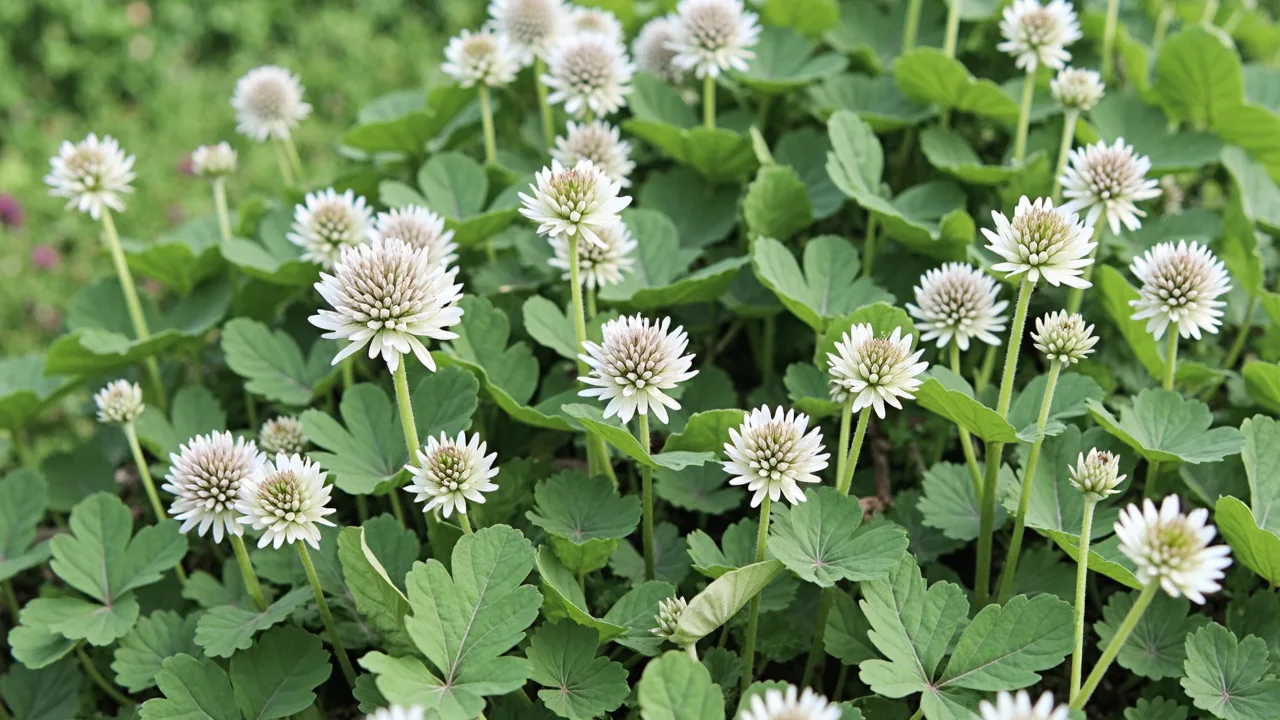
White Clover is a low-growing, mat-forming perennial that typically reaches 10–20 cm in height. Its leaves are the classic clover shape — three rounded, finely toothed leaflets borne on long, slender stalks arising from the creeping stems. Each leaflet is broadly oval, 1–2 cm across, and is usually marked with a pale, V-shaped chevron, sometimes described as a watermark. The leaves are a fresh mid-green and often held slightly above the soil on upright petioles.
The plant spreads by slender, leafless runners called stolons. As these creep across the soil surface they root at the nodes, throwing down tufts of fibrous roots and producing new leaves and flower stalks at each joint. This stoloniferous habit is what allows White Clover to colonise bare patches in lawns so effectively, and what makes it such a useful ground cover on slopes and path edges.
From late May through to October the plant produces its characteristic globular flower heads, 1.5–2 cm in diameter and held on long, upright stalks well above the foliage. Each head is composed of 40 to 80 individual pea-like florets, white at first and ageing to a soft pinkish-buff as they are pollinated. Beneath each head sits a pair of small green bracts. The flowers are rich in nectar and are visited constantly by bumblebees, honeybees, solitary bees and hoverflies.
Below ground, White Clover develops a branched taproot and an extensive network of fibrous roots. Crucially, its roots form nodules that host Rhizobium leguminosarum bacteria, which convert atmospheric nitrogen into a form the plant can use. This is the source of clover's reputation as a soil-improving plant.
Growing Conditions
White Clover is undemanding and adapts to almost any situation a British garden can offer, provided two basic needs are met: reasonable drainage and at least a few hours of direct sun. It performs best in well-drained, moderately fertile loam with a pH between 6.0 and 7.0, but it will grow happily in sandy soils, clay loams, and even the compacted ground beside paths and driveways. It is one of the few plants that thrives in the poor, dry conditions under garden trees and along lawn edges where grass struggles.
For flowering and dense, vigorous growth it needs four to six hours of direct sun a day. In deeper shade it survives but produces fewer flowers and looser mats. White Clover is fully hardy across the UK — it is rated RHS H7, the highest hardiness rating, equivalent to tolerating winter lows below −20 °C — and it grows vigorously in cool, moist conditions. Once established it copes well with summer drought, going slightly paler in colour but bouncing back with the autumn rains.
Its tolerance of being walked on and mown is excellent, which is why it has been a component of British lawn seed mixes since the Victorian era. The stolons knit together to form a springy, self-repairing surface that recovers well from the wear of family lawns.
Planting and Care
White Clover is grown either as a component of lawn mixes, as a living mulch or green manure in vegetable beds, or as a flowering ground cover in its own right. In all three cases the technique is similar: scratch up a fine, firm tilth in spring or early autumn, broadcast the seed at the recommended rate, rake lightly to bury it, and water until germination.
Sowing. Sow in spring (March to May) or early autumn (August to early September), when the soil is warm and moist. For a pure clover sward, broadcast at 5–10 g per square metre; for mixing with grass seed, use 1–2 g per square metre alongside a traditional lawn mixture. Germination takes 7–14 days. On ground where clover has not grown before, an inoculant of Rhizobium bacteria can be dusted onto the seed before sowing to speed up nodulation, though established British soils usually contain the bacteria already.
Watering. Keep the seedbed moist during germination and the first six weeks. Once plants have rooted down they are remarkably drought-tolerant and only need watering during prolonged dry spells.
Mowing. White Clover tolerates regular mowing down to 4–5 cm. Mowing every 7–10 days during the growing season keeps the sward tight and encourages dense, low growth. To enjoy the flowers for pollinators, leave a patch uncut, or raise the mower blades to 7–8 cm and accept the seeding that follows.
Feeding. As a nitrogen-fixing legume, White Clover rarely needs fertiliser. Indeed, applying nitrogen-rich feeds simply encourages the grass around it to outcompete the clover. A light dressing of phosphate and potash in early spring is enough on very poor soils.
Propagation. The simplest method is to lift and divide established clumps in spring or autumn, teasing the stolons apart and replanting them at 20 cm spacings. For larger areas, seed is cheap and reliable.
Seasonal care. Cut or strim the sward down at the end of the season to remove old flower heads and tidy the mat. In early spring, rake out any thatch and, if desired, oversow thin patches with fresh seed.
Common Problems
White Clover is generally a trouble-free plant. Most issues arise either from cultural conditions going wrong, or from a small set of fungal and invertebrate pests that are usually cosmetic rather than devastating.
Powdery mildew (Erysiphe polygoni) can coat the leaves with a white, dusty fungal growth during warm, humid spells in late summer. It is rarely serious in a mixed lawn and can be tolerated. Improving air circulation by removing overhanging vegetation and avoiding drought stress reduces its incidence.
Rust (Uromyces trifolii) produces small orange-brown pustules on the undersides of leaves, again usually in late summer. Rake up and dispose of affected clippings rather than composting them.
Slugs and snails may graze young seedlings and tender new growth in damp conditions, particularly in shaded beds. Encouraging natural predators (hedgehogs, ground beetles, thrushes) and using beer traps or ferrous-phosphate pellets is usually enough.
Clover weevil (Sitona lineatus) is a small grey-brown beetle whose adults nibble crescent-shaped notches in the leaf margins. Damage is rarely significant in a garden setting and the plant recovers quickly.
Vigour in lawns. The most common "problem" with White Clover in a traditional lawn is that it grows too well. Where a tidy, uniform turf is the goal, the answer is to improve the underlying lawn health — overseed bare patches with grass, mow at the right height, and avoid drought stress — rather than reaching for a weedkiller.
Popular Varieties
Several improved cultivars of White Clover have been bred for particular uses, from large-leaved forage types to small, neat lawn forms. The following are all well-established, commercially available cultivars with documented characteristics.
'Haifa' is a large-leaved Ladino-type cultivar bred for high forage yield and good drought tolerance. It is widely used in UK agriculture as a companion to ryegrass in silage leys.
'Alice' (also sold as 'Alice White Clover') is a medium-leaved cultivar bred for persistence under grazing, with good winter hardiness and reliable spring growth. It is commonly included in UK pasture mixes.
'AberLasting' is a small-to-medium-leaved variety from the IBERS Aberystwyth breeding programme, selected for persistency under continuous sheep grazing and for high sugar content in the leaves. It has performed well in UK trials.
'Barblanca' is a medium-leaved Dutch-bred cultivar widely sold for use in amenity lawn mixtures and wildflower turf, with good ground cover and uniform flowering.
'Sonja' is a Swedish-bred, very small-leaved cultivar that flowers less freely than larger types, making it a popular choice for low-input lawn mixes where a tidier appearance is wanted without sacrificing the nitrogen-fixing benefits.
'Rivendel' is a compact, small-leaved variety developed in Scandinavia for short, dense swards. It tolerates close mowing and is often blended with fine fescues for an ornamental lawn.
When buying seed, look for named cultivars from reputable UK or European seed houses rather than generic "white clover" packets, as cultivar choice makes a real difference to vigour, leaf size and flowering.
Pests and Diseases
| Problem | Symptoms | Management |
|---|---|---|
| Slugs and snails | Irregular holes chewed in leaves and seedlings damaged or eaten entirely. | Use beer traps, copper tape barriers, or hand-pick at night to reduce populations. |
| Powdery mildew | White, dusty fungal growth appears on leaves and stems, often in humid conditions. | Improve air circulation and avoid overhead watering; remove severely affected foliage. |
| Root rot | Plants wilt and yellow despite adequate moisture, with roots appearing soft and brown. | Ensure well-drained soil and avoid waterlogging to prevent fungal infection. |
| Clover root aphid | Stunted growth and yellowing leaves caused by sap-sucking insects on roots. | Encourage natural predators like ladybirds; severe cases may require systemic insecticides. |
| Anthracnose | Dark, sunken lesions on stems and leaves leading to wilting and plant decline. | Remove infected plant parts and improve drainage to reduce humidity around the base. |
As an Amazon Associate, GardenWizz earns from qualifying purchases made through the links above. This does not affect the price you pay. See our disclaimer for details.