
Rhododendron ponticum
Rhododendron ponticum
The Gardening Year
Best months in UK gardens · full planting calendar →
At a Glance
| Botanical name | Rhododendron ponticum |
|---|---|
| Common name(s) | Rhododendron ponticum |
| Family | Ericaceae |
| Plant type | shrub |
| Height × Spread | 5–8 m × — |
| Position | Full shade |
| Soil | acidic soils |
| Flowering | March–May |
| Toxicity | Toxic; contains grayanotoxins. Honey produced from its pollen can be poisonous to humans (causing hypotension and bradycardia) and toxic to some bees. |
| Native range | Iberian Peninsula in southwest Europe and the Caucasus region in northern West Asia |
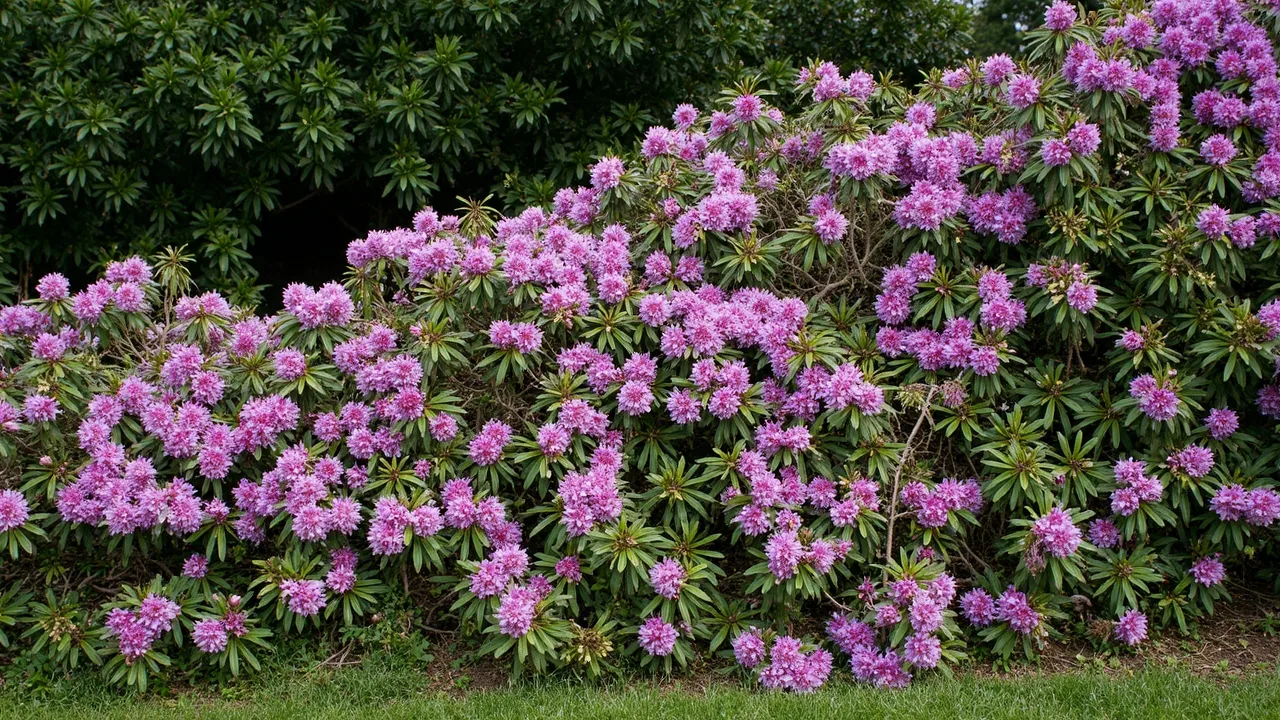
Rhododendron ponticum is a large, evergreen flowering shrub native to the Caucasus, Anatolia, parts of the Balkans and southern Spain. Introduced to British gardens in the late eighteenth century, it became a staple of woodland and estate planting thanks to its bold, late-spring flower display and tolerance of damp, acid conditions. Its dense, glossy foliage and showy trusses of funnel-shaped blooms make it one of the most recognisable flowering shrubs in UK horticulture, although the species itself is now regarded as a serious invasive weed in many parts of Britain and Ireland, and most modern garden rhododendrons are complex hybrids bred from it and related species.
Overview
The species belongs to the family Ericaceae and the large genus Rhododendron. In its native range it typically forms a dense, sprawling shrub 3–5 m tall, although mature specimens in sheltered British woodland can exceed this. It was widely planted from the nineteenth century onwards as cover for game and as ornamental shrubbery on acid soils. Its capacity to set abundant seed and to sucker freely, combined with a light, wind-borne seed, has allowed it to colonise acidic woodland and heathland in the west of Britain, Scotland, Wales and parts of Ireland, where it is now the target of long-running control programmes coordinated by the Non-Native Species Secretariat and local Wildlife Trusts.
Horticulturally, true R. ponticum is now rarely sold for garden planting in the UK; instead, modern garden cultivars are complex hybrids descended in part from this species along with R. catawbiense, R. fortunei, R. arboreum and others. These hybrids are typically selected to be seed-sterile or near-sterile, considerably more compact, and available in a wider colour range. Gardeners seeking the ponticum effect today almost always choose one of these improved hybrids rather than the species itself.
Appearance
R. ponticum is a vigorous evergreen shrub with a dense, rounded or broadly spreading habit. The leathery, oblong to elliptical leaves are typically 8–15 cm long and 3–5 cm wide, dark glossy green above and paler, often slightly glaucous beneath. New growth emerges in late spring as the flowers are finishing, and unfurls with a bronze or reddish tint before hardening to deep green.
The flowers are borne in rounded terminal trusses, usually of 8–15 individual blooms, opening in May and June and often extending into July in cooler, more northerly gardens. Each individual flower is broadly funnel-shaped, around 4–6 cm across, with five lobes and a long, prominent style. In the wild species the colour is typically a strong purplish-pink to lilac, often with a paler throat and faint spotting on the upper lobe. Hybrids derived in part from R. ponticum extend this range considerably, from pure white through pink, rose, lilac, mauve and deep violet, and there are selected forms with picotee edges, contrasting throats, and double or hose-in-hose flowers.
The fruit is a small, dry, five-valved woody capsule, roughly 1.5–2.5 cm long, packed with fine, light seed. In the species these capsules are produced freely and shed seed from late summer onwards. In many modern hybrids the capsules are poorly developed or absent, which is one of the reasons these plants are considered lower-risk choices for British gardens than the species itself.
Growing Conditions
Soil is the single most important factor. Rhododendron ponticum and its hybrids are calcifuges — they demand acidic soil in the pH range 4.5–6.0, with abundant organic matter and reliable moisture through the growing season. On chalky, limestone or otherwise alkaline ground the plants will develop interveinal chlorosis, the leaf edges scorch, and growth will progressively weaken until the plant dies. In such conditions it is feasible to grow rhododendrons in large raised beds or containers filled with ericaceous compost, but in-ground success in alkaline soil is not realistic without sustained soil amendment.
Light should be dappled or filtered. Deep shade reduces flowering and encourages sparse, leggy growth; harsh, exposed afternoon sun bleaches foliage and stresses the roots. The classic British setting — light woodland, the edge of a shrub border backed by taller trees, or a north- or east-facing slope — suits them well.
Climate is on their side across most of the UK. They thrive in the mild, damp maritime conditions of the west and north and perform particularly well in Scotland, Wales, Cornwall, Cumbria and the wetter parts of Northern Ireland. They are hardy to roughly −15 °C once established, though soft new growth and opening buds are vulnerable to late spring frosts, which can scorch the flowers in cold inland gardens. They dislike hot, dry summers; a mulch and a steady supply of rainwater are far more useful than additional feeding.
Companion planting is straightforward: any ericaceous shrub associates well, including Camellia, Pieris, Kalmia, heathers and Vaccinium. Under-planting with spring bulbs such as Galanthus, Narcissus and bluebells is traditional and works because the rhododendron canopy is shallow enough to admit light before it leafs out fully.
Planting and Care
Plant from October through March, whenever the soil is workable and not waterlogged or frozen. Container-grown plants from garden centres can go in at any time of year provided they are kept well watered through the first summer. Dig a hole two to three times the width of the rootball but no deeper, and incorporate generous quantities of leaf mould, well-rotted bark, or proprietary ericaceous compost into the backfill. Plant with the rootball just at the soil surface — rhododendrons are surface-rooted and bury poorly.
Water thoroughly at planting and through the first two growing seasons whenever the top few centimetres of soil dry out. Once established they are surprisingly drought-tolerant in cool British summers, but they suffer badly in prolonged dry spells, when leaf edges scorch and bud set for the following year is reduced. Use rainwater wherever possible, particularly in hard-water areas, because mains water in much of the UK is sufficiently alkaline to gradually raise soil pH.
Mulch annually in spring with acidic organic matter — pine bark, conifer needles, or leaf mould — to a depth of 5–8 cm, keeping it clear of the immediate trunk. Feed only if growth is weak or leaves are pale: a slow-release ericaceous fertiliser, or a top-dressing of sulphur chips in late winter, is sufficient. Over-feeding produces soft growth that flowers poorly and is vulnerable to frost.
Pruning is minimal. Remove dead, damaged or crossing wood after flowering has finished, typically in late June. Spent flower trusses can be deadheaded carefully by snapping them off just above the new growth buds; this improves appearance and, in the species, reduces seed set. Hard pruning into old wood is not recommended — rhododendrons do not regenerate readily from bare stems — but if a plant has outgrown its space, it can be reduced by a third over two or three years after flowering.
Propagation of cultivars is by semi-ripe cuttings taken in late summer and rooted under mist with bottom heat, or by layering in spring. The species itself can be grown from seed, but hybrid cultivars will not come true and must be propagated vegetatively.
Common Problems
Powdery mildew appears as a pale, dusty coating on the leaf surface in dry summers. It is rarely fatal but disfigures foliage; improve airflow around the plant and water in dry spells to reduce stress. Bud blast, caused by the fungus Pycnostysanus azaleae and spread by the rhododendron leafhopper, turns buds brown and prevents them opening. The main practical control is to manage the leafhopper population. Chlorosis — yellowing between the veins — is almost always a soil-pH problem rather than a disease, and is corrected only by acidifying the soil or relocating the plant.
Of the insect pests, the rhododendron leafhopper (Graphocephala fennahi) is conspicuous in late summer as a pale, crimson-striped insect that hops from the foliage when disturbed. Its feeding is largely cosmetic, but it is significant as the vector of bud blast. The adult vine weevil (Otiorhynchus species) notches the leaf margins in summer, while its soil-dwelling larvae chew roots and can kill small or container-grown plants; biological control with parasitic nematodes is effective in pots. Rhododendron lace bug (Stephanitis rhododendri) causes a characteristic bronze, stippled mottling on the upper leaf surface and is most troublesome in dry, sunny sites.
The most significant "problem" in a British context is, however, ecological. R. ponticum is invasive in many regions, and gardeners outside its native range should seek advice from the Non-Native Species Secretariat or their local Wildlife Trust before planting it. Modern hybrid cultivars bred to be seed-sterile are the appropriate choice for ornamental planting in most British gardens.
Popular Varieties
Because the species itself is rarely recommended for planting, most gardeners choose improved hybrids. The following are widely available in UK nurseries and have a long record of reliable performance.
- 'English Roseum' — a vigorous, hardy hybrid of R. catawbiense parentage that tolerates heavier and slightly less acid soils than many rhododendrons. Bears dense trusses of clear rose-pink flowers in late May and reaches roughly 2.5–3 m.
- 'Album' — a classic white-flowered hybrid, low and broad-growing to about 2 m, with pale green buds opening to pure white trusses in May. Tolerates cooler, more northerly conditions well.
- 'Cunningham's Blush' — a compact, rounded shrub to about 1.5–2 m with pale pink buds opening to blush-white flowers, often with a faint green throat marking. Late-flowering and reliable.
- 'Catawbiense Grandiflorum' — a long-established, vigorous lilac-purple hybrid, one of the toughest for cold inland gardens, reaching 2.5–3 m and flowering reliably even after hard winters.
Several dwarf hybrids such as those in the yakushimanum group are also worth considering for smaller gardens, generally reaching under 1.5 m with neat, indumented foliage and full-sized flower trusses.
Pests and Diseases
| Problem | Symptoms | Management |
|---|---|---|
| Bud blight (Pestalotiopsis) | Blackened, shrivelled flower buds and young shoots that fail to open or die back. | Prune out affected growth in dry weather and avoid overhead watering to reduce humidity. |
| Powdery mildew | White, dusty fungal growth on leaves and stems, often causing distortion of new growth. | Improve air circulation by thinning dense thickets and apply a suitable fungicide if severe. |
| Root rot (Phytophthora) | General decline, yellowing leaves, and wilting despite adequate soil moisture. | Ensure well-drained soil conditions and avoid waterlogging; remove severely infected plants. |
| Slugs and snails | Irregular holes chewed in young leaves and seedlings, often with slime trails visible. | Use physical barriers like copper tape or apply iron phosphate-based slug pellets. |
| Budworm (Coleophora rhododendrella) | Small caterpillars feeding inside flower buds, causing them to turn brown and drop prematurely. | Monitor for webbing in late spring and prune out infested buds before larvae emerge. |