
Scots Pine
Pinus sylvestris
At a Glance
| Botanical name | Pinus sylvestris |
|---|---|
| Common name(s) | Scots Pine |
| Family | Pinaceae |
| Plant type | tree (Evergreen coniferous tree; lifespan normally 150–300 years, with oldest recorded specimens over 760 years.) |
| Height × Spread | 46.6 m × — |
| Position | Full sun |
| Soil | any well-drained soil |
| Flowering | — |
| Toxicity | — |
| Native range | Eurasia; native to northern Europe ranging from Western Europe to Eastern Siberia, south to the Caucasus Mountains and Anatolia, and north to well inside the Arctic Circle in Fennoscandia. Native to GB / Ireland. |
Scots Pine (Pinus sylvestris) is a large evergreen conifer and the only pine truly native to the United Kingdom and Ireland. Widespread across Eurasia, it ranges from western Europe to eastern Siberia and from the Arctic Circle in Fennoscandia south to the Caucasus and Anatolia. In the UK it is both a familiar sight in Caledonian pinewoods, Highland deer forests and Breckland heaths, and a mainstay of commercial forestry. Its tolerance of poor, acidic, sandy and rocky soils, together with strong wind resistance, has made it one of the most adaptable conifers in British cultivation. Gardeners value it as a specimen tree, for shelterbelts, and for naturalistic and reclamation plantings.
Overview
Scots Pine is a long-lived pioneer tree. Wild and planted specimens commonly reach 150–300 years, with the oldest recorded individuals exceeding 700 years. It forms a straight, clean bole topped by an open, broadly columnar crown in youth, becoming more domed and irregular with age. The species has enormous ecological and economic importance: its timber (known historically as deal or European Redwood) is used for construction, joinery, fencing and paper pulp, while its bark yields tannins and, historically, turpentine. In the garden it is most often used as a large specimen, a windbreak or part of a wildlife planting, though compact and dwarf cultivars are widely grown in smaller spaces.
Appearance
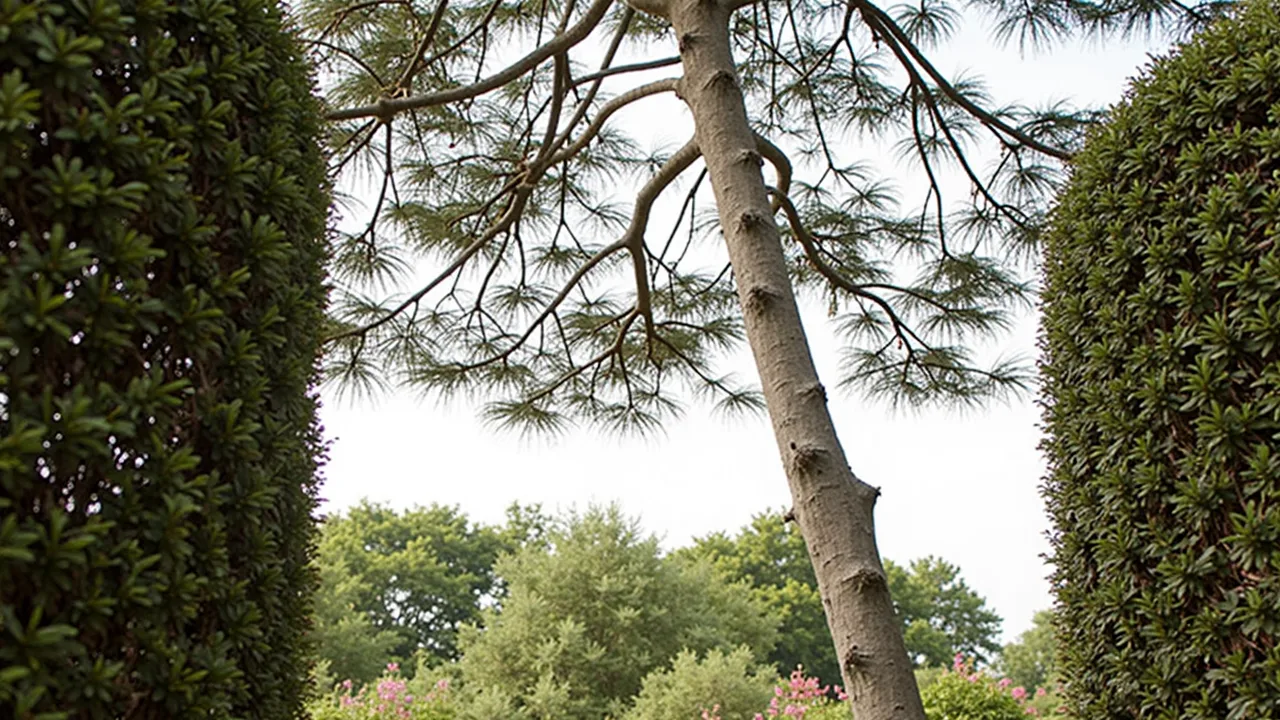
A mature Scots Pine in the open develops a tall, straight trunk and a tall, rounded crown, often irregular on the oldest specimens. The bark is one of the tree's most distinctive features: thin, papery and orange-red to cinnamon-brown on the upper trunk and branches, flaking in irregular plates, darkening to grey-purple and deeply furrowed at the base of old trees. This two-tone effect is most pronounced on mature specimens growing in the open.
The needles are stiff, slightly twisted and a blue- to grey-green, typically 3–7 cm long. They grow in pairs (a fascicle of two for this species) and persist on the tree for two to four years before being shed. The slight twist of the needles gives the canopy a softly silvery cast when seen at a distance or moved by wind.
Reproductive structures are cones rather than flowers. Small yellow male cones are borne in clusters at the base of new shoots in late spring and shed pollen freely. Female cones are green when young, maturing over 18 months to a dull grey-brown; they are ovoid, 3–7 cm long, and open on the tree to release small winged seeds. Old cones may persist on the branches for several years after seed release.
Growing Conditions
Scots Pine is one of the hardiest broadleaf-tree-sized conifers in cultivation. RHS hardiness rating H7 indicates it tolerates temperatures below −20 °C, making it suitable for every part of the UK and Ireland, including the most exposed upland sites in Scotland and the colder inland counties of England. It performs best in full sun; shaded sites produce open, sparse crowns and poorer needle colour.
The species is adapted to free-draining, often acidic substrates. It thrives on sandy, gravelly and rocky soils and on the peaty, ironpan-affected ground typical of Caledonian pinewoods. It will also grow on loam and clay provided the site is not waterlogged. Alkaline or chalky soils are tolerated but growth tends to be slower. Soil fertility is neither necessary nor desirable — Scots Pine is a pioneer of nutrient-poor ground and rich soils can encourage soft, leggy growth. Once established the tree is markedly drought-tolerant, sending roots deep into the substrate, and is highly wind-firm, which is why it has long been planted in coastal and upland shelterbelts.
Avoid sites that waterlog in winter, compacted ground, or frost pockets where young stock can be damaged by late spring frosts after the new shoots have flushed.
Planting and Care
Planting. Plant Scots Pine in the open ground during the dormant season — autumn through to early spring — when soil is workable and not frozen. Bare-root transplants of small sizes (under 1 m) establish readily and are the most economical choice for forestry and woodland use. Container-grown stock can be planted at any time of year provided the ground is moist and the tree is kept watered through the first growing season. Prepare a planting pit only marginally larger than the rootball; Scots Pine performs best when its roots are encouraged to move out into the surrounding soil rather than into a deep pocket of enriched compost. Stake only where the site is exposed, and remove the stake after two to three years to allow the trunk to develop taper.
Watering. Water young trees during prolonged dry weather in their first two to three seasons. Once established, Scots Pine needs no routine irrigation and is highly drought-tolerant.
Feeding. Routine feeding is unnecessary on most UK garden soils and is positively undesirable on poor substrates, where it can produce rank, unbalanced growth. If growth is genuinely poor on very depleted ground, a single spring application of a general-purpose slow-release fertiliser around the root area is sufficient.
Pruning. Scots Pine needs minimal pruning. Remove dead, damaged or crossing branches in late summer or early autumn, taking care not to cut back into old wood beyond the needle-bearing shoots, as conifers do not regenerate from bare wood. To control size or thicken the canopy on young trees, "candle pruning" — pinching or snapping the elongating spring shoots by half — encourages a denser habit without stimulating vigorous upright regrowth. For hedgerow or screening use, retain a single strong leader to maintain upward growth.
Propagation. Named cultivars are propagated by grafting onto P. sylvestris seedling rootstocks in winter. The species itself is raised from seed; fresh seed germinates readily after a short cold period, though commercial seed is usually sourced from selected forestry stands rather than garden-collected cones.
Seasonal care. Little seasonal work is needed. Sweep up shed needles beneath mature trees as required — they are slow to break down but make a useful acidic mulch for ericaceous plants. Watch for snow loading on young whips in their first few winters in very exposed sites; gently knock heavy snow from branches before it breaks them.
Container cultivation is possible for the first few years only. Specimens intended as large garden or woodland trees should be planted out while still young, as established Scots Pines resent root disturbance.
Common Problems
- Dothistroma needle blight (Dothistroma septosporum): brown bands and spots on needles followed by premature needle drop. Most serious in damp seasons on dense, sheltered trees. Improve airflow by thinning crowded specimens and, in ornamental settings, copper-based fungicides can be used as a protectant in early summer.
- Pine shoot beetle (Tomicus piniperda): beetles tunnel into fresh shoots in spring, causing the tips to wilt, turn brown and die back. Statutory pest in the UK; the principal control is to avoid moving untreated firewood from affected areas.
- Pine adelgid (Pineus pini): a sap-sucking insect that causes needles to become distorted and swollen. Generally a cosmetic problem on mature trees; small infestations can be tolerated.
- Phytophthora root rot: causes wilting, dieback and eventual collapse. The single most important control is site selection — never plant Scots Pine where the soil drains poorly.
- Conifer aphids (Cinara spp.): large grey-brown aphid colonies may form on young shoots, often accompanied by sooty mould on the bark below. Seldom damaging to mature trees; beneficial insects usually bring them under control.
- Sawfly larvae and pine shoot moth: caterpillar-like larvae of several species can defoliate shoots in spring. Damage is rarely serious on large specimens.
- Honey fungus (Armillaria spp.): a potential problem on stressed or old specimens, particularly on sites previously occupied by infected material.
Young trees may also suffer from wind rock on the most exposed sites until a deep root system has developed; firm them back into the soil after gales and stake only where necessary, as prolonged staking produces a weaker tree.
Popular Varieties
A wide range of Pinus sylvestris cultivars is available from UK nurseries, ranging from large architectural specimens to dwarf forms suitable for rock gardens and containers. The species itself has not been awarded the Royal Horticultural Society's Award of Garden Merit (AGM); named cultivars listed below are well-established in cultivation but their current AGM status is not asserted here.
- Pinus sylvestris 'Watereri' (also sold as 'Waterer's Dwarf' or 'Pumila'): a slow-growing, broad-conical cultivar reaching around 4–6 m in many decades, with notably blue-grey needles. Widely planted as a specimen in smaller gardens.
- Pinus sylvestris 'Aurea' (Golden Scots Pine): a slower-growing form whose winter needles carry a distinct golden-yellow tint, particularly striking against darker conifers. Best colour in full sun; tends to green in heavy shade.
- Pinus sylvestris 'Fastigiata': a narrow, columnar selection with branches held close to the trunk, useful as a vertical accent or in very narrow borders.
- Pinus sylvestris 'Beuvronensis': a dwarf, bun-forming cultivar, eventually reaching around 1 m tall and rather wider, with short blue-green needles. Popular for rock gardens, heather beds and containers.
- Pinus sylvestris 'Pendula': a weeping form, usually top-grafted at the desired height, with strongly pendulous branches; the eventual size and habit are governed by the staking and training given in the first years.
Pests and Diseases
| Problem | Symptoms | Management |
|---|---|---|
| Pine shoot moth | Shoots turn brown and die back, often with visible webbing or frass. | Apply appropriate insecticide in spring when larvae are active. |
| Honey fungus | General decline, yellowing needles, and white fungal growth at the base. | Improve drainage and remove infected roots; no chemical cure exists. |
| Needle cast diseases | Older needles turn brown or grey and drop prematurely. | Apply fungicide in spring and improve air circulation around the tree. |
| Conifer aphids | Clusters of small insects on new growth causing stunting and sticky honeydew. | Spray with insecticidal soap or horticultural oil during active growth. |
| Sawfly larvae | Needles are skeletonized or eaten, leaving behind frass and damaged foliage. | Hand-pick larvae or use a targeted insecticide if infestation is severe. |
For step-by-step help, read Controlling Aphids Naturally. Or browse the full plant problem solver to diagnose an issue by symptom.
As an Amazon Associate, GardenWizz earns from qualifying purchases made through the links above. This does not affect the price you pay. See our disclaimer for details.