
Euphorbia characias
Euphorbia characias
The Gardening Year
Best months in UK gardens · full planting calendar →
🖨 Printable care card (PDF)At a Glance
| Botanical name | Euphorbia characias |
|---|---|
| Common name(s) | Euphorbia characias |
| Family | Euphorbiaceae |
| Plant type | shrub |
| Height × Spread | 80–180 cm × 120 cm |
| Position | Full sun |
| Soil | well-drained, light soil |
| Flowering | March–June |
| Toxicity | IRRITANT to skin/eye, harmful if eaten |
| Native range | Mediterranean Basin |
Euphorbia characias, the broad-leaved or Mediterranean spurge, is one of the most striking evergreen perennials available to UK gardeners. A native of dry, rocky hillsides across the western Mediterranean, it has settled into British gardens with remarkable ease, offering year-round structure and a vivid spring display of chartreuse-yellow bracts that few other hardy plants can match. It is grown as much for its bold, architectural habit and silvery-grey foliage as for its flowers, and it remains a mainstay of gravel, coastal, and Mediterranean-style plantings from Cornwall to the Highlands.
Overview
Euphorbia characias belongs to the spurge family, Euphorbiaceae, a large and varied group whose members share a single defining feature: a milky white latex sap that bleeds from any cut or broken stem. In E. characias this sap is copious and irritating to skin and eyes, so the plant should always be handled with stout gloves, long sleeves, and eye protection. Beyond this, it is one of the most useful structural plants for a dry, sunny border in the British climate, combining drought tolerance, evergreen presence, and a long flowering season with very little routine maintenance.
Its hardiness rating of H4 means it is hardy throughout most of the UK, coping with winter temperatures down to roughly −10 °C given reasonable drainage and a sheltered position. It is not, however, a plant for cold, wet, heavy soils or for exposed east-facing sites, and gardeners in northern or inland districts should give it the warmest, most free-draining spot available.
Appearance
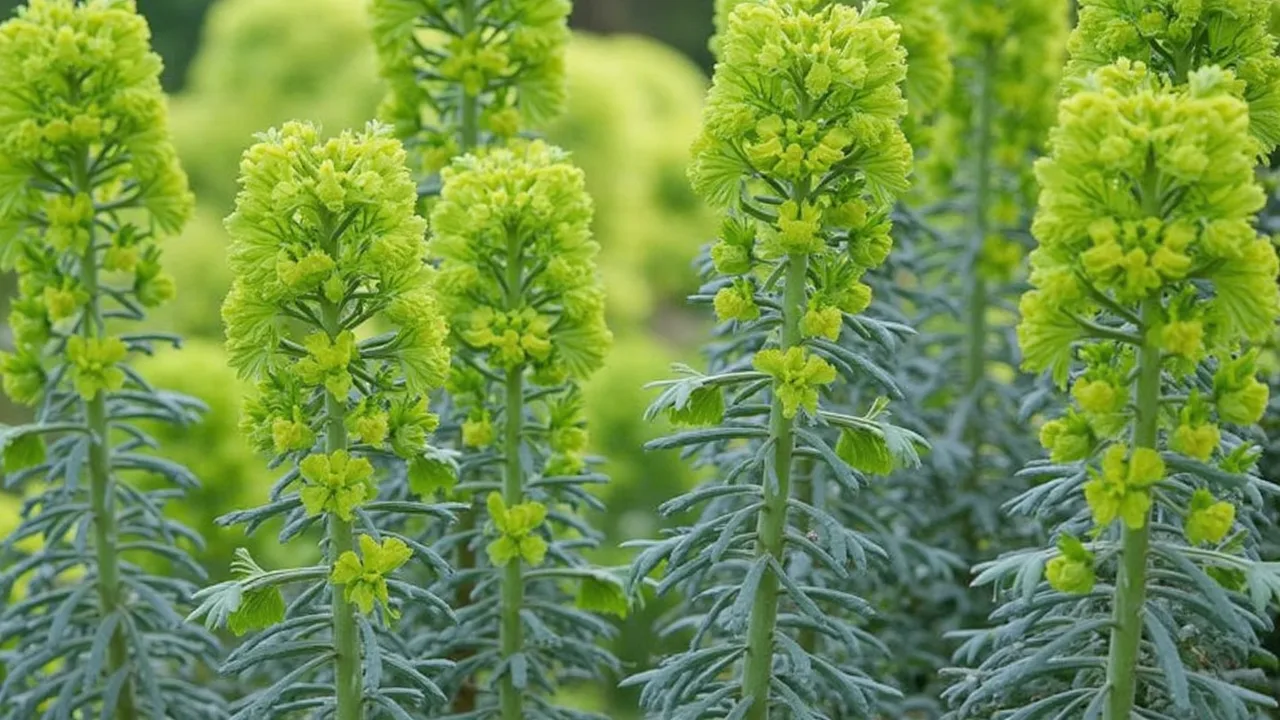
Euphorbia characias forms a dense, rounded mound of upright stems that reach roughly 1–1.2 m in height with a similar spread, making it one of the bolder foliage plants for the middle of a sunny border. Each stem is stout and becomes woody at the base as the plant matures, while the upper growth remains soft and is topped in spring by the characteristic flower clusters. Stems arise from a single crown and increase slowly outwards, building a thicket of vertical accents over several years.
The foliage is narrow, oblong to linear, and typically 5–12 cm long, arranged spirally up the stems. The colour is a distinctive glaucous grey-green, often described as blue-grey, and is one of the plant's most useful ornamental features outside the flowering season. In mild winters the leaves remain evergreen; in colder inland or northern districts they may be partly shed, leaving the plant semi-evergreen.
Flowering occurs from April through June in the UK, slightly later in cooler districts. What appears to be a single large flower at each stem tip is in fact a dense, dome-shaped cyathium up to 20 cm across, made up of many tiny individual flowers surrounded by showy, petal-like bracts. In E. characias these bracts are a luminous chartreuse-yellow, almost lime, and the overall effect at peak bloom is of glowing yellow torches above silvery foliage. The flowers are followed by smooth, two-lobed seed capsules, which are not especially ornamental but persist through summer and add a quiet textural note.
Growing Conditions
Euphorbia characias asks for two things above all else: full sun and excellent drainage. It is adapted to dry, rocky Mediterranean habitats and tolerates, even prefers, lean, stony soils that would starve most border perennials. In cultivation this translates to a well-drained loam, a sandy soil, or a gravelly scree; heavy clay, compacted ground, and any site where water sits through winter should be avoided or improved before planting.
Soil pH is not critical, and the species tolerates anything from slightly acidic to slightly alkaline conditions (roughly pH 6.0–8.0). Fertility should be modest: rich, heavily fed soils produce floppy, lush growth that is prone to collapse and winter damage. A lean diet, with at most a light top-dressing of grit around the crown in spring, keeps the plant compact and tough.
In terms of position, full sun is strongly preferred for the best flowering, the tightest habit, and the driest possible root run. Light dappled shade is tolerated but flowering will be reduced and stems may stretch. A sheltered spot away from cold, drying winds is helpful, particularly in northern and inland gardens; an east- or south-facing wall provides useful warmth and reflected heat. Once established, E. characias is notably drought-tolerant and is also one of the more reliable perennials for exposed coastal sites, where it tolerates salt-laden winds without complaint.
Planting and Care
The best time to plant is in spring, once the soil has begun to warm (typically March to May), or in early autumn (September) to allow roots to establish before winter. Container-grown plants from garden centres can be set out at any time the ground is workable, but avoid planting in midsummer drought or in the depths of winter when waterlogged soil is a risk. Space plants 60–90 cm apart depending on the effect desired — closer for a quicker block of cover, wider for individual specimens. Water thoroughly at planting and during the first dry summer; thereafter supplementary watering is needed only in prolonged drought.
Routine feeding is generally unnecessary. A light mulching of grit or gravel around the base of the plant in spring keeps the crown dry and discourages basal rot, and is preferable to organic mulches such as bark or compost, which can hold moisture against the stems and encourage disease.
Pruning is straightforward. The classic technique is to cut back the spent flowering stems to the base in late summer, once the display has faded, taking care to avoid the sap. Any stems that have been damaged by winter cold or wind should be removed in spring, once new shoots are visible low on the plant, cutting back to healthy growth or to the base. Straggly, leggy plants can be rejuvenated by cutting all stems back hard in spring, although flowering will be skipped for a year. Always wear gloves and wash any tools that have come into contact with the sap before using them elsewhere.
Propagation is easily done by basal cuttings in spring or early summer. Young shoots 7–10 cm long are pulled or cut from the crown, the cut end is left to dry for an hour or two so the latex can set, and the cutting is then inserted into a free-draining mix of compost and grit. Division of established clumps in spring is also reliable, and seed can be sown in autumn or spring, although cultivars will not come true from saved seed.
Seasonal care is light: in autumn leave the seed heads in place for winter interest and as a food source for birds; in spring cut away any winter-damaged growth and top-dress with grit; through summer the plant largely looks after itself provided drainage is sound.
Common Problems
The single most common cause of failure is wet soil, particularly through winter. Waterlogging around the crown encourages root and basal rot, which shows as blackening of the stems from the base upwards followed by collapse. There is no effective cure once rot has taken hold, so prevention is everything: plant in free-draining soil, on a slope or raised bed if necessary, and avoid organic mulches that hold moisture.
In severe winters, particularly where temperatures fall below −10 °C or where cold is combined with persistent wet, the evergreen top growth may be cut back by frost. Plants usually recover from the base in spring provided the crown and roots are sound; damaged stems should be cut back to healthy growth.
Older plants sometimes become bare and woody at the base with a tuft of growth only at the top. Hard pruning in spring, as described above, can rejuvenate them; very old, exhausted specimens are best replaced, as E. characias is naturally a relatively short-lived perennial or subshrub.
Pests are rarely a serious issue. Greenfly and whitefly can colonise young shoots in spring but rarely cause lasting damage. Grey mould (Botrytis) is uncommon and usually only a problem in very wet seasons or where plants are crowded with poor air movement. Rabbits and deer generally leave euphorbias alone.
The milky sap is the plant's most consistent hazard. It is a skin and eye irritant on contact and toxic if ingested, so gloves, long sleeves, and eye protection should be worn whenever the plant is cut or handled. Sap that gets on the skin should be washed off promptly with soap and water. E. characias should not be planted close to children's play areas or where pets brush against it. The irritant compound is known as euphorbium.
Popular Varieties
The most widely grown form in UK gardens is Euphorbia characias subsp. characias, the western Mediterranean subspecies, valued for its broad, grey-green leaves and bold flower heads. The closely related Euphorbia characias subsp. wulfenii (sometimes sold as E. characias 'Wulfenii' or E. wulfenii) differs in having more slender leaves with a brighter, more yellow-green tone, and slightly larger, looser flower clusters; it is often considered the more architectural of the two and is a parent of several well-known hybrids.
Among named selections, 'Humpty Dumpty' is a compact form reaching only around 60 cm, useful for smaller gardens or the front of a border. 'Blue Hills' is grown for particularly glaucous, blue-toned foliage that pairs well with the yellow-green bracts. 'Perry's Winter Blusher' and similar variegated forms display reddish or pink-flushed new growth in cooler weather, though availability in the UK trade varies from year to year.
Hybrids between E. characias and E. mellifera, sold as × pasteurii (sometimes 'John Phillips' or 'Roundway Titan'), combine the chartreuse flower colour with larger, darker green leaves and a taller, more open habit, and have become increasingly popular in milder gardens. As with all named euphorbia cultivars, named forms should be propagated by cuttings or division rather than seed, as seedlings will not come true to type.
Pests and Diseases
| Problem | Symptoms | Management |
|---|---|---|
| Root rot | Stems become soft and mushy, often collapsing, particularly after wet winters or in heavy soils. | Plant in well-drained soil and avoid waterlogging to prevent fungal infection. |
| Aphids | Clusters of small insects on new growth causing leaf distortion and sticky honeydew. | Encourage natural predators like ladybirds or treat with a systemic insecticide if severe. |
| Powdery mildew | A white, powdery fungal growth appears on leaves and flower bracts. | Improve air circulation and apply a fungicide specifically labeled for powdery mildew. |
| Rust | Orange or brown pustules develop on the undersides of leaves, leading to yellowing. | Remove affected foliage immediately and ensure good airflow around the plant. |
For step-by-step help, read Controlling Aphids Naturally and Treating Powdery Mildew. Or browse the full plant problem solver to diagnose an issue by symptom.
As an Amazon Associate, GardenWizz earns from qualifying purchases made through links on this page (including links within the article). This does not affect the price you pay. See our disclaimer for details.