
Crocosmia
Crocosmia crocosmiiflora
The Gardening Year
Best months in UK gardens · full planting calendar →
🖨 Printable care card (PDF)At a Glance
| Botanical name | Crocosmia crocosmiiflora |
|---|---|
| Common name(s) | Crocosmia |
| Family | Iridaceae |
| Plant type | perennial (deciduous cormous perennial; evergreen or deciduous perennials that grow from basal underground corms) |
| Height × Spread | 0.6–2 m × 10–50 cm |
| Position | Full sun, Partial shade |
| Soil | moderately fertile, humus rich soil; moist but well-drained |
| Flowering | June–November |
| Toxicity | — |
| Native range | southern and eastern Africa, ranging from South Africa to Sudan |
Overview
Crocosmia crocosmiiflora, widely known as montbretia, is a vigorous herbaceous perennial from the grasslands of South Africa and a familiar sight in British gardens from mid to late summer. The species most often grown in the UK is a hybrid between Crocosmia aurea and Crocosmia paniculata, first raised by the French nurseryman Victor Lemoine in 1880. It belongs to the iris family, Iridaceae, and grows from small underground corms that multiply each year to form steadily expanding clumps.
In the border, crocosmia earns its place through three qualities: vivid, late-season colour at a time when many perennial beds are beginning to tire, an upright, architectural silhouette, and a tolerance of most reasonable British garden soils. Its wiry, arching flower stems carry sprays of tubular blooms that open in succession from July into September, providing weeks of interest at a time when bees, hoverflies and butterflies are at their most active.
Appearance
Crocosmia grows from a clump of upright, sword-shaped leaves that emerge in spring as a tight fan, then lengthen through the season to roughly 60 to 80 cm. The leaves are bright to mid-green, slightly pleated along their length, and have a distinctly grassy, almost iris-like quality. From this base, taller flowering stems rise to around 60 to 90 cm, with a horizontal spread of about 15 to 30 cm per clump.
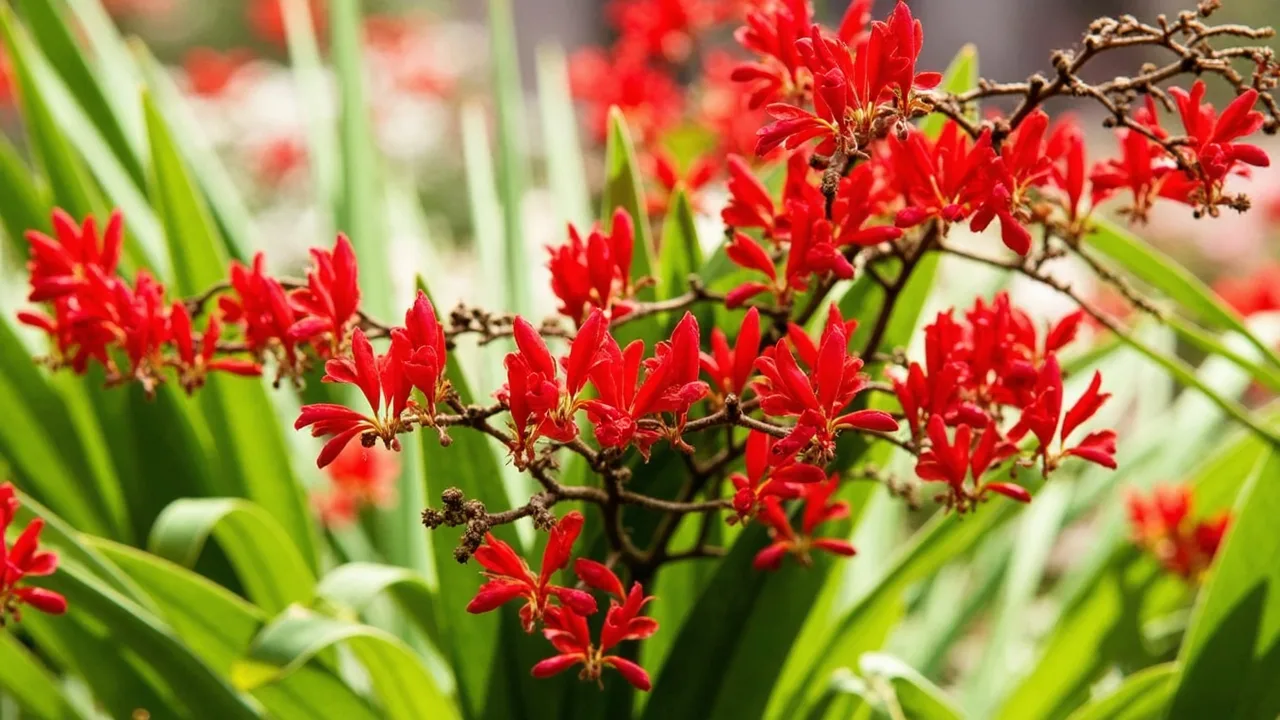
The flowers are carried along the upper part of each stem on short side-branches, giving the inflorescence its characteristic branched, zig-zag form. Each bloom is narrowly tubular at the base, opening into six spreading tepals in a star-like arrangement. In C. crocosmiiflora the colour is typically a strong orange-red, sometimes shading to deep scarlet, with a slightly paler yellow-orange throat. Flowering begins in July and continues, in successive flushes, into September.
Below ground, the plant forms chains of small, rounded corms clothed in fibrous tunics. New corms are produced each season on top of older ones, which is why established clumps gradually rise above the soil surface and benefit from periodic lifting and replanting. Seed capsules are small and inconspicuous, and in most garden settings the plant spreads vegetatively through corm offsets rather than by seed.
Growing Conditions
Crocosmia is fully hardy across most of the UK and can be left in the ground year-round in all but the coldest, wettest sites. It performs best in an open, sunny position, where the corms ripen well and flowering is reliable; light, dappled shade is tolerated but produces fewer and later flowers. The ideal soil is moist but well-drained, reasonably fertile, and neutral to slightly acidic, somewhere in the pH 6.0 to 7.5 range. Heavy clay can be improved with coarse grit and organic matter before planting, while very dry, sandy soils benefit from the addition of well-rotted compost to hold moisture during the summer.
Because crocosmia originates in summer-rainfall grassland, it appreciates consistent moisture through the growing season and resents sitting in cold, waterlogged ground over winter. In areas with poorly drained soil, planting on a gentle slope or in a raised bed makes a noticeable difference to corm survival and overall vigour.
Planting and Care
Corms are planted in spring, from March through to May, at a depth of roughly 8 to 10 cm and spaced 10 to 15 cm apart. In containers, use a loam-based compost such as John Innes No. 2 with extra grit added to sharpen drainage, and position pots in full sun.
Water freely during the main growing period from late spring until the foliage begins to yellow in autumn; once the leaves have died back, watering can be reduced significantly. Feeding is straightforward: a high-potash liquid fertiliser applied every two to three weeks from June through August supports both flowering and corm ripening for the following year.
After the first hard frost in autumn, cut the spent flowering stems down to the base. The leaves can be left in place over winter to protect the crown and the corms beneath it, then tidied away in early spring once new growth emerges. In colder parts of Scotland, the north of England and other exposed gardens, a thick, dry mulch of bark or straw applied in late autumn helps insulate the corms; in mild, well-drained sites this is rarely necessary.
Propagation is most easily done by division. Every three to four years, in spring, lift congested clumps and tease the chains of corms apart, replanting only the largest, healthiest ones at the correct depth and spacing. Smaller offsets can be potted up separately to grow on for a season before being planted out. Crocosmia can also be raised from seed, although seedlings will not come true to the parent and this method is really only worthwhile for species rather than named cultivars.
Common Problems
Crocosmia is generally robust, but a few routine issues are worth watching for. Aphids may colonise young shoots and flower stems in late spring; a strong jet of water or a treatment of insecticidal soap usually keeps them in check. Capsid bugs produce small, ragged holes in the leaves and distorted buds, and are best dealt with by hand-removal where the infestation is light. Red spider mite is mainly a problem under glass or in very dry, sheltered corners, and is addressed by improving humidity around the foliage.
The most damaging disorder is corm rot, usually caused by waterlogged soil or by damage to the corms during lifting. Affected corms turn soft and discoloured and should be discarded; the remainder can be replanted in improved, free-draining ground. Slugs and snails target the emerging shoots in spring, particularly in damp seasons, and iron-based slug pellets or physical barriers are the standard response. Powdery mildew can appear on crowded clumps during dry summers and is prevented by spacing plants more generously and removing affected foliage to improve airflow.
One final consideration is vigour. Crocosmia crocosmiiflora is naturally a strong grower and can spread quickly through its corms, producing large colonies that are difficult to remove once established. In smaller gardens, or where neighbouring plants are delicate, it is worth lifting and dividing clumps annually to keep them within bounds. In some parts of the UK the species is regarded as an invasive garden escape, so deadheading before seed set and disposing of unwanted corms responsibly is good practice.
Popular Varieties
Within Crocosmia crocosmiiflora and its near relatives, a number of well-established cultivars are widely available from British nurseries. All are hardy in UK gardens and share the same general cultivation requirements.
'Lucifer' is the most widely planted cultivar, grown for its vigorous upright habit and large, vivid red flowers held well above the foliage. It was raised by Alan Bloom and is reliably hardy, often reaching 90 cm or more in good soil.
'Emily McKenzie' is a lower-growing selection, typically 60 cm tall, with large, outward-facing flowers in a warm orange shade marked with a deeper red throat. It flowers later than many varieties and suits smaller borders and containers.
'George Davison' is an old cultivar with soft yellow flowers on slender stems, useful for lighting up the back of a late-summer border alongside deep blues and purples.
'Meteore' produces arching sprays of warm orange flowers and has a slightly more relaxed, informal habit than 'Lucifer', making it a good partner for ornamental grasses.
'Solfatare' is grown chiefly for its bronze-tinted foliage, which emerges in spring before the apricot-yellow flowers open in late summer; it is slower to establish than green-leaved forms but offers a longer season of interest.
Beyond these, breeders have introduced a wider range of named hybrids in recent years, including larger-flowered and more compact forms. Where named cultivars are planted, propagation must be by division rather than seed, as seedlings will not retain the characteristics of the parent.
Pests and Diseases
| Problem | Symptoms | Management |
|---|---|---|
| Corm rot | Plants show poor growth with yellowing leaves and soft, decaying corms. | Ensure well-drained soil and discard any damaged or rotting corms when dividing. |
| Gladiolus rust | Small brown spots appear on the leaves and occasionally on the flowers. | Improve air circulation by dividing clumps and avoid planting in shaded, damp positions. |
| Red spider mite | Fine webbing is visible on foliage, often accompanied by stippled or discoloured leaves. | Keep plants well-watered to reduce stress and spray with water or horticultural oil if infested. |
| Slugs and snails | Irregular holes are eaten in the emerging shoots and young leaves in spring. | Use slug pellets, copper tape barriers, or hand-pick pests at night to protect new growth. |
For step-by-step help, read Dealing with Slugs and Snails. Or browse the full plant problem solver to diagnose an issue by symptom.
As an Amazon Associate, GardenWizz earns from qualifying purchases made through the links above. This does not affect the price you pay. See our disclaimer for details.