Japanese Maple
Acer palmatum · palmate maple · smooth Japanese maple
At a Glance
| Botanical name | Acer palmatum |
|---|---|
| Common name(s) | Japanese maple, palmate maple, smooth Japanese maple |
| Family | — |
| Plant type | shrub |
| Height × Spread | 600–10000 cm × 450–10000 cm |
| Hardiness | — |
| Position | Partial shade, Full shade |
| Soil | moderate to well-drained soil |
| Flowering | April–June |
| Toxicity | — |
| Native range | Korea, Japan, China, eastern Mongolia, and southeast Russia |
Overview
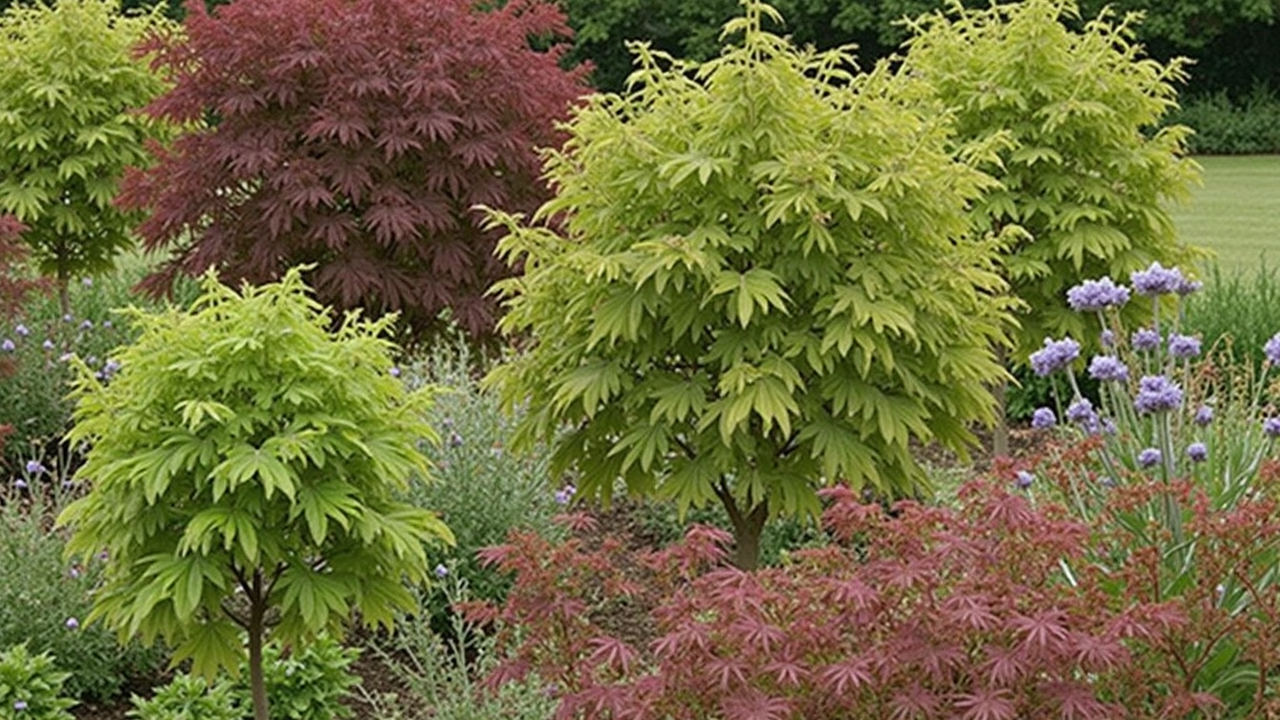
Acer palmatum, commonly known as Japanese maple, palmate maple, or smooth Japanese maple, is a species of deciduous shrub or small tree. It is native to Korea, Japan, China, eastern Mongolia, and southeast Russia. Many cultivars have been selected and are grown worldwide for their diverse forms, leaf shapes, and spectacular colours.
Botanical Description
Acer palmatum typically reaches heights of 6 to 10 m (20 to 33 ft), rarely 16 m (52 ft), with a mature width of 4.5 to 10 m (15 to 33 ft). It often grows as an understory plant in shady woodlands, may have multiple trunks joining near the ground, and develops a dome-like canopy when mature. The leaves are 4–12 cm long and wide, palmately lobed with five, seven, or nine acutely pointed lobes. Flowers are produced in small cymes, each with five red or purple sepals and five whitish petals. The fruit consists of paired winged samaras, each 2–3 cm long with a 6–8 mm seed. The species displays considerable genetic variation, with seedlings from the same parent tree often differing in leaf size, shape, and colour. Three subspecies are recognised based on leaf size, lobe number, margin type, and seed wing length.
Origin and Habitat
Native to Korea, Japan, China, eastern Mongolia, and southeast Russia, Acer palmatum naturally occurs in shady woodlands as an understory plant. It grows at varying altitudes across its range, with different subspecies adapted to lower or higher elevations.
Cultivation
Acer palmatum has been cultivated in Japan for centuries and introduced to temperate regions worldwide since the 1800s, with the first specimen reaching Britain in 1821. It is suitable for hardiness zones 5–8. Most cultivars prefer partial shade, especially in hotter climates, though some tolerate full sun, particularly red, purple-red, black-red, bronze, or dark green cultivars. Variegated cultivars (white, cream, yellow, yellow-orange, or light green) require shade protection. The species is adaptable, blends well with companion plants, and is suitable for borders, ornamental paths, and containers due to its compact, non-invasive root system. Moderate to well-drained soil is essential; it will not survive in poorly drained, waterlogged soil.
Care and Maintenance
Prune only to remove dead branches or to shape artistically by carefully selecting individual branches to remove; avoid hedge-like pruning. Trees heal readily after pruning without aftercare. They naturally self-prune shaded internal branches. Pruning can highlight the tree's form, especially in winter. Japanese maples are prone to die during drought and prefer consistent moisture; established trees are less susceptible. They do not require heavy fertilisation and should only be very lightly fertilised.
Uses
Japanese maples are popular in traditional Japanese gardens, often used as accent trees providing summer shade and autumn colour. They are a favoured subject for bonsai and feature in art. Numerous cultivars are grown for ornamental purposes in Europe and North America. Preparations from branches and leaves are used in traditional Chinese medicine. The leaves are edible; a local dish from Minoh, momiji tempura, involves pickling leaves for a year before coating them in flour, sesame seeds, and sugar, then deep frying.
Cultivars and Varieties
| Cultivar | Height | Flower | Notes | AGM |
|---|---|---|---|---|
| 'Aka shigitatsu sawa' | — | pinkish-white leaves with green veins | — | |
| 'Ao ba jo' | — | — | dwarf with bronze-green summer foliage | |
| 'Arakawa' | — | — | Upright vigorous growth with an exceptional rough bark that makes it very sought after for bonsai |
Pests and Diseases
| Problem | Symptoms | Management |
|---|---|---|
| drought | — | prefer consistent water conditions |
Quick Care Summary
| Sunlight | Partial shade, Full shade |
|---|---|
| Soil | moderate to well-drained soil |
| Hardiness | — |
| Sow | September–November |
| Plant | March–May |
| Prune | — |
Facts sourced from Wikipedia / Acer palmatum (https://en.wikipedia.org/wiki/Acer_palmatum)
As an Amazon Associate, GardenWizz earns from qualifying purchases made through the links above. This does not affect the price you pay. See our disclaimer for details.