Chives
Allium schoenoprasum
At a Glance
| Botanical name | Allium schoenoprasum |
|---|---|
| Common name(s) | Chives |
| Family | Amaryllidaceae |
| Plant type | perennial (hardy herbaceous perennial (bulbous)) |
| Height × Spread | 10–30 cm × 5–15 cm |
| Hardiness | H6 (to -15.0 °C) |
| Position | Full sun, Partial shade |
| Soil | Fertile, moisture-retentive but well-drained; chalk, clay, loam or sand |
| Flowering | May–July |
| Toxicity | Toxic to dogs and cats if ingested (as with all alliums) |
| Native range | Temperate Europe, Asia and North America |
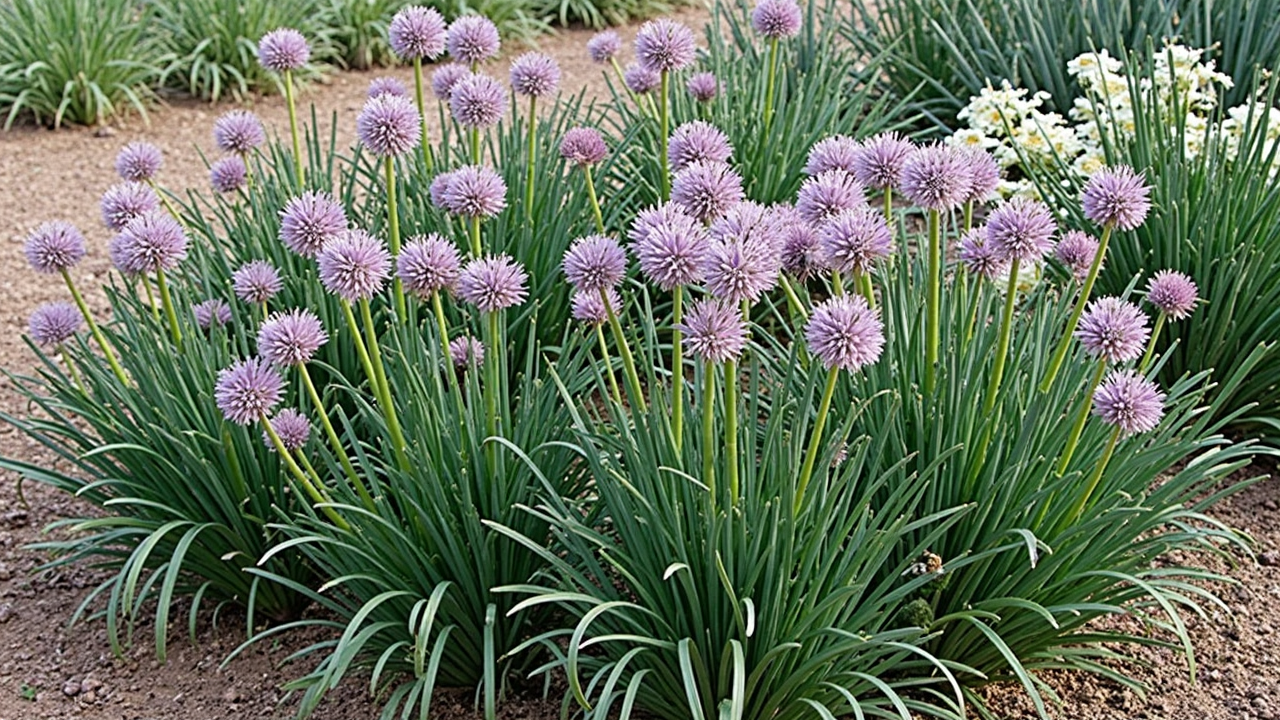
Chives (Allium schoenoprasum) are a clump-forming, bulbous perennial herb in the onion family (Amaryllidaceae, formerly Alliaceae). Native to temperate regions of Europe, Asia and North America, they are the smallest and most delicately flavoured of the common culinary alliums. Easy to grow, cold-tolerant and attractive to pollinators, chives are a staple of British kitchen gardens, allotments and ornamental herb borders, where their mauve pompom flowers provide weeks of early-summer colour.
Overview
A hardy herbaceous perennial, chives die back to small white bulbs in winter and re-emerge in early spring. The leaves are slender, hollow and tubular, giving the plant a grass-like appearance, while the dense, spherical flower heads sit atop stiff stems from late May through to July. Every part of the plant is edible: the leaves carry a mild onion flavour, the flowers are mildly sweet and can be tossed into salads, and the bulbs, though rarely used, are also edible.
Chives have been cultivated in Europe since at least the Middle Ages and were traditionally grown for both culinary and medicinal purposes. Today they remain one of the most widely grown herbs in UK gardens, valued as much for their ornamental qualities as for their use in the kitchen. They are particularly associated with French and German cookery, but are equally at home in British herb beds, patio containers and windowsill pots.
A single established clump is reliably productive for three to five years before it becomes congested and benefits from division, making chives one of the lowest-maintenance herbs a UK gardener can grow.
| Botanical name | Allium schoenoprasum |
| Common name | Chives |
| Plant type | Herbaceous perennial |
| Hardiness | RHS H7 (hardy throughout the UK, below -20 °C) |
| Sunlight | Full sun to light shade |
| Soil type | Moist, well-drained, moderately fertile |
| Flowering season | Late May to July |
| Mature size | 25-50 cm tall, 30-40 cm spread |
Appearance
Chives form dense tufts of upright, cylindrical leaves 25-50 cm tall, each leaf being a smooth, hollow tube roughly 4-6 mm in diameter with a soft, waxy bloom. The leaves are a medium, slightly glaucous green and arise in tight clusters from a basal plate of small, slender bulbs connected by short rhizomes.
The flowering stems, also hollow, are noticeably stiffer than the leaves and grow 30-60 cm tall, terminating in a tight, rounded umbel 2-4 cm across composed of numerous small, six-tepalled, bell-shaped flowers in a clear pinkish-lilac to mauve. Each umbel typically contains 20-30 flowers that open progressively over two to three weeks. After flowering, the umbels dry to form papery seed heads that can be left for ornamental effect or collected for propagation.
The root system is shallow and fibrous, with offsets gradually expanding the clump outward. Mature clumps can reach 30-40 cm across after several seasons of undisturbed growth.
Growing Conditions
Chives prefer a moist but well-drained, moderately fertile soil in full sun, though they tolerate light dappled shade, particularly in hotter southern gardens. Soil pH should ideally sit between 6.0 and 7.5; very acid or very alkaline soils will check growth.
Hardiness is excellent. The Royal Horticultural Society rates Allium schoenoprasum as H7, the highest hardiness rating on the UK scale, meaning it tolerates temperatures below -20 °C and can be grown throughout the British Isles, including exposed northern and upland sites. Chives are also relatively wind-tolerant thanks to their flexible leaves, although flowering stems can snap in very exposed positions.
While chives enjoy moisture during the growing season, they will not tolerate waterlogged ground in winter, and heavy clay should be improved with grit and organic matter before planting. Conversely, on very light, free-draining soils they appreciate a generous mulch of garden compost each spring to conserve moisture and feed the clump.
In containers, chives grow well in any standard peat-free multipurpose compost, provided the pot is at least 20 cm deep and has reliable drainage. They are also a useful companion plant in vegetable beds, reputed to deter aphids from carrots and improve the flavour of tomatoes.
Planting and Care
Planting. Sow seed indoors from February to April in modules at 18-21 °C, or direct sow outdoors from April once the soil has warmed. Seedlings can be transplanted or thinned to 20-30 cm apart. Pot-grown plants from garden centres can be planted out at any time between spring and early autumn, provided they are kept watered until established. Container-grown clumps can be planted slightly proud of the soil surface to discourage basal rot.
Watering. Chives are not drought-tolerant. During dry spells in late spring and summer, water thoroughly once or twice a week rather than little and often, as this encourages deeper rooting. Container plants, in particular, dry out quickly and may need daily watering in hot weather.
Feeding. An annual mulch of garden compost in early spring is usually sufficient. On very poor soils, an additional liquid feed of seaweed or general-purpose fertiliser every four to six weeks through the growing season will boost leaf production. Over-feeding with high-nitrogen fertilisers produces lush but weakly flavoured leaves.
Pruning and harvesting. Begin harvesting once clumps are well established, typically from late spring in the year after sowing. Cut leaves to within 2-3 cm of the ground using sharp scissors, taking no more than half the clump at any one time to avoid weakening the plant. Regular cutting encourages a fresh flush of tender leaves and delays flowering, although many gardeners leave a portion of the clump to flower for the bees. After flowering, cut the whole plant back hard to 5 cm; new leaves will regrow within a few weeks.
Propagation. Divide congested clumps in spring or autumn: lift, split into smaller sections each with a few bulbs, and replant immediately. Chives also self-seed freely, and seedlings can be lifted and transplanted in spring. Seed can be collected from dried flower heads in late summer and stored in a cool, dry place; viability is typically two to three years.
Seasonal care. Mulch lightly in autumn after the tops die back. In early spring, rake off any debris and apply compost. Cut back any remaining old growth before the new shoots emerge. In very cold regions, container plants benefit from being moved to a cold frame or unheated greenhouse for the worst of the winter, although established plants in the ground are fully hardy.
Common Problems
Chives are generally trouble-free, but a few issues can arise. Leek rust (Puccinia allii) is the most common disease, causing orange pustules on the leaves in damp summers. Improving air circulation, avoiding overhead watering, and removing infected foliage usually controls it; in severe cases, destroy badly affected clumps and replant in a fresh site. Onion white rot (Sclerotium cepivorum) is rarer but devastating and persists in soil for many years, so do not plant chives where it has been a problem.
Among pests, blackfly occasionally colonises the flower buds in early summer and can simply be washed off or tolerated. Alliums in general are not seriously troubled by slugs or snails, which is one of chives' advantages over softer-leaved herbs. Newly emerged shoots can be nibbled by pigeons in exposed sites, particularly in early spring, but damage is rarely severe enough to warrant protection.
A common non-pathological problem is the clump becoming congested after three to five years, leading to thin, weak leaves and reduced flowering. The remedy is straightforward: lift and divide.
Popular Varieties
Several named cultivars of Allium schoenoprasum are widely available in the UK, varying mainly in leaf thickness, vigour and flower colour.
- 'Forescate': a vigorous, broad-leaved selection with notably large, deep pink flowers; a popular choice for ornamental effect.
- 'Black Island Blush': a compact form with dark green foliage and pale pink flower heads, well suited to containers.
- 'Fine Leaved' (sometimes sold as 'Thin Leaf' or by the German name 'Feinblättriger'): a finer, more delicate form prized by chefs for its tender, mild-flavoured leaves.
- 'Staro': a heavy-cropping, broad-leaved cultivar bred for forcing and pot production; widely sold as a windowsill herb.
- 'Corsican White' (sometimes listed as A. schoenoprasum var. alba): a white-flowered form occasionally offered by specialist herb nurseries, attractive in ornamental plantings.
Garlic chives (Allium tuberosum), sometimes sold as 'Chinese chives', are a closely related species with flat, garlic-scented leaves and white flowers in late summer. Although distinct, they are grown in the same way and are a useful companion to ordinary chives in the kitchen garden.
---
Cultivars and Varieties
| Cultivar | Height | Flower | Notes | AGM |
|---|---|---|---|---|
| 'Forescate' | 45 cm | Rose-pink, early summer | Taller, vigorous; strong pink colour | |
| 'Rising Star' | 30 cm | Pink | Uniform habit; good for containers | |
| 'Silver Chimes' | 25 cm | White | Compact white-flowered form |
Pests and Diseases
| Problem | Symptoms | Management |
|---|---|---|
| Allium leaf miner | Wavy white lines in leaves; pupae in stems; distorted growth | Cover with insect-proof mesh spring and autumn; remove affected growth |
| Downy mildew | Pale patches and grey-purple mould on leaves in wet weather | Improve air flow; avoid overhead watering; remove infected leaves |
| White rot | Yellowing, wilting; white fluffy fungus and black sclerotia on bulbs | No cure; lift and destroy affected plants; do not replant alliums there for years |
Quick Care Summary
| Sunlight | Full sun, Partial shade |
|---|---|
| Soil | Fertile, moisture-retentive but well-drained; chalk, clay, loam or sand |
| Hardiness | H6 (-15.0 °C) |
| Sow | February–September |
| Plant | March–May |
| Prune | — |
Facts sourced from RHS Plant Finder https://www.rhs.org.uk/plants/859/allium-schoenoprasum/details