
Achillea
Achillea millefolium
At a Glance
| Botanical name | Achillea millefolium |
|---|---|
| Common name(s) | Achillea |
| Family | Asteraceae |
| Plant type | perennial |
| Height × Spread | 20–100 cm × — |
| Hardiness | H7 (to -20.0 °C) |
| Position | Full sun, Partial shade |
| Soil | Moist but well-drained; Well-drained; Acid, Alkaline, Neutral; free-draining soil |
| Flowering | March–October |
| Toxicity | — |
| Native range | temperate regions of Eurasia and North America; Europe to W Asia |
Achillea millefolium, commonly known as yarrow, is a hardy herbaceous perennial native to grasslands, meadows and roadsides across much of the temperate northern hemisphere, including the British Isles. It is one of the longest-established wildflowers in the UK, recorded in herbals since medieval times and still a familiar sight on chalk downland, motorway verges and unimproved pasture. The genus name Achillea refers to the Trojan war hero Achilles, who — according to legend — used the plant to staunch the wounds of his soldiers; millefolium means "thousand leaves", describing the finely divided, fern-like foliage.
Today yarrow is grown both as a cottage-garden perennial and as a pollinator plant. Its flat-topped flower heads, held on strong stems well above the foliage, are exceptionally attractive to bees, hoverflies and butterflies, and they make a long-lasting cut flower, both fresh and dried. A single established clump will flower for several weeks in high summer, and the seed heads remain decorative well into autumn.
Overview
Yarrow is one of the easiest perennials to grow in the UK. It tolerates drought, thin chalky soils, salt-laden coastal winds and the neglect that kills fussier border plants, yet it still produces weeks of flower from early summer onwards. It is an excellent choice for low-maintenance gardens, gravel plantings, wildlife borders, and the kind of sunny, free-draining bank where little else will thrive. The species itself is a useful plant, but named cultivars in shades of pink, red, apricot, cream and pale yellow have largely displaced the wild form in ornamental gardens.
Beyond the garden, A. millefolium has a long history in herbal medicine — used traditionally as a wound herb, a bitter tea and a strewing herb — and the RHS notes that bees and other pollinators visit it readily. It is, in short, a plant that rewards minimal input with a long season of interest, both for the gardener and for the wider garden ecology.
Appearance
The most recognisable feature of yarrow is the foliage. Each leaf is narrowly lance-shaped, 5-20 cm long, and divided almost to the midrib into very fine, feathery segments — hence "thousand leaves". The leaves are arranged in a flat basal rosette and along the flowering stems, and they are softly hairy, giving the whole plant a slightly grey-green, matte appearance. Crushed foliage has a distinctive, slightly aromatic scent.
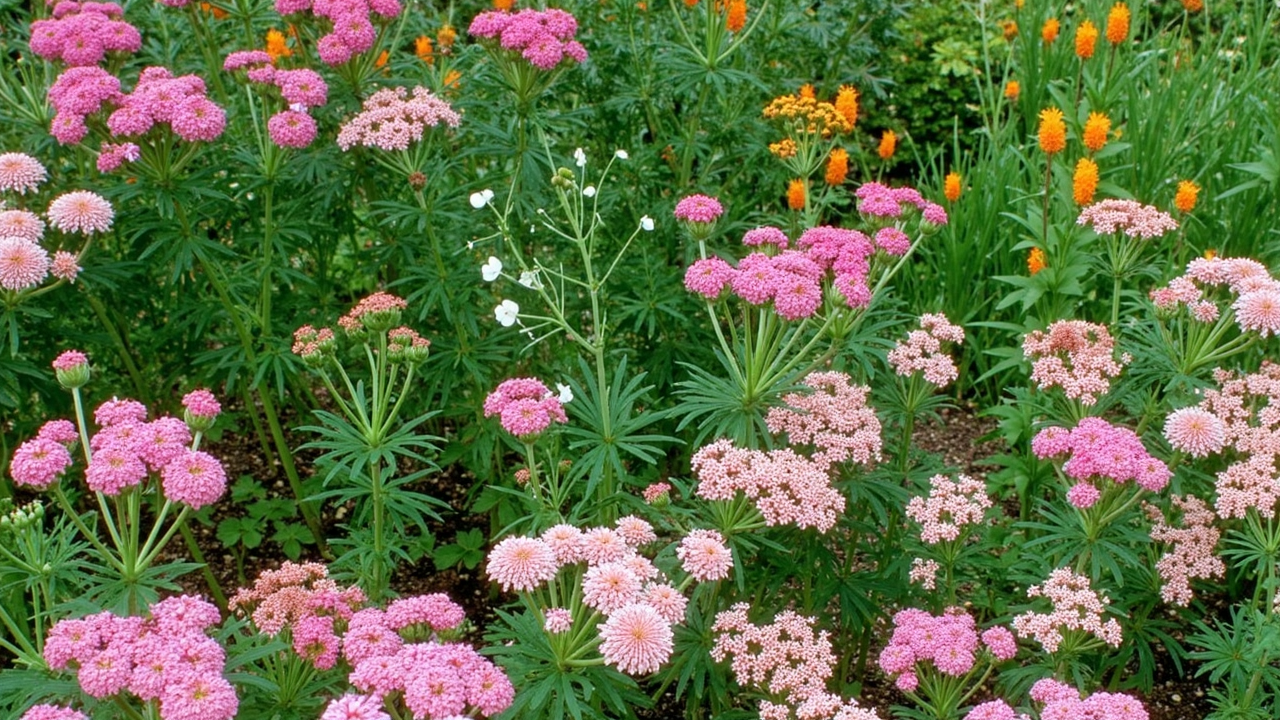
The flowering stems are stiff, upright and slightly ridged, growing 40-80 cm tall depending on soil fertility and cultivar. They branch near the top and carry dense, flat or slightly domed flower heads (technically corymbs) made up of many tiny individual florets. In the wild type these are usually white, sometimes with a faint pink flush as they age. Named cultivars offer a wider range, including soft pink, deep rose, brick red, terracotta, mustard yellow and cream.
The root system is fibrous and rhizomatous, which is why established plants spread steadily to form broad clumps. The stems die back to ground level in late autumn, and a low rosette of overwintering foliage is usually visible at the base of the plant from mid-winter onwards.
Growing Conditions
In the UK, yarrow performs best in full sun and well-drained soil. It is not fussy about pH and grows happily on acidic, neutral and chalky/alkaline ground, including the thin, stony soils typical of south-facing borders and rock gardens. The one condition it really does not tolerate is winter waterlogging, which rots the crown.
Soil fertility is best kept on the low side. Rich, heavily fed ground produces lush, leafy growth that flops in summer and needs staking; lean, drier soil keeps the plant compact, the stems sturdier, and the flower colour more intense. This is the opposite of most border perennials, and worth remembering when siting a new plant.
Yarrow is fully hardy throughout the UK, including upland and exposed northern sites. Established clumps shrug off frost, wind and prolonged drought. It is also notably salt-tolerant, which makes it a good choice for coastal gardens where many herbaceous perennials struggle. The species is generally considered a RHS hardy perennial (commonly classed in the H7 hardiness range, meaning hardy to below -20°C), though specific cultivar ratings should be confirmed at the point of sale; this article does not list an RHS Award of Garden Merit (AGM) for the species, and readers seeking an AGM-recognised form should check the current RHS plant finder listings.
In pollinator terms, yarrow is among the most useful of garden perennials. The flat corymbs provide an easy landing platform for bees, hoverflies, lacewings and butterflies, and the plant flowers during the midsummer "June gap" when many other nectar sources have finished.
Planting and Care
When to plant. Container-grown yarrow can be planted at any time the ground is workable, but spring (March-May) and early autumn (September-October) give the best establishment. Avoid planting into cold, wet winter soil.
Where to plant. Choose the sunniest, best-drained spot available. In heavier clay, plant on a slight mound or incorporate sharp grit and well-rotted organic matter into the planting hole to improve drainage. Space plants 40-50 cm apart to allow for spread.
Watering. Yarrow is drought-tolerant once established. Water newly planted specimens regularly through their first growing season; thereafter, supplementary watering is rarely needed except in prolonged dry spells on very free-draining soil. Over-watering is a more common cause of failure than under-watering.
Feeding. Little or no feeding is required. On very poor soils a light top-dressing of well-rotted compost in spring is sufficient. Avoid high-nitrogen fertilisers, which encourage floppy growth.
Pruning and deadheading. Cut back the faded flower stems to the basal rosette in late summer to encourage a smaller second flush in many cultivars and to keep the clump tidy. Leave a few seed heads over winter as food for birds and as cover for beneficial insects, then cut the plant hard back to ground level in late February or early March before the new growth pushes up.
Propagation. Yarrow is easily propagated by division in spring or autumn — lift established clumps, split them with two forks back-to-back, and replant the outer, vigorous sections. Basal cuttings taken in spring from the new growth will root readily in a gritty compost. The species also self-seeds freely; if you want to keep a particular cultivar true, deadhead before the seed ripens or remove unwanted seedlings in spring. Seed-raised plants will not come true to the parent colour.
Seasonal care. In UK conditions yarrow is essentially a "plant and leave" perennial. A handful of tasks — spring division every 3-4 years to keep clumps vigorous, summer deadheading, an autumn tidy — covers the whole annual cycle. Mulching is not normally needed and can in fact retain too much moisture around the crown.
Common Problems
Yarrow is unusually trouble-free, but the following issues are worth knowing about.
Powdery mildew. The most common complaint, especially in dry summers or on plants grown in slightly shaded, dry positions. A white, powdery coating appears on the leaves, usually in mid- to late summer. It is largely cosmetic — the plant survives — but severe infections weaken the clump. Improve air circulation by dividing congested plants, avoid overhead watering, and water at the base if mildew is a recurring problem.
Aphids. Greenfly and blackfly occasionally colonise the new spring growth. On a healthy, established plant natural predators (hoverflies, lacewings, ladybirds) usually bring them under control within a couple of weeks. A strong jet of water or, in severe cases, a soft soap spray will deal with heavy infestations.
Flopping. Tall cultivars grown on rich or shaded ground tend to collapse in midsummer rain. The cure is cultural: choose shorter cultivars for richer sites, plant in full sun, and avoid over-feeding. The Chelsea chop (cutting stems back by about a third in late May) also produces shorter, stockier plants that need less support.
Crown rot. Caused by waterlogged soil, especially over winter. The plant wilts, the crown turns brown and soft, and the clump dies. There is no cure; lift and destroy affected plants, improve drainage, and replace with healthy stock.
Spreading beyond its allotted space. Yarrow's rhizomatous roots can colonise neighbouring plants, particularly on lighter soils. Edging or dividing every few years keeps it in check. In lawn or meadow settings this is a feature rather than a fault.
Toxicity. Yarrow is generally considered non-toxic to humans, but the foliage can occasionally cause contact dermatitis in sensitive individuals. It is cited by some sources as mildly toxic to cats, dogs and horses if eaten in quantity, though such reports are uncommon; pet owners with grazing animals should consult a vet if concerned. GardenWizz has not independently verified every safety claim and readers should treat this section as a starting point rather than a definitive safety reference.
Popular Varieties
The wild A. millefolium is a handsome plant in its own right, but the named cultivars below are the forms most commonly offered by UK nurseries. Colours can vary slightly with soil and light, and the descriptions below reflect typical performance in UK gardens.
- 'Cerise Queen' — bright, deep pink flower heads fading to soft pink as they age, on stems to around 60-80 cm. A vigorous, long-flowering cultivar that has been widely grown in the UK for decades.
- 'Red Velvet' — one of the best dark reds, with rich, non-fading crimson-coral flower heads over feathery green-grey foliage. To about 60-70 cm. Holds its colour well in full sun and tolerates drier soils.
- 'Terracotta' — as the name suggests, warm terracotta-orange flower heads that age to soft yellow. A classic partner for blue-flowered perennials such as Perovskia and Catananche. To about 70-80 cm.
- 'Moonshine' — strictly this is a hybrid (Achillea 'Moonshine', A. clypeolata × A. millefolium 'Taygetea'), but it is so widely grown alongside A. millefolium cultivars that it is worth mentioning: flat sulphur-yellow flower heads over silvery, finely cut foliage, to around 60 cm. Excellent for hot, dry borders.
- 'Lilac Beauty' — soft lilac-pink flowers on strong stems to about 70 cm, useful for cooler planting schemes.
- 'White Queen' — large, clean white flower heads on stems to 80 cm, a good alternative to the species for a more formal border.
- 'Apfelblüte' (Apple Blossom) — pale pink flower heads fading to near-white, compact habit to around 50-60 cm.
Readers should note that cultivar availability in UK nurseries changes from year to year, and the colour descriptions above are typical rather than guaranteed; a plant purchased as 'Red Velvet' should be deep coral-red, but shade variation between nurseries is normal.
---
Pests and Diseases
| Problem | Symptoms | Management |
|---|---|---|
| Powdery mildew | A white, dusty fungal growth appears on leaves and stems, often causing foliage to yellow or distort. | Improve air circulation by thinning crowded plants and water at the base to keep foliage dry. |
| Aphids | Small green or black insects cluster on new growth and flower buds, often leaving sticky honeydew. | Squash infestations by hand or spray with a strong jet of water; introduce ladybirds for biological control. |
| Slugs and snails | Irregular holes are eaten in young leaves and flower heads, accompanied by silky trails and slime. | Use beer traps, copper tape barriers, or iron phosphate-based pellets to deter feeding. |
| Root rot | Foliage wilts and turns yellow despite moist soil, often due to waterlogged conditions in heavy clay. | Ensure well-drained soil and avoid overwatering; lift and divide congested clumps in spring. |
| Rust | Orange or brown pustules develop on the undersides of leaves, potentially causing premature leaf drop. | Remove affected leaves immediately and avoid overhead watering to reduce humidity around the plant. |
Quick Care Summary
| Sunlight | Full sun, Partial shade |
|---|---|
| Soil | Moist but well-drained; Well-drained; Acid, Alkaline, Neutral; free-draining soil |
| Hardiness | H7 (-20.0 °C) |
| Sow | March–May |
| Plant | March–May |
| Prune | March–November |



As an Amazon Associate, GardenWizz earns from qualifying purchases made through the links above. This does not affect the price you pay. See our disclaimer for details.