Snapdragon
Antirrhinum majus · great snapdragon · lion's-mouth · rabbit's mouth
At a Glance
| Botanical name | Antirrhinum majus |
|---|---|
| Common name(s) | snapdragon, great snapdragon, lion's-mouth, rabbit's mouth |
| Family | Plantaginaceae |
| Plant type | perennial (Often cultivated as an annual plant in colder areas where it may not survive the winter.) |
| Height × Spread | 50–200 cm × — |
| Hardiness | — |
| Position | Full sun, Partial shade |
| Soil | — |
| Flowering | April–September |
| Toxicity | — |
| Native range | south-central France and the eastern Pyrenees to north-eastern Spain and the Balearic Islands |
Overview
Antirrhinum majus, commonly known as the common snapdragon or simply snapdragon in horticulture, is a species of flowering plant in the genus Antirrhinum. It belongs to the family Plantaginaceae. The common name derives from the flower's reaction to pressure on its throat, causing the "mouth" to snap open like a dragon's. Widely cultivated as an ornamental plant in borders and for cut flowers, it is a perennial but is typically grown as an annual. The species has been in cultivation since the 15th century.
Botanical Description
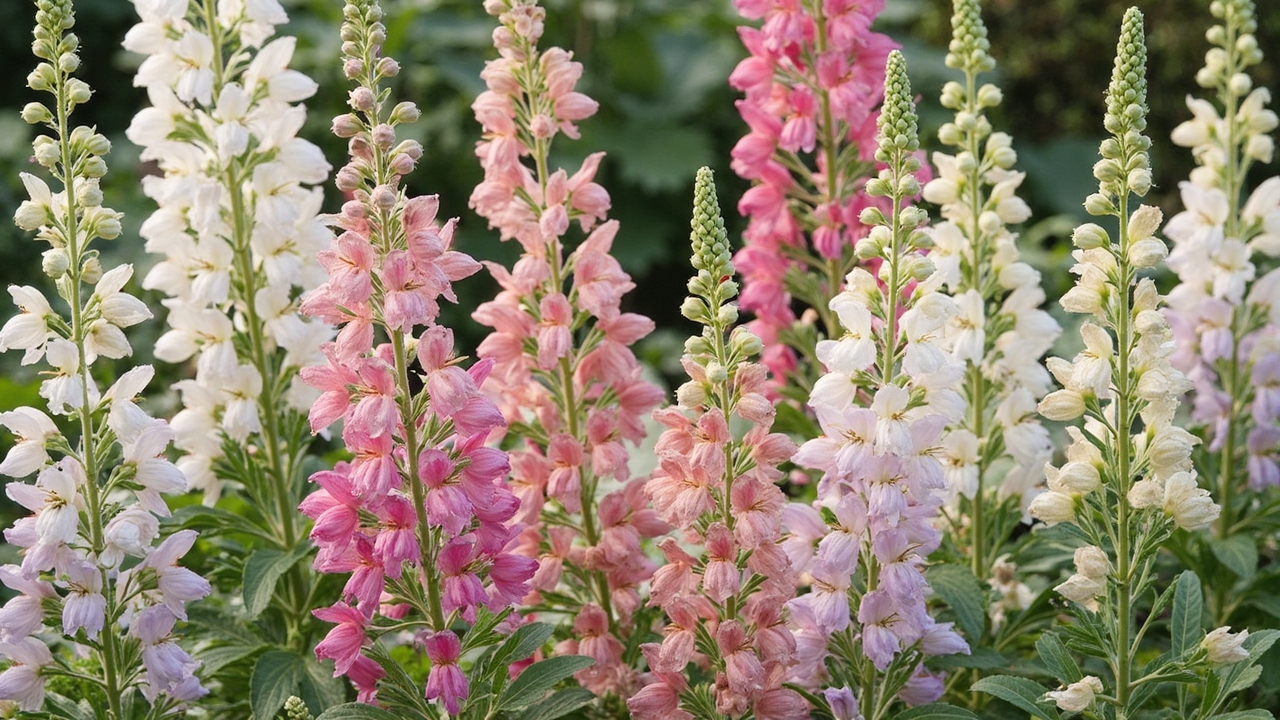
This herbaceous perennial grows to a height of 0.5–1 m, rarely up to 2 m. Its leaves are spirally arranged, broadly lanceolate, measuring 1–7 cm in length and 2–2.5 cm in breadth. The flowers are produced on a tall spike, each 3.5–4.5 cm long, zygomorphic, with two 'lips' closing the corolla tube. Wild plants typically have pink to purple flowers with yellow lips, while cultivated varieties display a range of colours including red, pink, orange, yellow, and white. The inflorescence bears 8 to 30 short-stalked flowers, with a glandular-hairy axis. The fruit is an ovoid capsule, 10–14 mm in diameter, shaped like a skull, containing numerous small seeds.
Origin and Habitat
Native to south-central France and the eastern Pyrenees to north-eastern Spain and the Balearic Islands, Antirrhinum majus often grows in crevices and walls. It is now found cultivated or naturalised on every continent except Antarctica.
Cultivation
Antirrhinum majus tolerates some frost and thrives best at temperatures of 17–25 °C (63–77 °F), with nighttime temperatures around 15–17 °C (59–63 °F) promoting growth. It can be grown from seed, flowering within 3 to 4 months, or from cuttings. Though perennial, it is commonly cultivated as a biennial or annual, particularly in colder regions where winter survival is unlikely. Naturalised populations occur widely in Europe north of its native range and in temperate regions globally.
Care and Maintenance
The plant requires full sun or partial shade. It is often grown as an annual in cooler climates. Cultivars with various flower colours, including lavender, orange, pink, yellow, and white, are available, alongside peloric forms featuring a single large symmetrical flower. The cultivars 'Floral Showers Deep Bronze' and 'Montego Pink' have received the Royal Horticultural Society's Award of Garden Merit.
Uses
Primarily used as an ornamental plant in garden borders and for cut flowers, Antirrhinum majus has historical common names including great snapdragon, lion's-mouth, rabbit's mouth, bonny rabbits, calf-snout, toad's mouth, bulldogs, and lion's-snap.
#Snapdragon #AntirrhinumMajus #UKGardening #OrnamentalPlants #GardenWizz #PerennialPlants #FlowerGardens #Horticulture #GardenDesign #PlantCare
Cultivars and Varieties
| Cultivar | Height | Flower | Notes | AGM |
|---|---|---|---|---|
| 'Floral Showers Deep Bronze' | — | — | Gained the Royal Horticultural Society's Award of Garden Merit. | |
| 'Montego Pink' | — | — | Gained the Royal Horticultural Society's Award of Garden Merit. |
Pests and Diseases
| Problem | Symptoms | Management |
|---|---|---|
| Aphids | Target and consume terminal growth and underside of leaves, causing a darkened or spotted appearance on the leaves. | — |
| Frankliniella occidentalis | Causes small lesions in shoots and flower buds, removes pollen from anther. | Managed with predatory mite Neoseiulus. |
| Anthracnose | Targets leaves and stem causing yellow with a brownish border to the infected spot. | Destroy infected plants and space existing ones farther apart. |
| Botrytis | Causes wilting of flower spikes, light browning of stem below cluster of flowers, quick localized drying and browning in flower, leaves, and shoots. | Cut off infected stock and clear surrounding area. |
| Pythium | Causes wilting if plant is receiving adequate water. | — |
| Rust | Light-green circles on stem or underside of leaves that turn brown and form pustules, causes premature blooming, smaller flowers, and earlier decomposition. | — |
| Stem rot | Cottony growth on stem near soil, suggests destroying infected plant. | — |
Quick Care Summary
| Sunlight | Full sun, Partial shade |
|---|---|
| Soil | — |
| Hardiness | — |
| Sow | January, October, November, December |
| Plant | February–December |
| Prune | — |
Facts sourced from Wikipedia / Antirrhinum majus (https://en.wikipedia.org/wiki/Antirrhinum_majus)
As an Amazon Associate, GardenWizz earns from qualifying purchases made through the links above. This does not affect the price you pay. See our disclaimer for details.