Tarragon
Artemisia dracunculus · estragon · French tarragon · Russian tarragon
At a Glance
| Botanical name | Artemisia dracunculus |
|---|---|
| Common name(s) | tarragon, estragon, French tarragon, Russian tarragon |
| Family | Asteraceae |
| Plant type | perennial |
| Height × Spread | 120–150 cm × — |
| Hardiness | — |
| Position | Full sun |
| Soil | — |
| Flowering | June |
| Toxicity | estragole (carcinogen and teratogen in mice) |
| Native range | widespread in the wild across much of Eurasia and North America |
Overview
Tarragon (Artemisia dracunculus), also known as estragon, is a perennial herb in the family Asteraceae. It is widespread in the wild across much of Eurasia and North America and is cultivated for culinary and medicinal purposes. One subspecies, Artemisia dracunculus var. sativa, is cultivated for its aromatic leaves as a culinary herb. Informal names distinguish variations, including 'French tarragon' (best for culinary use) and 'Russian tarragon'.
Botanical Description
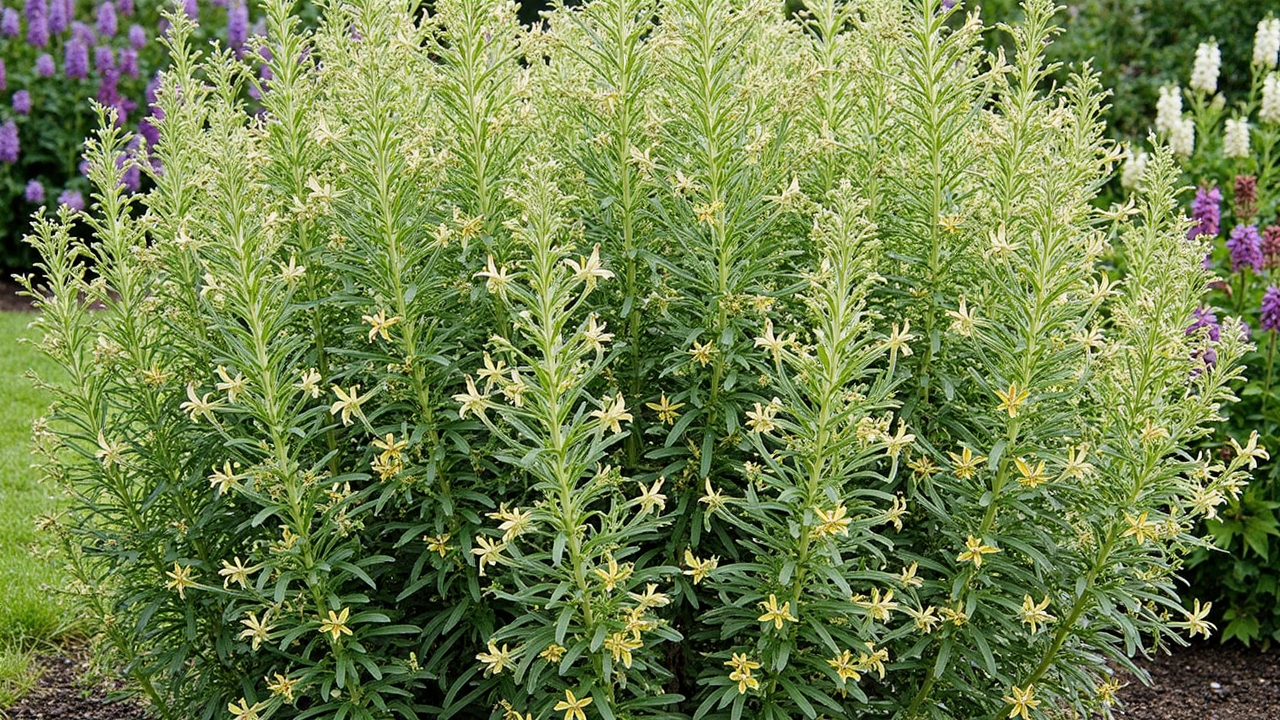
Tarragon grows to 120–150 centimetres (4–5 feet) tall, with slender branches. The leaves are lanceolate, 2–8 cm (1–3 in) long and 2–10 mm (1⁄8–3⁄8 in) broad, glossy green with an entire margin. Flowers are produced in small capitula 2–4 mm (1⁄16–3⁄16 in) diameter, each containing up to 40 yellow or greenish-yellow florets. French tarragon seldom produces flowers or seeds. Some tarragon plants produce sterile seeds, while others produce viable seeds. The plant has rhizomatous roots that enable spreading and reproduction.
Origin and Habitat
Tarragon is widespread in the wild across much of Eurasia and North America. It is cultivated for culinary and medicinal purposes in various regions.
Cultivation
French tarragon (Artemisia dracunculus var. sativa) is propagated by root division, as its flowers are sterile and it is not grown from seed. Russian tarragon (A. dracunculoides L.) can be grown from seed but is less aromatic than French tarragon. It is hardier and more vigorous, spreading at the roots and growing over a metre tall. Russian tarragon prefers poor soils, tolerates drought and neglect, and produces many leaves from early spring. It is recommended to grow Russian tarragon indoors from seed and plant in summer. Mexican tarragon (Tagetes lucida) is a better culinary substitute for French tarragon but cannot be grown as a perennial in cold climates.
Care and Maintenance
Prune after flowering. Russian tarragon spreads readily via rhizomes and can be divided easily. French tarragon requires root division for propagation due to sterile flowers.
Uses
Tarragon is one of the four fines herbes of French cooking, particularly suitable for chicken, fish, and egg dishes. It is the main flavouring component of Béarnaise sauce and used to make tarragon vinegar. Fresh tarragon is used in Syrian cheese dishes, shish barak, and kibbeh labaniyeh. In Iran and Armenia, it is used in sabzi khordan/kanachi (fresh herbs), stews, and pickles such as khiar shoor. It is also an ingredient in chakapuli, a Georgian dish, and the Armenian/Russian soft drink Tarkhuna. Russian tarragon is sometimes used in crafts and for young spring stems cooked as an asparagus substitute, though it is widely considered unsuitable for culinary use due to diminishing flavour.
Cultivars and Varieties
| Cultivar | Height | Flower | Notes | AGM |
|---|---|---|---|---|
| 'French tarragon' | — | — | not grown from seed, propagated by root division | |
| 'Mexican tarragon' | — | — | much more reminiscent of French tarragon, with a hint of anise, much more robust flavor than Russian tarragon that does not diminish significantly with age, cannot be grown as a perennial in cold climates | |
| 'Russian tarragon' | — | — | can be grown from seed, much weaker in flavor compared to French variety, more hardy and vigorous, spreads at the roots, grows over a meter tall, prefers poor soils, tolerates drought and neglect, loses flavor as it ages |
Pests and Diseases
| Problem | Symptoms | Management |
|---|---|---|
| sterile flowers | — | — |
| loss of flavor as it ages | — | — |
Quick Care Summary
| Sunlight | Full sun |
|---|---|
| Soil | — |
| Hardiness | — |
| Sow | April–September |
| Plant | April–September |
| Prune | — |
Facts sourced from Wikipedia / Artemisia dracunculus (https://en.wikipedia.org/wiki/Artemisia_dracunculus)