Beetroot
Beta vulgaris · beet
At a Glance
| Botanical name | Beta vulgaris |
|---|---|
| Common name(s) | beet |
| Family | Amaranthaceae |
| Plant type | perennial (rarely, biennial) |
| Height × Spread | 120–200 cm × — |
| Hardiness | — |
| Position | Full sun |
| Soil | pH-neutral to slightly alkaline soils containing plant nutrients and additionally sodium and boron |
| Flowering | — |
| Toxicity | — |
| Native range | southwestern, northern and Southeast Europe along the Atlantic coasts and the Mediterranean Sea, in North Africa, Macaronesia, to Western Asia |
Overview
Beta vulgaris is a species of flowering plant in the subfamily Betoideae of the family Amaranthaceae. It is a perennial plant, though cultivated forms are mostly biennial. Three subspecies are recognised, with the wild ancestor being sea beet (Beta vulgaris subsp. maritima). Cultivated beets belong to subsp. vulgaris and include several distinct cultivar groups: sugar beet, beetroot (garden beet), chard (spinach beet or silverbeet), and mangelwurzel.
Botanical Description
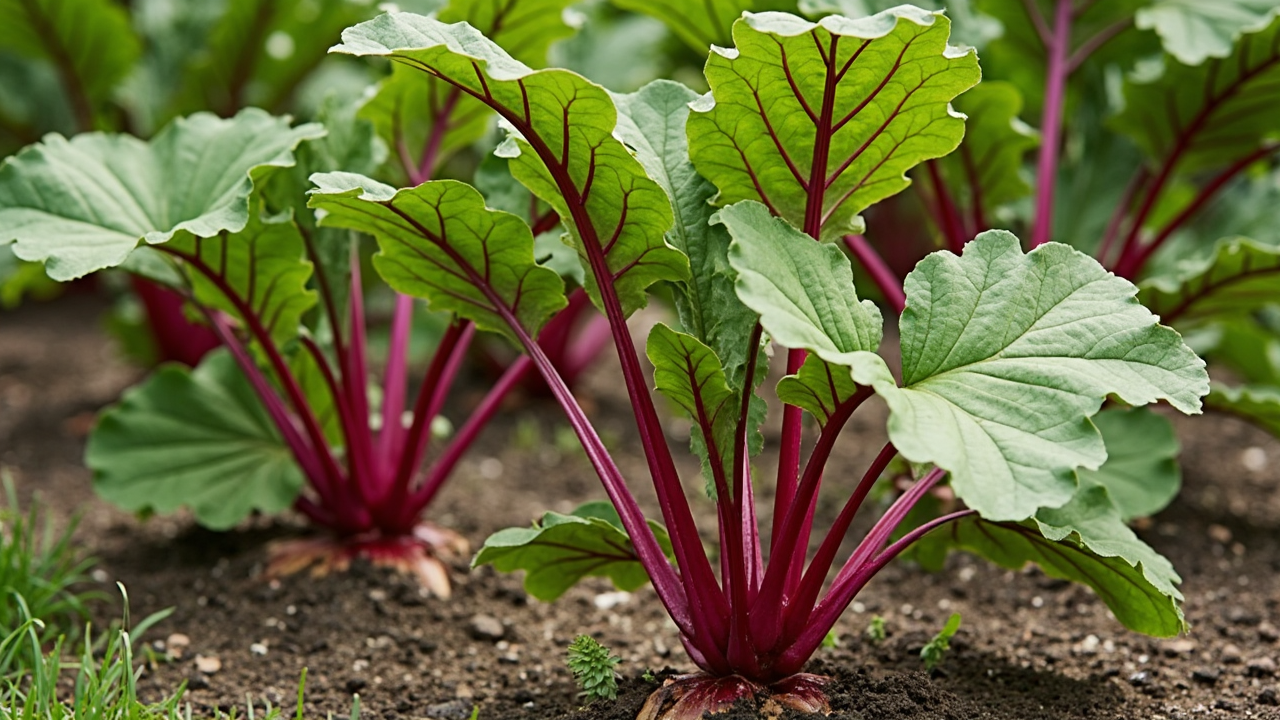
Beta vulgaris is a herbaceous plant up to 120 centimetres (4 ft) tall, rarely reaching 200 cm. Wild forms have brown, fibrous, sometimes swollen, woody roots, while cultivated forms have dark red, white, or yellow, moderately to strongly swollen and fleshy roots. Stems are erect or procumbent in wild forms, ribbed and striate. Basal leaves have long petioles (sometimes thickened and coloured) and oblanceolate to heart-shaped, dark green to dark red blades, 5–20 cm long on wild plants (larger in cultivated forms). Upper leaves are smaller, rhombic to narrowly lanceolate. Flowers are small, urn-shaped, green or reddish, produced in dense spike-like inflorescences. Fruits are lenticular seeds enclosed by a leathery perianth, with a red-brown seed coat. The plant is diploid (2n = 18 chromosomes).
Origin and Habitat
Wild forms of Beta vulgaris are distributed along the Atlantic coasts and Mediterranean Sea in southwestern, northern and Southeast Europe, North Africa, Macaronesia, and Western Asia. They grow naturally on coastal cliffs, stony and sandy beaches, salt marshes, coastal grasslands, and in disturbed habitats. Cultivated beets are grown worldwide in frost-free regions, preferring relatively cool temperatures between 15 and 19 °C.
Cultivation
Beets are cultivated for multiple purposes: as a fodder crop (mangelwurzel), for sugar production (sugar beet), as a leaf vegetable (chard), or as a root vegetable (beetroot). They tolerate salty soils and drought due to their coastal ancestry. Cultivation requires pH-neutral to slightly alkaline soils containing plant nutrients, sodium, and boron. Sugar beet is the most important crop within the order Caryophyllales.
Care and Maintenance
- Plant in full sun.
- Maintain soil pH between neutral and slightly alkaline.
- Ensure adequate boron levels; commercial crops require 600 grams of elemental boron per hectare for optimal growth.
- Harvest roots when mature; leaf varieties can be harvested continuously.
- Avoid boron deficiency, which causes meristem and shoot decline, leading to heart rot.
Uses
Culinary uses include consumption of beetroot roots (baked, boiled, steamed, pickled), chard leaves and midribs (cooked or stir-fried), and spinach beet leaves as pot herbs. Beetroot is a key ingredient in Eastern European dishes like borscht. Nutritionally, 100g of beetroot provides 43 calories, 88% water, 10% carbohydrates, 2% protein, and significant folate (27% DV) and manganese (16% DV). Betalain pigments (betanin, isobetanin, etc.) give red/purple colour, distinct from anthocyanins. Some individuals experience beeturia (red urine) due to betacyanin. Traditionally, beetroot is eaten on Rosh Hashana in Jewish culture. The plant serves as a food source for Lepidoptera larvae.
#UKGardening #GardenWizz #Beetroot #BetaVulgaris #VegetableGardening #EdiblePlants #BotanicalReference #GardenCare #PlantTaxonomy #CulinaryBotany
Cultivars and Varieties
| Cultivar | Height | Flower | Notes | AGM |
|---|---|---|---|---|
| 'Altissima Group' | — | — | sugar beet | |
| 'Cicla Group' | — | — | spinach beet or chard | |
| 'Conditiva Group' | — | — | beetroot or garden beet | |
| 'Crassa Group' | — | — | mangelwurzel | |
| 'Flavescens Group' | — | — | swiss chard |
Pests and Diseases
| Problem | Symptoms | Management |
|---|---|---|
| lack of boron | meristem and the shoot to languish, eventually leading to heart rot | — |
Quick Care Summary
| Sunlight | Full sun |
|---|---|
| Soil | pH-neutral to slightly alkaline soils containing plant nutrients and additionally sodium and boron |
| Hardiness | — |
| Sow | March–May |
| Plant | March–May |
| Prune | — |
Facts sourced from Wikipedia / Beta vulgaris (https://en.wikipedia.org/wiki/Beta_vulgaris)
As an Amazon Associate, GardenWizz earns from qualifying purchases made through the links above. This does not affect the price you pay. See our disclaimer for details.