
Buddleia
Buddleja davidii · butterfly-bush · orange eye · summer lilac
At a Glance
| Botanical name | Buddleja davidii |
|---|---|
| Common name(s) | butterfly-bush, orange eye, summer lilac |
| Family | Scrophulariaceae |
| Plant type | shrub |
| Height × Spread | 500–1600 cm × — |
| Hardiness | — (to -20.0 °C) |
| Position | Full sun |
| Soil | — |
| Flowering | May–September |
| Toxicity | — |
| Native range | most of China except for the far northeast |
Overview
Buddleja davidii, commonly known as butterfly-bush, orange eye, or summer lilac, is a species of flowering plant in the family Scrophulariaceae. It is a vigorous shrub widely cultivated as an ornamental plant, with numerous named cultivars. The genus was named after Reverend Adam Buddle, an English botanist, and the species name davidii honours the French missionary and explorer Father Armand David, who was the first European to report the shrub. The species was introduced to European horticulture in the 1890s following collections by botanists in China. It received the RHS Award of Merit in 1898 and the Award of Garden Merit in 1941.
Botanical Description
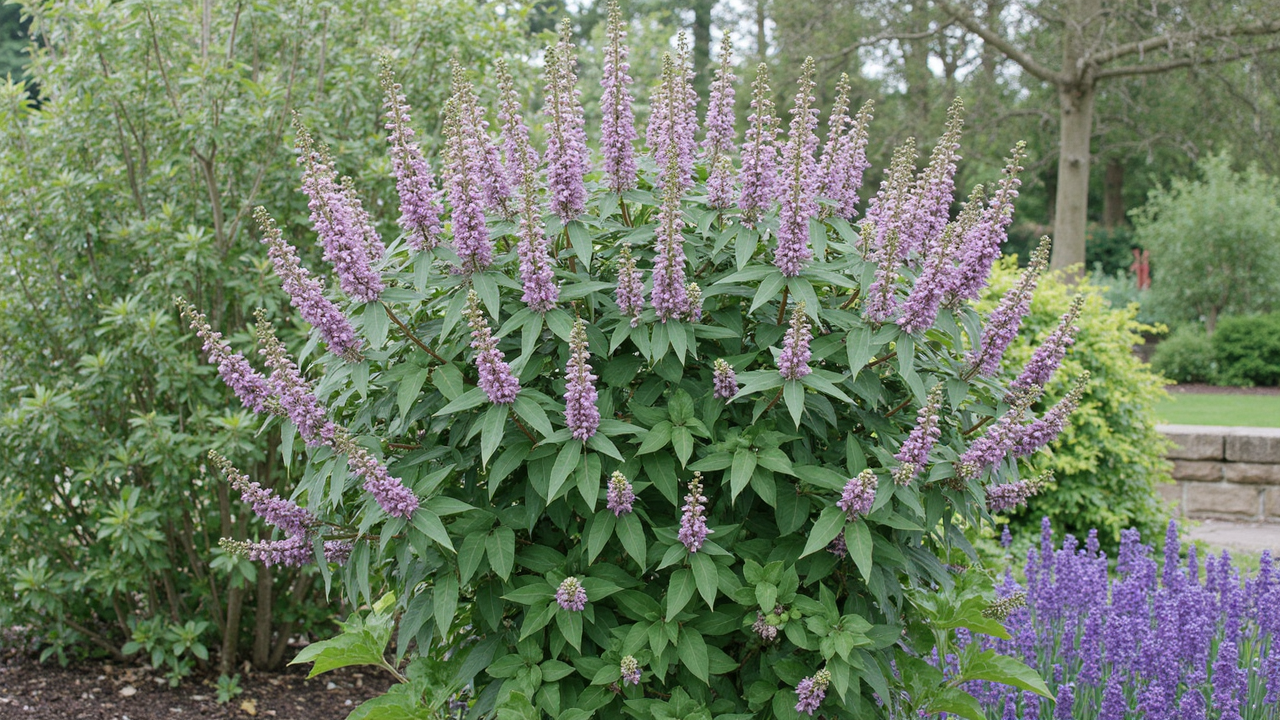
Buddleja davidii is a vigorous shrub with an arching habit, growing to a height of 5 m (16 ft). The bark is pale grey-brown, becoming flaky and deeply fissured with age. Younger branches are quadrangular in section, covered in dense indumentum. The opposite, lanceolate leaves measure 7–20 cm long and 2–7 cm broad, grey-green to dark green above, and greyish-white tomentose beneath when young, becoming grey-green with age. Flowers are honey-scented, lilac to purple or occasionally white, produced in terminal panicles typically under 20 cm long but sometimes exceeding 30 cm. The flowers are hermaphrodite (perfect), with ploidy 2n = 76 (tetraploid). Seeds are very small and wind-dispersed.
Origin and Habitat
Native to most of China except for the far northeast, Buddleja davidii is naturally found in temperate regions of the country. It has been naturalised in Australia, central and southern Europe, and is designated as an invasive species in the United Kingdom, Republic of Ireland, New Zealand, and parts of the United States.
Cultivation
Buddleja davidii cultivars are widely cultivated worldwide as ornamental shrubs, valued for their flowers as a nectar source for butterflies. The species and its cultivars are not hardy in northern or montane climates, being killed by temperatures below −15 to −20 °C (5 to −4 °F). Hardiness is rated USDA zones 5–9. Cultivars include approximately 180 named varieties, with some exhibiting dwarf habits (growing to no more than 1.5 m). Notable cultivars include 'Golden Glow', 'Silver Frost', 'Lo & Behold' series, and 'Flutterby' series.
Care and Maintenance
Prune after flowering to encourage new growth, as younger wood is more floriferous. Hard-pruning in spring after the last frost is recommended to promote flowering. Removal of spent flower panicles reduces self-seeding and encourages further flowering, extending the season beyond the typical six-week period. Flowers of subsequent flushes are smaller. To prevent seeding and promote further flowering, spent blossoms should be deadheaded as soon as they are spent. Non-invasive cultivars (e.g., 'Lo & Behold' series, 'Flutterby' series) produce little to no viable seed.
Uses
Buddleja davidii is primarily used as an ornamental plant in gardens for its showy flowers and value as a nectar source for butterflies. However, it does not provide food for butterfly larvae, and its invasive potential in natural habitats has led to controversy. It is naturalised along railway lines, on urban derelict sites, and in gardens in several countries. Non-invasive cultivars are promoted to mitigate ecological concerns while maintaining ornamental value.
#BuddlejaDavidii #ButterflyBush #UKGardening #InvasiveSpecies #OrnamentalShrubs #RHS #GardenCare #PollinatorFriendly #Buddleja #GardenWizz
Cultivars and Varieties
| Cultivar | Height | Flower | Notes | AGM |
|---|---|---|---|---|
| 'Blue Chip' | — | — | — | |
| 'Pink Delight' | — | — | — |
Pests and Diseases
| Problem | Symptoms | Management |
|---|---|---|
| invasive species | spreads on open land, railway lines, urban areas and in gardens | deadheading blossoms to prevent seeding |
Quick Care Summary
| Sunlight | Full sun |
|---|---|
| Soil | — |
| Hardiness | — (-20.0 °C) |
| Sow | March–April |
| Plant | March–April |
| Prune | January |
Facts sourced from Wikipedia / Buddleja davidii (https://en.wikipedia.org/wiki/Buddleja_davidii)
As an Amazon Associate, GardenWizz earns from qualifying purchases made through the links above. This does not affect the price you pay. See our disclaimer for details.