Camellia
Camellia japonica · common camellia · Japanese camellia
At a Glance
| Botanical name | Camellia japonica |
|---|---|
| Common name(s) | common camellia, Japanese camellia |
| Family | Theaceae |
| Plant type | shrub |
| Height × Spread | 150–600 cm × — |
| Hardiness | — |
| Position | Full sun, Partial shade |
| Soil | — |
| Flowering | January–March |
| Toxicity | — |
| Native range | China and Japan |
Overview
Camellia japonica, commonly known as common camellia or Japanese camellia, is a species of flowering plant in the genus Camellia within the tea family Theaceae. It is a shrub valued primarily as an ornamental garden plant, with thousands of cultivars developed for their flowers. The floriculture of Camellia japonica originated in China, with cultivation documented since the Song Dynasty.
Botanical Description
Camellia japonica is a flowering shrub typically reaching 1.5–6 metres in height, occasionally up to 11 metres. Young branches are purplish brown, ageing to greyish brown. The leaves are alternately arranged, leathery, dark green above and paler beneath, measuring 5–11 centimetres long by 2.5–6 centimetres wide, with a petiole 5–10 millimetres long. Leaf margins are finely toothed (serrulate), and the base is pointed (cuneate). Wild flowers appear between January and March, measuring 6–10 centimetres across, with six or seven rose or white petals. The flowers occur singly or in pairs on short stems, featuring numerous stamens and a three-lobed style. The fruit is a globe-shaped capsule containing one or two brown seeds, 1–2 centimetres in diameter.
Origin and Habitat
Native to China and Japan, Camellia japonica grows naturally in forests at altitudes of 300–1,100 metres (980–3,600 ft). It is indigenous to regions including Shandong, eastern Zhejiang, Taiwan, south Japan, and South Korea. The variety C. japonica var. rusticana occurs in forested areas of China, particularly in regions with heavy snowfall at altitudes from 120–1,100 metres, under deciduous beech trees.
Cultivation
Camellia japonica thrives in partial shade to full sun positions. It is widely cultivated as an ornamental plant in gardens across the world, with historical cultivation in China dating to the Song Dynasty. The plant is grown in temperate regions, including parts of the United States (e.g., South Carolina, Alabama), Australia, and Europe, where it is established in gardens and as a state flower in Alabama.
Care and Maintenance
Prune after flowering to maintain shape and encourage new growth. The plant requires consistent moisture and well-drained, acidic soil. It benefits from protection against strong winds and extreme temperatures.
Uses
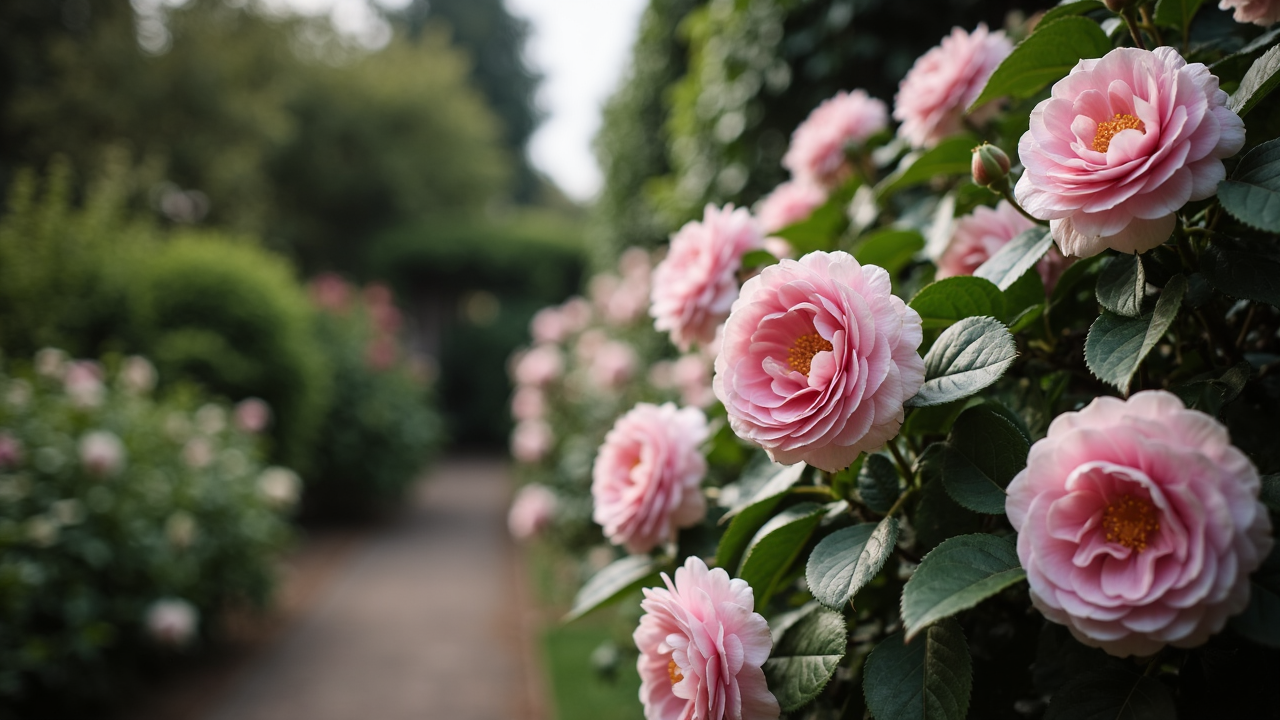
Camellia japonica is primarily cultivated as an ornamental garden plant, valued for its flowers which range in colour from red to pink to white, often with multi-coloured stripes or specks. It serves as a significant resource for flower-feeding insects and is the official state flower of Alabama in the United States. Historically, it has been featured in Chinese art and porcelain since the 11th century.
Cultivars and Varieties
| Cultivar | Height | Flower | Notes | AGM |
|---|---|---|---|---|
| 'Alba Plena' | 76 cm | pure white flowers about 3 to 4 inches across | nicknamed the 'Bourbon Camellia' | |
| 'Elegans' | — | large pink flowers with white streaks | — | |
| 'Giulio Nuccio' | — | red to pinkish petals and yellow stamens | — | |
| 'Mathotiana Alba' | — | pure white flowers | — | |
| 'The Czar' | — | light crimson semi-double-flowered | — |
Quick Care Summary
| Sunlight | Full sun, Partial shade |
|---|---|
| Soil | — |
| Hardiness | — |
| Sow | — |
| Plant | — |
| Prune | — |
Facts sourced from Wikipedia / Camellia japonica (https://en.wikipedia.org/wiki/Camellia_japonica)
As an Amazon Associate, GardenWizz earns from qualifying purchases made through the links above. This does not affect the price you pay. See our disclaimer for details.