Cosmos
Cosmos bipinnatus · garden cosmos · Mexican aster · cosmea
At a Glance
| Botanical name | Cosmos bipinnatus |
|---|---|
| Common name(s) | garden cosmos, Mexican aster, cosmea |
| Family | Asteraceae |
| Plant type | annual (often considered half-hardy, although plants may reappear via self-sowing for several years) |
| Height × Spread | 60–275 cm × — |
| Hardiness | — |
| Position | Full sun |
| Soil | pH between 6.0 and 8.5 |
| Flowering | July–September |
| Toxicity | — |
| Native range | Mexico |
Overview
Cosmos bipinnatus, commonly called the garden cosmos, Mexican aster or cosmea, is a medium-sized flowering herbaceous plant in the daisy family Asteraceae. It is an annual plant, often considered half-hardy in British gardening literature, though it may reappear via self-sowing for several years. The species and its cultivars are widely cultivated as ornamental plants in temperate climate gardens.
Botanical Description
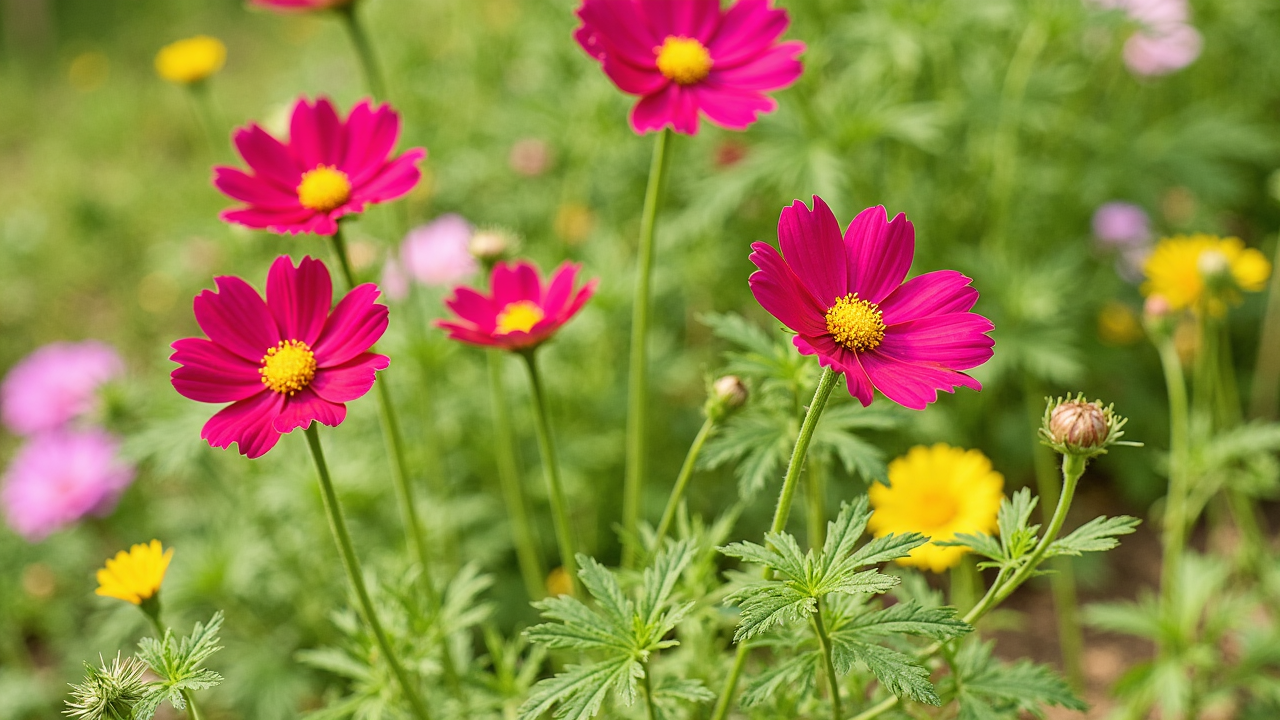
Cosmos bipinnatus varies in height from 60 cm to 2 m, rarely reaching 2.75 m. The stems are branched and typically densely covered with fine, rough trichomes, though some specimens are hairless. The leaves are finely divided into threadlike segments, appearing linear-filiform to narrow linear with a width of 0.5 to 1.7 mm. The inflorescences are cup-shaped, 5–7 cm in diameter, comprising eight ray florets in shades of pink, violet or white, and numerous yellowish tubular disc florets. The ray florets are reversely ovate, 20–35 mm long, with three broad, wavy teeth at the tips. The achenes are spindle-shaped, blackish, smooth or short-bristly, with a distinct rostrum 0.5–1.7 mm long, and inner achenes up to 18 mm long.
Origin and Habitat
Native to Mexico according to Plants of the World Online, Cosmos bipinnatus has naturalized in scattered locations across North America, South America, the West Indies, Italy, Australia, and Asia. It is considered an invasive species in many regions due to its use as an ornamental plant and tendency to escape cultivation, becoming a weed in some habitats.
Cultivation
Cosmos bipinnatus prefers a soil pH between 6.0 and 8.5, reflecting its native alkaline Central American habitat. It requires full sun for optimal flowering, though partial shade is tolerated. Germination occurs within 7–10 days at 24 °C (75 °F), with flowering beginning 60–90 days after germination. The plant is not tolerant of frost and is suited to temperate climates with warm to hot summers. It can mature to 0.61–1.22 m in height with a spread of 300–460 mm.
Care and Maintenance
Prune after flowering to encourage further blooms. The plant is susceptible to breakage in heavy rain due to its delicate stems and may become top-heavy when grown singly; planting in groups alleviates this by allowing bipinnate leaves to interlock and support each other. It does not tolerate drought, strong winds, or cold temperatures well. Common pests include snails, slugs and aphids.
Uses
Cosmos bipinnatus attracts birds and butterflies, including monarch butterflies, making it suitable for pollinator and honey-bee habitat gardens. Certain cultivars, such as 'Versailles', are developed for the cut flower trade due to their compact habit.
Cultivars and Varieties
| Cultivar | Height | Flower | Notes | AGM |
|---|---|---|---|---|
| 'Apollo Carmine' | — | — | agm | |
| 'Apollo Pink' | — | — | agm | |
| 'Apollo White' | — | — | agm | |
| 'Daydream' | — | pink inner ring on a white background | — | |
| 'Double Click Cranberries' | — | — | — | |
| 'Double Click Rose Bonbon' | — | — | — | |
| 'Double Click Snow Puff' | — | — | — | |
| 'Double Click Vari Extra' | — | — | — |
Pests and Diseases
| Problem | Symptoms | Management |
|---|---|---|
| excessive rain | breakage of delicate stems | — |
| cold temperatures | — | — |
| snails and slugs | — | — |
| aphids | — | — |
Quick Care Summary
| Sunlight | Full sun |
|---|---|
| Soil | pH between 6.0 and 8.5 |
| Hardiness | — |
| Sow | March–May |
| Plant | March–May |
| Prune | — |
Facts sourced from Wikipedia / Cosmos bipinnatus (https://en.wikipedia.org/wiki/Cosmos_bipinnatus)
As an Amazon Associate, GardenWizz earns from qualifying purchases made through the links above. This does not affect the price you pay. See our disclaimer for details.