
Courgette
Cucurbita pepo
At a Glance
| Botanical name | Cucurbita pepo |
|---|---|
| Common name(s) | Courgette |
| Family | — |
| Plant type | — |
| Height × Spread | 30–76 cm × 61–91 cm |
| Hardiness | — |
| Position | Full sun |
| Soil | — |
| Flowering | September |
| Toxicity | — |
| Native range | southern Mexico in Oaxaca and Ocampo, Tamaulipas |
Overview
Courgette, commonly known as zucchini in some regions, refers to summer squash varieties within the subspecies Cucurbita pepo subsp. pepo. This cultivated plant is a member of the genus Cucurbita and is widely grown for its edible fruits. It has been domesticated in the Americas for thousands of years and was disseminated globally following the Columbian Exchange. The species is interfertile across all subspecies, varieties, and cultivars.
Botanical Description
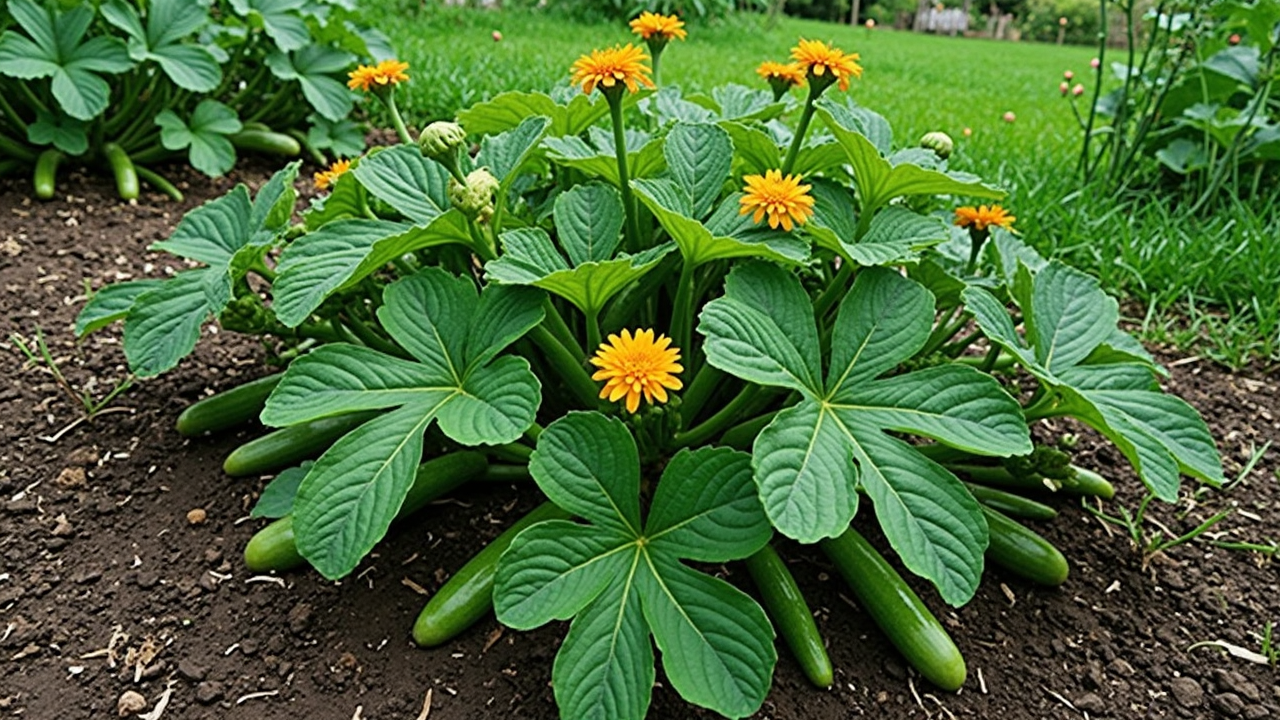
Plants typically reach heights of 30–76 centimetres (1–2+1⁄2 ft) and widths of 61–91 centimetres (2–3 ft). They feature yellow flowers and leaves with three to five lobes, measuring 20–35 centimetres (8–14 in) wide. Fruits vary significantly in shape and colour across cultivars, with domesticated forms exhibiting larger fruits and fewer seeds compared to wild relatives. Parthenocarpy occurs in certain cultivars. The species is host to the melonworm moth, squash vine borer, and pickleworm, while also serving as a primary pollen source for squash bees.
Origin and Habitat
Cucurbita pepo is native to southern Mexico, with the oldest known domestication sites in Oaxaca (8,000–10,000 years ago) and Ocampo, Tamaulipas (approximately 7,000 years ago). It was cultivated across prehistoric North America, extending north into Texas and the Greater Mississippi River Valley as part of the Eastern Agricultural Complex. The species thrives from sea level to elevations slightly above 2,000 metres (6,600 ft), adapting to both arid and moist regions. Wild populations include C. pepo subsp. fraterna in Tamaulipas and Nuevo León, Mexico, and C. pepo subsp. texana in southeastern Texas.
Cultivation
Cucurbita pepo requires full sun for optimal growth. It flowers in September, with fruits typically harvested during the summer months. The plant is suitable for cultivation in temperate UK climates when grown in well-drained soil and protected from frost. Summer squash varieties are typically harvested while young and tender.
Care and Maintenance
Prune after flowering to encourage continued fruit production. Ensure consistent watering during dry periods, particularly when fruits are developing. Mulching helps retain soil moisture and suppress weeds. Monitor for pests such as squash vine borers and melonworms, especially during the growing season.
Uses
The fruits are consumed fresh, often sliced or spiralised. Blossoms are fried as a delicacy. Dried squash is used for winter storage. In Zuni culture, gourds are crafted into cups, ladles, dippers, and storage receptacles. A poultice made from seeds and blossoms treats cactus scratches. Gourds are also used in ceremonial rattles and phallic dances symbolising fructification.
Quick Care Summary
| Sunlight | Full sun |
|---|---|
| Soil | — |
| Hardiness | — |
| Sow | April–October |
| Plant | April–October |
| Prune | — |
Facts sourced from Wikipedia / Cucurbita pepo (https://en.wikipedia.org/wiki/Cucurbita_pepo)
As an Amazon Associate, GardenWizz earns from qualifying purchases made through the links above. This does not affect the price you pay. See our disclaimer for details.