
Foxglove
Digitalis purpurea · common foxglove
At a Glance
| Botanical name | Digitalis purpurea |
|---|---|
| Common name(s) | foxglove, common foxglove |
| Family | Plantaginaceae |
| Plant type | biennial (monocarpic) |
| Height × Spread | 100–240 cm × — |
| Hardiness | — (to -15.0 °C) |
| Position | Partial shade, Full shade |
| Soil | acidic |
| Flowering | June |
| Toxicity | poisonous to humans and some animals |
| Native range | Western Europe and North Africa |
Overview
Digitalis purpurea, commonly known as foxglove or common foxglove, is a toxic species of flowering plant in the plantain family Plantaginaceae. It is a biennial plant that produces a rosette of leaves in its first year, flowers in its second year, and then dies (monocarpic). The plant is widely cultivated as an ornamental and is the original source of the heart medication digoxin. It has naturalised in parts of North America and other temperate regions beyond its native range.
Botanical Description
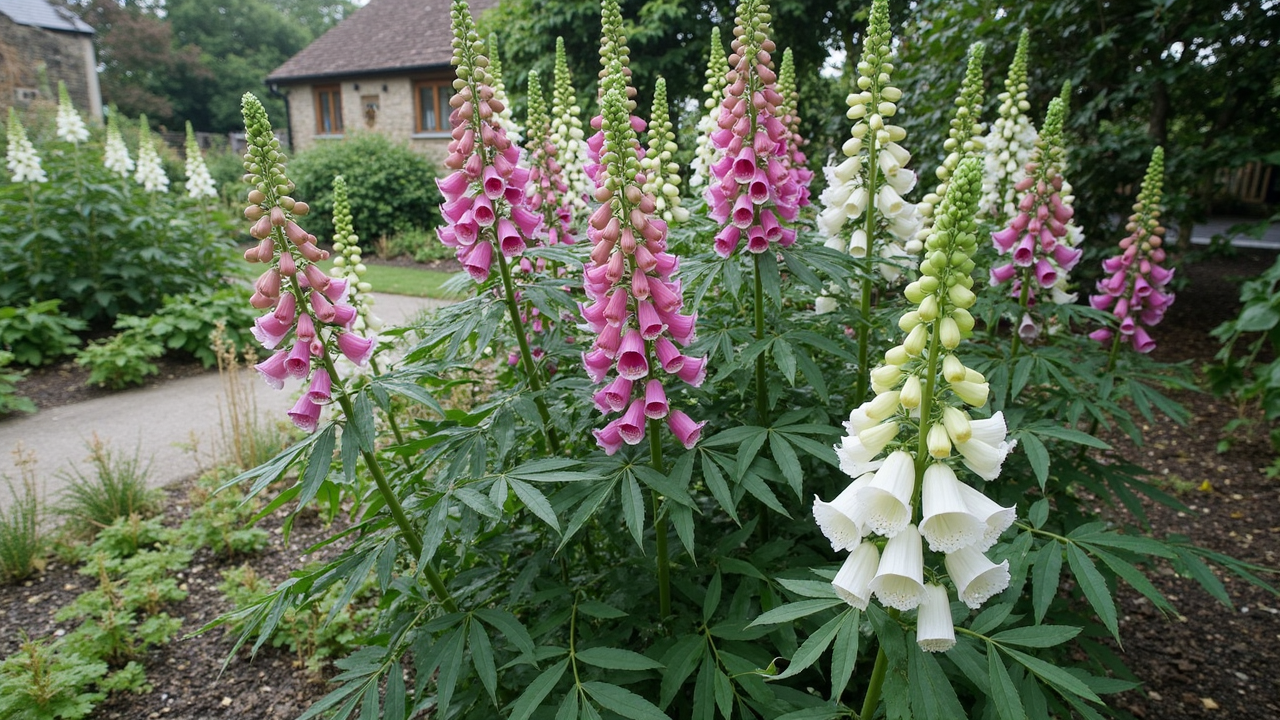
Digitalis purpurea is an herbaceous biennial or short-lived perennial. Its leaves are spirally arranged, simple, 10–35 cm long and 5–12 cm broad, covered with grey-white pubescent and glandular hairs, giving a woolly texture. The foliage forms a tight rosette at ground level in the first year. In the second year, a flowering stem develops, typically 1–2 m tall, bearing a showy terminal cluster of tubular, pendent flowers. Flower colours range from typical purple to pink, rose, yellow, or white in cultivated forms, with the inside of the flower tube heavily spotted. The flowering period occurs in early summer, with some additional flower stems developing later. The fruit is a capsule releasing numerous tiny seeds (0.1–0.2 mm).
Origin and Habitat
Native to Western Europe and North Africa, Digitalis purpurea occurs naturally in Belgium, Czech Republic, France, Germany, Ireland, Norway, Portugal, Spain, Sweden, the United Kingdom, Morocco, Corsica, and Sardinia. It grows in acidic soils within habitats including open woods, woodland clearings, moorland and heath margins, sea-cliffs, rocky mountain slopes, and hedge banks. It readily colonises disturbed sites such as recently cleared woodland, burnt areas, and construction sites, but is absent from deep shade within woodlands due to its requirement for light to germinate.
Cultivation
Digitalis purpurea is a popular ornamental plant valued for its height and colour in late spring and early summer. Cultivated forms often feature flowers surrounding the central spike, differing from the wild form where flowers appear on one side. Numerous cultivars exist with a range of flower colours, including white, pink, and purple, frequently sold as seed mixtures. The plant is hardy to −15 °C (USDA zones 4–9). It is commonly grown from seed or purchased as potted plants in spring.
Care and Maintenance
- Self-seeds readily, ensuring new plants in garden settings.
- Monocarpic, dying after flowering in the second year.
- Prefers acidic soil and partial to full shade.
- Requires humus-rich soil for optimal success but tolerates various mesic soils.
- Prune after flowering to encourage seed production for self-seeding.
Uses
The plant is the original source of digoxin (digitalis), a cardiac glycoside used medicinally for heart failure. Extracted from the leaves, digoxin was historically used to regulate heartbeat, with its clinical application pioneered by William Withering. It is also a nectar source for bees, which use it to make honey. The plant is toxic to humans and animals due to cardiac glycosides (digitoxin and digoxin), causing symptoms including low pulse rate, nausea, vomiting, and cardiac arrest if ingested.
#Foxglove #Digitalis #UKGardening #GardenWizz #BiennialPlants #ToxicPlants #MedicinalPlants #Wildflowers #GardenCare #PlantMedicine
Cultivars and Varieties
| Cultivar | Height | Flower | Notes | AGM |
|---|---|---|---|---|
| 'Excelsior hybrids' | — | white, pink and purple | — |
Pests and Diseases
| Problem | Symptoms | Management |
|---|---|---|
| Digitoxin toxicity | low pulse rate, nausea, vomiting, uncoordinated contractions of different parts of the heart, leading to cardiac arrest and death | — |
Quick Care Summary
| Sunlight | Partial shade, Full shade |
|---|---|
| Soil | acidic |
| Hardiness | — (-15.0 °C) |
| Sow | March–May |
| Plant | March–May |
| Prune | — |
Facts sourced from Wikipedia / Digitalis purpurea (https://en.wikipedia.org/wiki/Digitalis_purpurea)