
Honeysuckle 'Serotina'
Lonicera periclymenum 'Serotina'
The Gardening Year
Best months in UK gardens · full planting calendar →
🖨 Printable care card (PDF)At a Glance
| Botanical name | Lonicera periclymenum 'Serotina' |
|---|---|
| Common name(s) | Honeysuckle 'Serotina' |
| Family | Caprifoliaceae |
| Plant type | climber (Deciduous) |
| Height × Spread | 4–8 m × 100–150 cm |
| Position | Partial shade |
| Soil | fertile, moist but well-drained soil |
| Flowering | June–November |
| Toxicity | Fruit are ornamental - not to be eaten. Wear gloves and other protective equipment when handling. |
| Native range | — |
Overview
Honeysuckle 'Serotina' is a late-flowering cultivar of the native woodbine honeysuckle, Lonicera periclymenum, prized in UK gardens for extending the season of honeysuckle scent well into late summer. It is grown chiefly for its richly coloured, highly fragrant bicolour blooms and its reliable performance against walls, fences and through mature shrubs. The cultivar holds the Royal Horticultural Society's Award of Garden Merit, reflecting its long-standing reputation as one of the best climbing honeysuckles for British conditions.
Distinctive Features
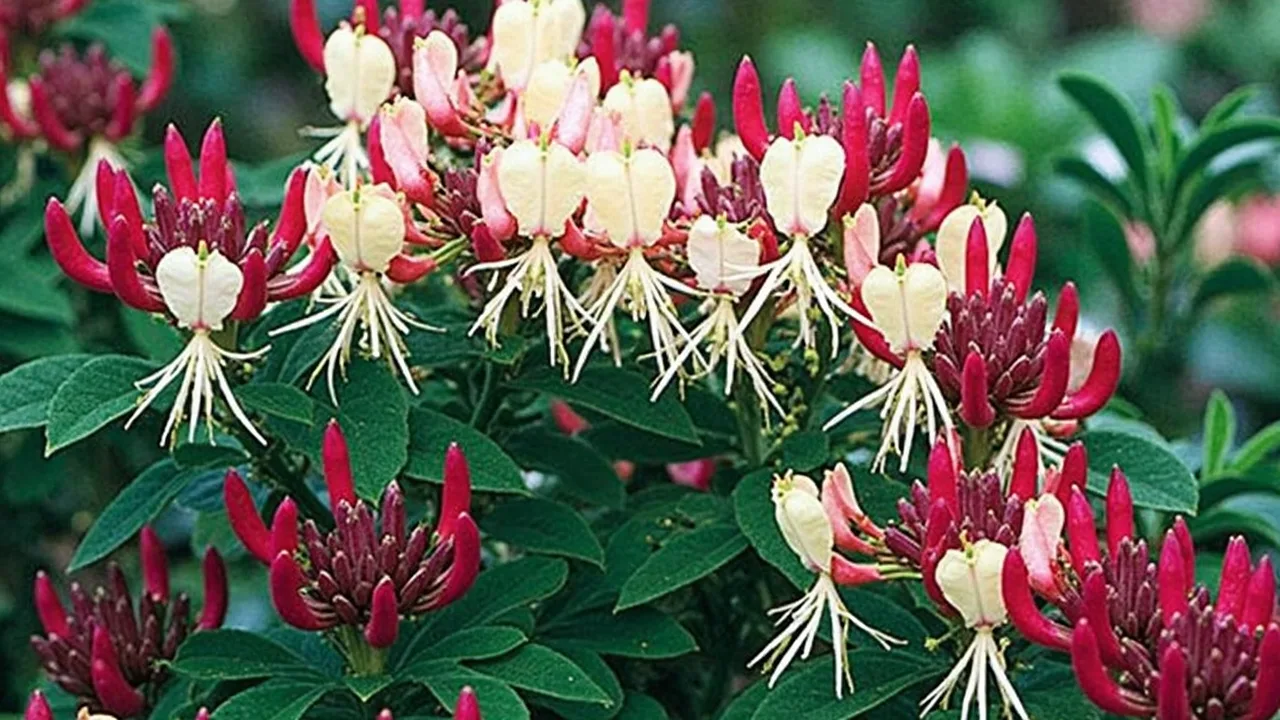
'Serotina' differs from the typical wild woodbine chiefly in flower colour, flower timing and intensity of perfume. The buds are a deep purple-red, opening to creamy white on the outside of the corolla with a yellow-tinged throat, producing a striking two-tone effect that is far more vivid than the cream-and-pink tones of the straight species. The trusses are carried in whorls at the shoot tips from midsummer well into early autumn, several weeks later than most Lonicera periclymenum cultivars, which is the source of its common name, the late Dutch honeysuckle.
The scent is also notably stronger and more complex than many other cultivars, with a sweet, heady quality that carries well on a warm evening. In growth it is vigorous and twining, reaching roughly 5–7 m on a suitable support, with deciduous, blue-green foliage that is paler on the reverse. The flowers are followed in autumn by small, glossy red berries, which are not ornamentally significant but are appreciated by garden birds.
Growing Notes
'Serotina' is hardy across most of the UK and tolerates the conditions described for the species, with one or two cultivar-specific points worth noting. It performs best with its roots in cool, moist shade and its top growth in sun, which is the usual recipe for the most abundant flowering. Like the species, it is best planted young and left undisturbed, as older, established plants resent transplanting.
First-year flowering is often modest; plants usually settle in over their first season and flower more freely from the second year onwards. Pruning is light: in late winter, remove any dead or weak shoots and, if necessary, shorten flowered growth by up to a third to keep the framework within bounds. Avoid hard cutting back into old wood, which the plant can be slow to recover from. Support is essential — it climbs by twining, so a trellis, wires, an obelisk or a host shrub such as a mature rose or climbing framework all work well. Plants sold as pot-grown specimens can be planted at any reasonable time of year, avoiding prolonged frozen or waterlogged ground.
Best Used For
'Serotina' is an excellent choice for a scented garden near a seating area, path or frequently used doorway, where its late-season perfume can be appreciated. It suits cottage-garden plantings, where it can be trained over a fence or allowed to scramble through a large shrub, and is equally effective on a house wall, pergola post or sturdy obelisk in a border. It tolerates light shade better than many flowering climbers, making it useful on north- and east-facing walls where other scented plants struggle, and its late flowering period is a valuable nectar source for bees and other pollinators when many summer climbers are finished.
Pests and Diseases
| Problem | Symptoms | Management |
|---|---|---|
| Powdery mildew | White, dusty fungal growth appears on leaves and stems, often causing distortion or yellowing. | Improve air circulation, avoid overhead watering, and apply a suitable fungicide if severe. |
| Honeysuckle aphids | Clusters of small green or black insects on new growth, causing leaf curling and sticky honeydew. | Encourage natural predators like ladybirds or treat with a systemic insecticide if infestations are heavy. |
| Silver leaf | Leaves develop a silvery sheen on the underside and may become distorted or die back. | Prune out affected branches well below the infection point and burn them to prevent spread. |
| Fungal leaf spot | Small, dark spots appear on leaves, which may turn yellow and drop prematurely. | Remove fallen leaves in autumn and avoid wetting foliage when watering to reduce humidity. |
| Thrips | Tiny insects cause silvery or bronzed patches on leaves and flowers, often leaving black specks of excrement. | Use blue sticky traps to monitor populations and apply insecticidal soap if necessary. |
For step-by-step help, read Controlling Aphids Naturally and Treating Powdery Mildew. Or browse the full plant problem solver to diagnose an issue by symptom.
As an Amazon Associate, GardenWizz earns from qualifying purchases made through links on this page (including links within the article). This does not affect the price you pay. See our disclaimer for details.