
Holly
Ilex aquifolium · common holly · English holly · European holly
At a Glance
| Botanical name | Ilex aquifolium |
|---|---|
| Common name(s) | holly, common holly, English holly, European holly |
| Family | Aquifoliaceae |
| Plant type | shrub |
| Height × Spread | 200–450 cm × 100–300 cm |
| Hardiness | — (to -10.0 °C) |
| Position | Full shade, Partial shade |
| Soil | clay, acidic, nutrient poor soils |
| Flowering | February–April |
| Toxicity | — |
| Native range | western and southern Europe, northwest Africa, and southwest Asia |
Overview
Ilex aquifolium, commonly known as holly, common holly, English holly, European holly, or Christmas holly, is a species of flowering plant in the family Aquifoliaceae. It is the type species of the genus Ilex and is regarded as the defining representative of the holly genus. Native to western and southern Europe, northwest Africa, and southwest Asia, it is one of the few native hardwood evergreen trees in the British Isles. The plant is associated with Christmas traditions and the Roman festival of Saturnalia, with its glossy green, prickly leaves and bright red berries featured in decorations. It is also a popular ornamental shrub or hedge, with numerous cultivars available.
Botanical Description
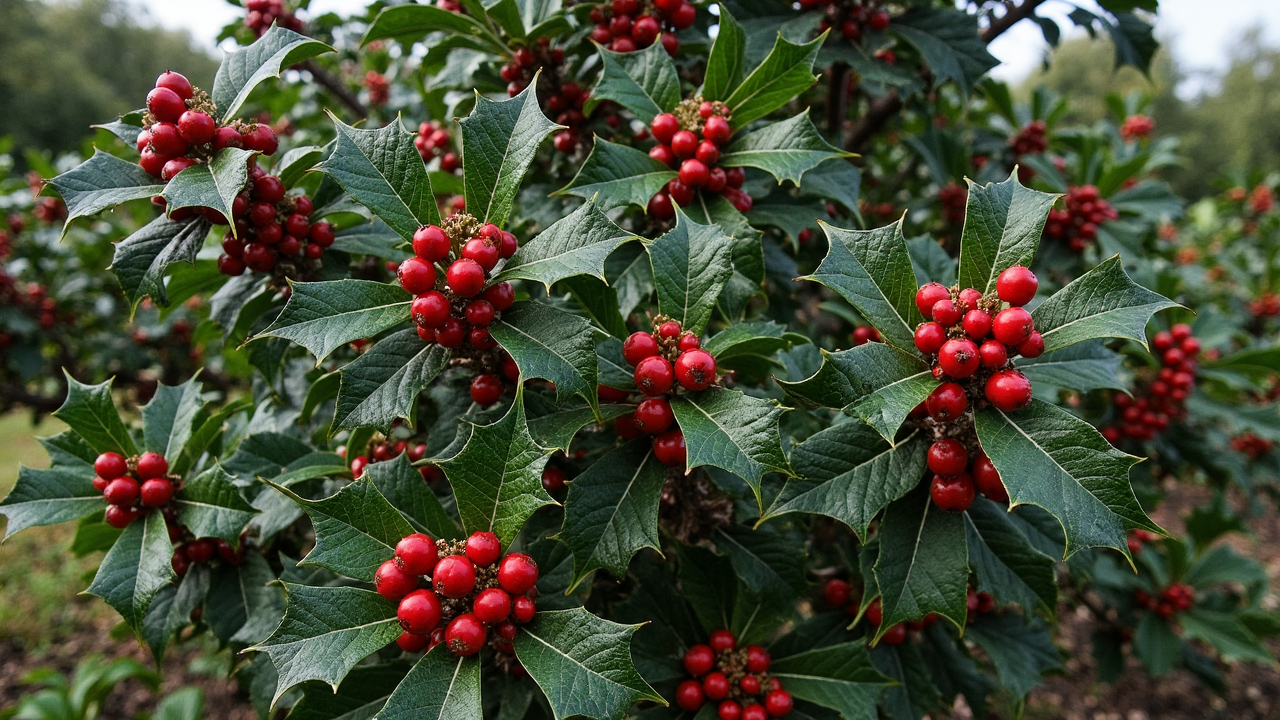
European holly is an evergreen shrub or tree, typically 2–3 m tall and broad, though it can exceed 15 m in height in exceptional cases. It has a straight trunk, pyramidal crown, and branches arising from the base. The bark is smooth and silver-grey when young, developing small fissures with age. The leaves are evergreen, 5–12 cm long, dark green and shiny above with a lighter underside, ovate to oblong-elliptic in shape, and often edged with sharp spines (up to six to eight per side). Older trees and those in shade may have smooth-edged leaves. The flowers are white, sometimes with a red tinge, with four parts, and the plant is usually dioecious, requiring male and female plants for fruit production. The fruit is a bright red or yellow drupe, 6–10 mm in diameter, produced only on female plants, containing 3–4 seeds that germinate in the second or third spring.
Origin and Habitat
Native to western and southern Europe, northwest Africa, and southwest Asia, its native status in central and eastern Europe is disputed. It is not native to Poland or Hungary but is native to Bulgaria and Romania. In Asia, it is listed as native to Iran and Lebanon by the IUCN, though POWO considers it introduced in Turkey and Syria. It grows from sea level to 600 m elevation, primarily in the understory or edges of deciduous forests in oceanic or Mediterranean climates, often associated with oak forests. It is a pioneer species that repopulates forest margins or clearcuts and tolerates frost and summer drought. It is classified as a species of least concern by the IUCN, though its population is severely fragmented with declining mature individuals.
Cultivation
Ilex aquifolium is widely grown in parks and gardens across temperate regions. It adapts well to a range of difficult soils, including clay, acidic, and nutrient-poor soils, but is intolerant of poor drainage. It thrives in full or partial shade and is commonly used for hedges due to its spiny leaves and tolerance of pruning. It is not suitable for waterlogged conditions, as it is prone to root rot, canker, or leaf blight in wet environments.
Care and Maintenance
Prune after flowering to maintain shape and density. Remove dead or diseased wood promptly. Ensure well-drained soil to prevent root rot. In wet conditions, monitor for fungal diseases. The plant requires male and female specimens for fruit production, with flowering typically occurring in spring (February–April) but occasionally in winter.
Uses
The plant is traditionally used in Christmas decorations, wreaths, and cards due to its glossy leaves and berries. It serves as an important winter food source for birds and small mammals once the berries soften after frost. It is also valued as an ornamental plant in gardens and for creating dense, spiny hedges. Historically, it has been associated with folklore and music in British tradition. In some regions, it has become invasive, particularly in the Pacific Northwest of North America and Hawaii.
Cultivars and Varieties
| Cultivar | Height | Flower | Notes | AGM |
|---|---|---|---|---|
| 'Ilex × altaclerensis' | — | — | hybrid between I. aquifolium and I. perado | ✓ |
Pests and Diseases
| Problem | Symptoms | Management |
|---|---|---|
| root rot, canker, or leaf blight | — | — |
Quick Care Summary
| Sunlight | Full shade, Partial shade |
|---|---|
| Soil | clay, acidic, nutrient poor soils |
| Hardiness | — (-10.0 °C) |
| Sow | September–November |
| Plant | March–May |
| Prune | November–December |
Facts sourced from Wikipedia / Ilex aquifolium (https://en.wikipedia.org/wiki/Ilex_aquifolium)
As an Amazon Associate, GardenWizz earns from qualifying purchases made through the links above. This does not affect the price you pay. See our disclaimer for details.