Apple
Malus domestica
At a Glance
| Botanical name | Malus domestica |
|---|---|
| Common name(s) | apple |
| Family | — |
| Plant type | tree |
| Height × Spread | 60–1500 cm × — |
| Hardiness | — |
| Position | Full sun, Partial shade |
| Soil | — |
| Flowering | April |
| Toxicity | — |
| Native range | Central Asia |
Overview
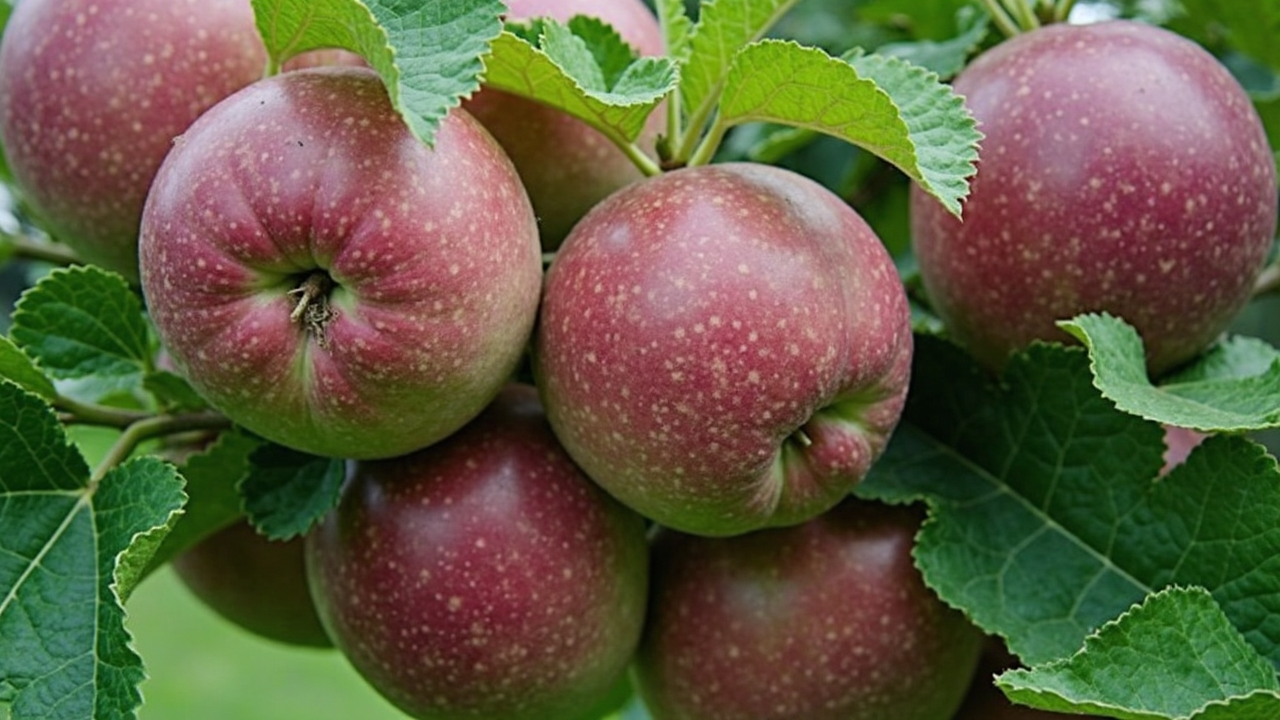
The apple (Malus domestica) is the round, edible fruit of an apple tree, cultivated worldwide as the most widely grown species within the genus Malus. It is a deciduous tree typically reaching 2–4.5 metres in cultivation, though wild specimens may exceed 15 metres. Over 7,500 cultivars exist, bred for diverse tastes and uses including fresh eating, cooking, and cider production. Commercial propagation relies on clonal grafting onto rootstocks to ensure consistent fruit characteristics and control tree size.
Botanical Description
Apple trees are deciduous, with bark on the trunk appearing dark grey or grey-brown and young branches reddish or dark-brown with a smooth texture. Young twigs bear fine downy hairs, becoming hairless with age. Buds are egg-shaped, dark red or purple, measuring 3–5 mm, with hairy edges. Leaves are simple, ovate, elliptic, or oblong, with broadly-angled teeth and a glabrescent upper surface; undersides are densely hairy. They attach alternately via short stems (1–3.5 cm long). Flowers are five-petaled, rose-pink when opening and fading to white or light pink, 3–4 cm in diameter, borne in cymes of 3–7 flowers. The central "king bloom" opens first. Fruit is a pome, typically 2.5–12 cm in diameter, with a ground colour of yellow, green, yellow-green, or whitish yellow and an overcolour ranging from orange-red to brown-red. The skin may be russeted and covered in epicuticular wax.
Origin and Habitat
Native to Central Asia, where its wild ancestor Malus sieversii persists in the Tian Shan mountains of southern Kazakhstan, Kyrgyzstan, Tajikistan, and northwestern China. Cultivation likely began 4,000–10,000 years ago in this region before spreading via the Silk Road to Europe. Secondary introgression from Malus sylvestris (crabapple) occurred during domestication. The fruit was introduced to North America by European colonists.
Cultivation
Apple trees are propagated commercially through clonal grafting onto rootstocks to control growth rate, tree size, and fruiting speed. Trees grown without rootstocks are larger and slower to fruit. Rootstocks allow for easier harvesting and are selected based on desired tree characteristics. The species is diploid with 17 chromosomes, though triploid cultivars exist.
Care and Maintenance
Apple trees require full sun or partial shade. They are hardy to −40 °C (−40 °F) in overwintering wood and buds, but open blossoms are damaged by temperatures of −2 °C (28 °F) or lower. Prune after flowering to maintain shape and health.
Uses
Cultivars are bred for specific uses: fresh eating, cooking, or cider and juice production. The fruit has cultural significance in various mythologies and religions, including Norse, Greek, and Christianity. The genome was sequenced in 2010 to aid disease control and selective breeding.
#MalusDomestica #AppleTree #OrchardCrops #UKGardening #FruitTrees #PlantTaxonomy #DeciduousTrees #AppleCultivars #GardenWizz #BotanicalReference
Quick Care Summary
| Sunlight | Full sun, Partial shade |
|---|---|
| Soil | — |
| Hardiness | — |
| Sow | September–November |
| Plant | March–May |
| Prune | December |
Facts sourced from Wikipedia / Malus domestica (https://en.wikipedia.org/wiki/Malus_domestica)
As an Amazon Associate, GardenWizz earns from qualifying purchases made through the links above. This does not affect the price you pay. See our disclaimer for details.