Chamomile
Matricaria chamomilla · German chamomile · Hungarian chamomile (kamilla) · wild chamomile
At a Glance
| Botanical name | Matricaria chamomilla |
|---|---|
| Common name(s) | chamomile, German chamomile, Hungarian chamomile (kamilla), wild chamomile |
| Family | Asteraceae |
| Plant type | annual |
| Height × Spread | 15–60 cm × — |
| Hardiness | — |
| Position | Full sun, Partial shade |
| Soil | well balanced soils with good topsoil |
| Flowering | May–July |
| Toxicity | — |
| Native range | southern and eastern Europe |
Overview
Matricaria chamomilla (synonym: Matricaria recutita), commonly known as chamomile, German chamomile, Hungarian chamomile (kamilla), wild chamomile, blue chamomile, or scented mayweed, is an annual plant of the composite family Asteraceae. It is commonly used to make a tea, though the name M. recutita is often applied to the herbal product chamomile, with other species also used. Historically used in various ancient cultures, it is promoted for a range of conditions, though evidence for effectiveness is limited, and it may cause mild side effects or drug interactions, requiring caution around allergies, estrogen-sensitive conditions, and during pregnancy.
Botanical Description
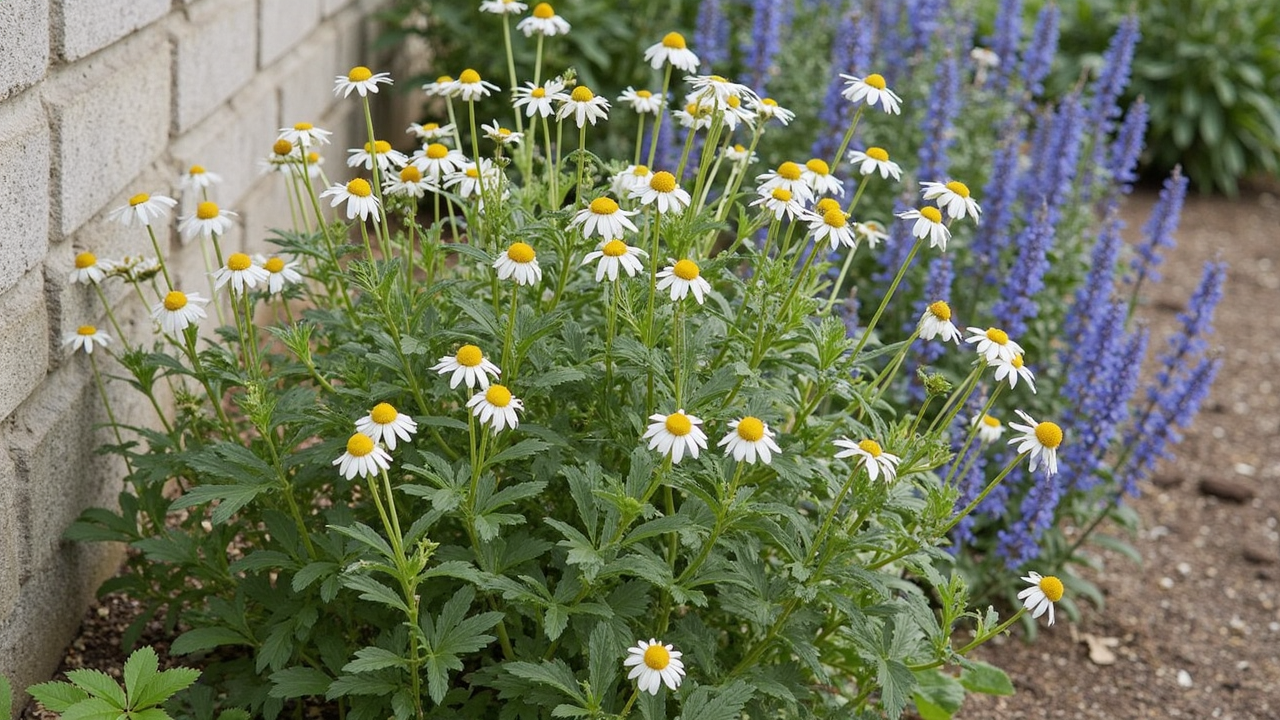
Matricaria chamomilla is a member of the Asteraceae family, featuring a branched, erect, and smooth stem growing to 15–60 cm in height. Its long, narrow leaves are bipinnate or tripinnate. The flowers are borne in paniculate flower heads (capitula), with white ray florets furnished with a ligule and yellow disc florets. The hollow receptacle is swollen and lacks scales, distinguishing it from Anthemis arvensis (corn chamomile), which has a scaled receptacle. The flowers bloom in early to midsummer, are fragrant, and contain essential oil giving a characteristic scent. The oil's blue colour, due to chamazulene, explains the common name blue chamomile. The fruit is a yellowish-brown achene.
Origin and Habitat
Native to southern and eastern Europe, Matricaria chamomilla is now found on all continents. It naturalises readily in suitable conditions.
Cultivation
Chamomile grows best on well balanced soils with good topsoil, though it does not require special soil. It can be planted as an annual crop in autumn or spring, or treated as a perennial due to its ability to self-seed. Aphids are a major insect pest in production, with significant diseases in Europe including downy mildew, powdery mildew, and rust. The plant often flowers 2 to 3 times per year, allowing for multiple harvests.
Care and Maintenance
The flowering period lasts 50–65 days, with individual flower development taking approximately 20–25 days. Harvesting occurs during flowering periods to collect the flowers for tea production.
Uses
Chamomile is commonly used to make a tea. German chamomile is used in herbal medicine. The flowers contain 0.3–1.5% essential oil, extracted by distillation from fresh flower buds and stalks. Bisabolol accounts for up to 33% of the oil's content. Over 120 chemical constituents have been identified in chamomile flowers, including bisabolol, farnesene, chamazulene, apigenin, quercetin, patuletin, luteolin, and coumarin.
#Chamomile #MatricariaChamomilla #Asteraceae #HerbalTea #UKGardening #GardenWizz #BotanicalReference #PlantMedicine #AnnualPlant #HerbalMedicine
Pests and Diseases
| Problem | Symptoms | Management |
|---|---|---|
| aphids | — | — |
| downy mildew | — | — |
| powdery mildew | — | — |
| rust | — | — |
Quick Care Summary
| Sunlight | Full sun, Partial shade |
|---|---|
| Soil | well balanced soils with good topsoil |
| Hardiness | — |
| Sow | January, September, October, November, December |
| Plant | January, September, October, November, December |
| Prune | — |
Facts sourced from Wikipedia / Matricaria chamomilla (https://en.wikipedia.org/wiki/Matricaria_chamomilla)