Rudbeckia
Rudbeckia fulgida
At a Glance
| Botanical name | Rudbeckia fulgida |
|---|---|
| Common name(s) | Rudbeckia |
| Family | Asteraceae |
| Plant type | perennial |
| Height × Spread | 120 cm × — |
| Hardiness | — |
| Position | Full sun, Partial shade |
| Soil | fertile soil enriched with lots of organic matter, which holds plenty of moisture in spring and summer, doesn't dry out or become waterlogged; moderately fertile, moisture retentive but not soggy |
| Flowering | July–October |
| Toxicity | — |
| Native range | eastern North America |
Overview
Rudbeckia fulgida, commonly known as the black-eyed Susan or orange coneflower, is a clump-forming herbaceous perennial in the daisy family (Asteraceae) and one of the most reliable late-season border plants grown in British gardens. Native to the eastern and central United States, where it inhabits moist meadows, prairie edges and open woodland, it has been cultivated in the United Kingdom for well over a century and is now considered a staple of the late summer and autumn herbaceous border. The following quick-care table summarises the essentials for UK growers; the full article below covers each in detail.
Rudbeckia fulgida is grown in British gardens primarily for its profuse display of golden-yellow, daisy-like flowers carried on upright stems from mid-summer well into autumn, often continuing until the first hard frosts. The species is closely related to the familiar annual black-eyed Susan (Rudbeckia hirta), but differs in being genuinely perennial, returning reliably from a woody crown each spring. Within the species, the most widely grown garden form is the cultivar 'Goldsturm', which has been a fixture of UK herbaceous borders since the 1960s. The plant is highly attractive to pollinators, particularly bees and hoverflies, and the seed heads persist into winter, providing structure in the dormant border and a useful food source for finches and other seed-eating birds. The Royal Horticultural Society has recognised several forms with the Award of Garden Merit, reflecting the plant's reliability in typical British garden conditions.
Appearance
Rudbeckia fulgida forms a dense, slowly expanding clump from a rhizomatous crown, with stems rising 60–90 cm above a basal rosette of leaves. The stems are mid-green, branched toward the top, and noticeably bristly with short, stiff hairs. The basal leaves are oval to lance-shaped, 10–20 cm long, with coarsely serrated edges and a rough, slightly hairy surface; stem leaves are smaller, narrower and often clasp the stem with small ear-like lobes at the base. Foliage colour is a fresh mid-green through the growing season, sometimes developing yellow or bronze tints in autumn before the plant dies back for winter.
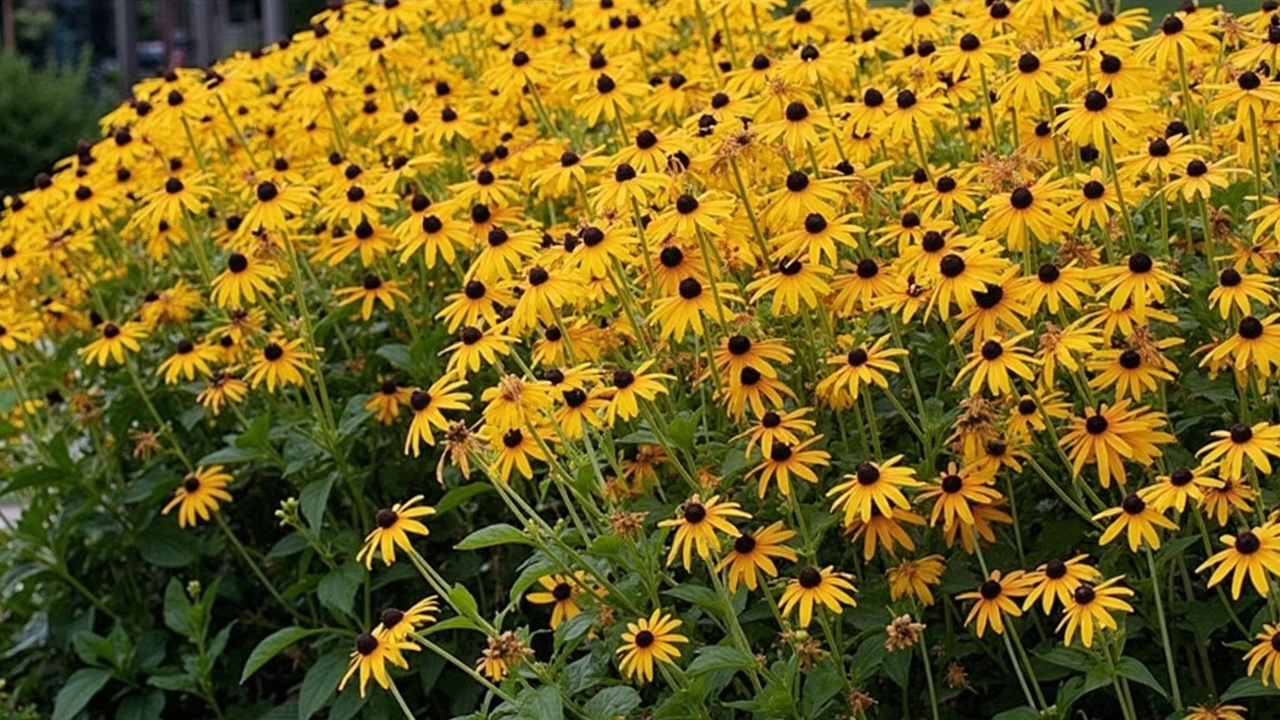
The flowers are borne singly at the tips of branched stems from mid-July through October. Each flower head is a classic member of the daisy family, with a ring of bright golden-yellow ray florets (the outer "petals") surrounding a prominent, raised central cone of dark brown to almost black disc florets. Individual heads are 5–8 cm across. The cone is roughly conical to short-columnar, typically 2–3 cm tall, and is the feature that gives the plant its common name. In some seasons the ray florets develop orange or mahogany tones at the base, but the predominant impression from a distance is a sheet of warm yellow held above the foliage. After pollination the cones darken further and ripen into seed heads that stand well above the foliage through autumn and into winter, particularly attractive when rimed with frost.
The overall habit is upright to slightly spreading, broader with age as the clump matures, and reliably self-supporting in full sun. In light shade or in highly fertile soil, stems can become leggy and benefit from discreet staking or the support of neighbouring perennials.
Growing Conditions
Rudbeckia fulgida performs best in full sun, where it produces the largest number of flowers on the strongest, most upright stems. It will tolerate light, dappled shade, particularly in the south of England, but flowering is reduced and stems may lean toward the light. In the United Kingdom this means a south- or west-facing border is ideal, although the plant also succeeds in open positions in east- and north-facing sites provided the soil does not dry out completely in summer.
Soil should be moderately fertile, well-drained yet moisture-retentive, with a pH between roughly 5.5 and 7.0. The plant adapts well to clay, loam and lighter sandy soils provided they are not parched in summer or waterlogged in winter. On thin, hungry soils it is worth working in a barrow-load of garden compost before planting, and on heavy clay a generous addition of well-rotted organic matter and, on the worst sites, coarse grit will help establish a workable root run. Once established the plant tolerates short dry spells well, but prolonged summer drought will reduce flowering and may scorch the lower leaves; a thick organic mulch applied in spring helps to conserve moisture.
The RHS rates Rudbeckia fulgida as hardy to H4, meaning it tolerates winter temperatures down to about -10 °C and is therefore reliably hardy throughout the United Kingdom, including most of lowland Scotland, northern England and the higher parts of Wales. It is not generally damaged by late spring frosts once new growth has hardened off, although very late sharp frosts can blacken the first emerging shoots, from which the plant readily recovers. The plant is fully deciduous, dying back to a small basal crown over winter and re-emerging in mid-spring.
Planting and Care
Plant container-grown Rudbeckia fulgida in October–November or March–April, while the soil is workable and the ground is still warm. Space plants 40–50 cm apart to allow each clump room to develop; 'Goldsturm' and other vigorous cultivars may eventually need 50–60 cm. Dig a hole wide enough to take the rootball comfortably, set the crown at the same depth as in the pot, backfill with the excavated soil, firm in well and water thoroughly. On exposed sites a short cane can be inserted at planting to give the first-year stems something to lean against until the root system is established.
Watering is most important in the first growing season. Water deeply once a week during prolonged dry spells, allowing the soil to dry slightly between waterings rather than keeping the surface constantly damp. Established plants need supplemental water only in extended summer drought.
Feeding should be modest. A 5–7 cm mulch of well-rotted garden compost or farmyard manure applied in early spring is usually sufficient. If growth appears weak, a single application of a balanced general-purpose fertiliser in late spring can be beneficial, but over-rich feeding produces soft, leafy growth at the expense of flowers and may make stems more prone to flopping.
Pruning is straightforward. In late autumn, after flowering has finished and the seed heads have been enjoyed, cut the stems down to within 10–15 cm of the crown. Alternatively, leave the seed heads in place for winter interest and for birds, cutting back hard in late February or early March before new growth begins. Remove any dead or damaged material from around the crown in spring to discourage slugs and to allow new shoots to come through cleanly. Every three to four years, particularly on vigorous cultivars such as 'Goldsturm', lift and divide congested clumps in spring to maintain flowering performance; this is also the principal means of propagation. Basal softwood cuttings, 8–10 cm long, taken in early summer from non-flowering shoots will root readily in a gritty, free-draining compost under a cold frame or in a shaded corner of the greenhouse. Seed can be sown in spring, but offspring will not come true to cultivar, so seed is used mainly for the species.
Common Problems
Powdery mildew is the most frequently reported foliar problem, producing a dusty white coating on the leaves from mid-summer onwards. It is favoured by humid, crowded conditions and overhead watering; improving air circulation by spacing plants correctly, watering at the base, and removing affected foliage will usually keep it in check. Aphids may cluster on young shoots and flower stems in spring; they rarely cause serious damage and are easily controlled by squashing, by a strong jet of water, or by encouraging natural predators such as ladybirds and hoverflies. Slugs and snails attack the soft new shoots in spring, particularly in damp seasons; copper tape around the crown, beer traps or the responsible use of slug pellets are the usual remedies.
Leaf miner produces winding pale tunnels in the leaves during summer; the damage is cosmetic only and rarely affects the vigour of the plant. Crown rot can occur on poorly drained soils, especially after a wet winter, and is best prevented by improving drainage at planting time and by avoiding heavy mulches that hold moisture against the crown. Aster yellows, a phytoplasma disease that causes yellowing, distorted growth and green, deformed flowers, is occasionally reported; affected plants should be lifted and destroyed, and control of the leafhoppers that spread the disease helps to limit its occurrence. The plant is not considered toxic to humans, dogs, cats or livestock.
Popular Varieties
Rudbeckia fulgida var. sullivantii 'Goldsturm' is by far the most widely grown form in the United Kingdom. It has a neat, upright habit to about 60 cm, an exceptionally long flowering period from July to October, and a generous quantity of 7–10 cm wide golden-yellow heads with prominent dark cones; it holds the RHS Award of Garden Merit and is the form most often sold simply as "black-eyed Susan" in British garden centres. Rudbeckia fulgida var. deamii is a taller, more graceful variant, typically reaching 80–100 cm, with slightly larger, softer yellow flowers and a particularly robust constitution; it has also received the Award of Garden Merit. Rudbeckia fulgida 'Little Goldstar' is a compact selection, usually 40–50 cm tall and broad, bred for smaller gardens, the front of the border and container use, with a heavy display of proportionate flowers from July to September. Rudbeckia fulgida 'City Garden' is another compact form, similar in scale to 'Little Goldstar' and useful where the taller cultivars would be out of proportion. Most other Rudbeckias sold under the black-eyed Susan label, including the gloriosa daisies, are cultivars or hybrids of the related annual or short-lived perennial species Rudbeckia hirta and behave as annuals in most of the United Kingdom; the perennial clump-forming habit described in this article is specific to Rudbeckia fulgida and its varieties.
Pests and Diseases
| Problem | Symptoms | Management |
|---|---|---|
| Powdery mildew | White, dusty fungal growth appears on leaves and stems, often causing distortion. | Ensure good air circulation, water at the base, and apply a fungicide if severe. |
| Slugs and snails | Irregular holes in young leaves and silvery slime trails on foliage and stems. | Use physical barriers like copper tape or organic pellets to protect young growth. |
| Aphids | Clusters of small green or black insects on new shoots, causing sticky honeydew. | Squash by hand, blast with water, or use insecticidal soap for heavy infestations. |
| Leaf and bud eelworm | Distorted, swollen leaves and buds that fail to open properly. | Remove and burn affected plant parts immediately to prevent spread. |
| Stem weakness | Tall varieties flop over or break in wind due to heavy flower heads. | Support with stakes or use the Chelsea chop pruning technique in early summer. |
Quick Care Summary
| Sunlight | Full sun, Partial shade |
|---|---|
| Soil | fertile soil enriched with lots of organic matter, which holds plenty of moisture in spring and summer, doesn't dry out or become waterlogged; moderately fertile, moisture retentive but not soggy |
| Hardiness | — |
| Sow | February–July |
| Plant | March–May |
| Prune | — |
As an Amazon Associate, GardenWizz earns from qualifying purchases made through the links above. This does not affect the price you pay. See our disclaimer for details.