
Tulip
Tulipa
At a Glance
| Botanical name | Tulipa |
|---|---|
| Common name(s) | tulip |
| Family | Liliaceae |
| Plant type | perennial |
| Height × Spread | 5 cm × — |
| Hardiness | — |
| Position | Full sun |
| Soil | — |
| Flowering | March–May |
| Toxicity | Tulipanin A and B are toxic to horses, cats and dogs. |
| Native range | Southeast of Europe (Greece, Albania, North Macedonia, Kosovo, Southern Serbia, Bulgaria, most part of Romania, Ukraine, Russia) and Turkey in the west, through the Levant (Syria, Israel, Palestinian Territories, Lebanon and Jordan) and the Sinai Peninsula. From there it extends eastwards through Jerevan (Armenia), and Baku (Azerbaijan) and on the eastern shore of the Caspian Sea through Turkmenistan, Bukhara, Samarkand and Tashkent (Uzbekistan), to the eastern end of the range in the Pamir-Alai and Tien-Shan mountains in Central Asia, which form the centre of diversity. Further to the east, Tulipa is found in the western Himalayas, southern Siberia, Inner Mongolia, and as far as the northwest of China. |
Overview
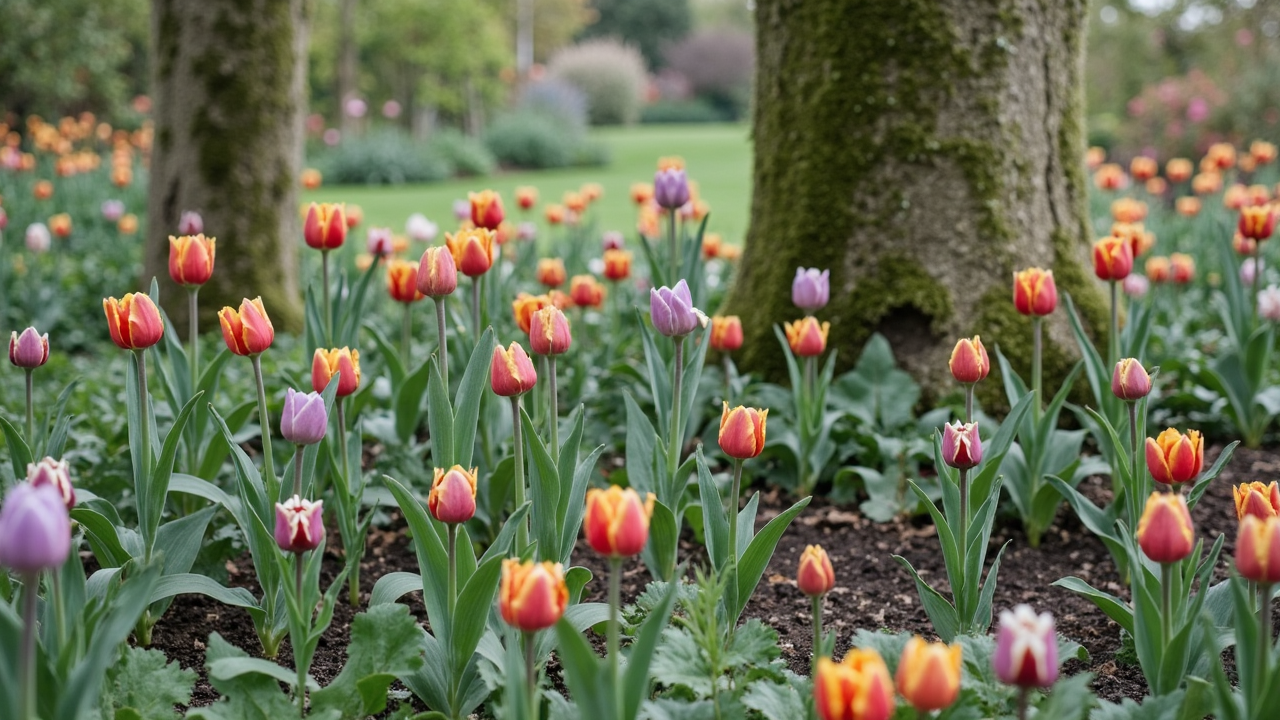
Tulips are spring-blooming perennial herbaceous bulbiferous geophytes within the genus Tulipa. They are renowned for their large, showy, brightly coloured flowers, typically in shades of red, orange, pink, yellow, or white, often featuring a contrasting blotch at the base of the tepals. The genus comprises approximately 75 species, divided among four subgenera, and is classified within the lily family, Liliaceae. Tulips have a long history of cultivation, originating in the Near East and Central Asia, and became globally significant following their introduction to Europe in the sixteenth century, notably during the Dutch tulip mania of 1634–1637.
Botanical Description
Tulips are perennial herbaceous plants that bloom in spring and die back to an underground bulb after flowering. The bulb diameter ranges from 1 cm to 5 cm. Stems bear few leaves, typically two to six, though some species may have up to 12; leaves are strap-shaped, cauline, alternate, and bluish-green with a waxy coating. The flowers are actinomorphic, hermaphrodite, and usually erect, arranged singly or in small clusters. They feature six free tepals (petal-like structures) in two whorls, forming a cup or star shape. The tepals are brightly coloured, often with a darker blotch at the base, while the stamens and three-lobed stigma are characteristic. The fruit is a leathery capsule containing numerous flat, disc-shaped seeds.
Origin and Habitat
Native to a band stretching from southeastern Europe (including Greece, Bulgaria, Romania, Ukraine, and Russia) through Turkey, the Levant, and Central Asia (including the Pamir-Alai and Tien-Shan mountains), tulips are adapted to temperate steppes and mountainous regions. They were first cultivated in Persia from the 10th century, later spreading to Anatolia and the Ottoman Empire by the 15th century, where they became a symbol of the empire. Tulips were introduced to Northern Europe in the sixteenth century following observations by diplomats at the Ottoman court, leading to their widespread cultivation and the Dutch tulip mania of the 17th century.
Cultivation
Tulips thrive in full sun and well-drained soil, requiring a temperate climate with a distinct dormant period during summer. They are adapted to natural habitats in steppes and mountainous areas, where they flower in spring and become dormant after the foliage dies back. Modern cultivation focuses on both species (botanical tulips) and hybrid cultivars, with the Netherlands remaining a major global producer. They are suited to temperate gardens and are commonly grown from bulbs planted in autumn.
Care and Maintenance
Plant bulbs in autumn in well-drained soil in full sun. Allow foliage to die back naturally after flowering to replenish the bulb. Do not cut foliage prematurely. In regions with heavy rainfall or poor drainage, ensure soil is well-drained to prevent bulb rot. After flowering, remove spent blooms to prevent seed production, but leave the foliage intact until it turns yellow and dies back. For optimal bulb health, lift and divide bulbs every few years in late summer.
Uses
Tulips are widely cultivated as ornamental garden plants and for cut flowers. They are popular in floral arrangements and garden displays due to their vibrant colours and spring bloom. However, tulip bulbs and foliage contain tulipalin A, which causes occupational dermatitis in handlers such as bulb sorters and florists. Tulipanin, an anthocyanin pigment, is present in the flowers, while tuliposides contribute to allergic reactions. The Queen of the Night cultivar is noted for its near-black, maroonish purple hue, though no truly black tulips existed before 1986, when a Dutch breeder achieved this through cross-breeding.
#Tulip #Botanical #GardenPlants #Perennial #Liliaceae #TulipMania #UKGardening #GardenWizz #FlowerGardens #SpringFlowers
Pests and Diseases
| Problem | Symptoms | Management |
|---|---|---|
| Tulip breaking virus | Variegated patterns in the tulip flowers | — |
Quick Care Summary
| Sunlight | Full sun |
|---|---|
| Soil | — |
| Hardiness | — |
| Sow | September–November |
| Plant | March–May |
| Prune | — |
Facts sourced from Wikipedia / Tulip (https://en.wikipedia.org/wiki/Tulip)
As an Amazon Associate, GardenWizz earns from qualifying purchases made through the links above. This does not affect the price you pay. See our disclaimer for details.