
Lavender 'Hidcote'
Lavandula angustifolia 'Hidcote'
The Gardening Year
Best months in UK gardens · full planting calendar →
🖨 Printable care card (PDF)At a Glance
| Botanical name | Lavandula angustifolia 'Hidcote' |
|---|---|
| Common name(s) | Lavender 'Hidcote' |
| Family | Lamiaceae |
| Plant type | shrub (Evergreen) |
| Height × Spread | 60 cm × 50–100 cm |
| Position | Full sun |
| Soil | well-drained soil |
| Flowering | June–August |
| Toxicity | No specific toxicity is listed by the RHS. This is not a guarantee of safety — check with a vet or the ASPCA before pets or children eat any plant. |
| Native range | — |
Overview
Lavandula angustifolia 'Hidcote' is a compact, silver-leaved selection of English lavender widely grown in British gardens for its deep violet-blue flower spikes and tidy, low habit. Raised at Hidcote Manor Garden in Gloucestershire in the early twentieth century, it remains the form most often planted for formal edging and low hedges. It is valued over taller cultivars for its neat, uniform mounds and the particularly intense colour of its blooms.
Distinctive Features
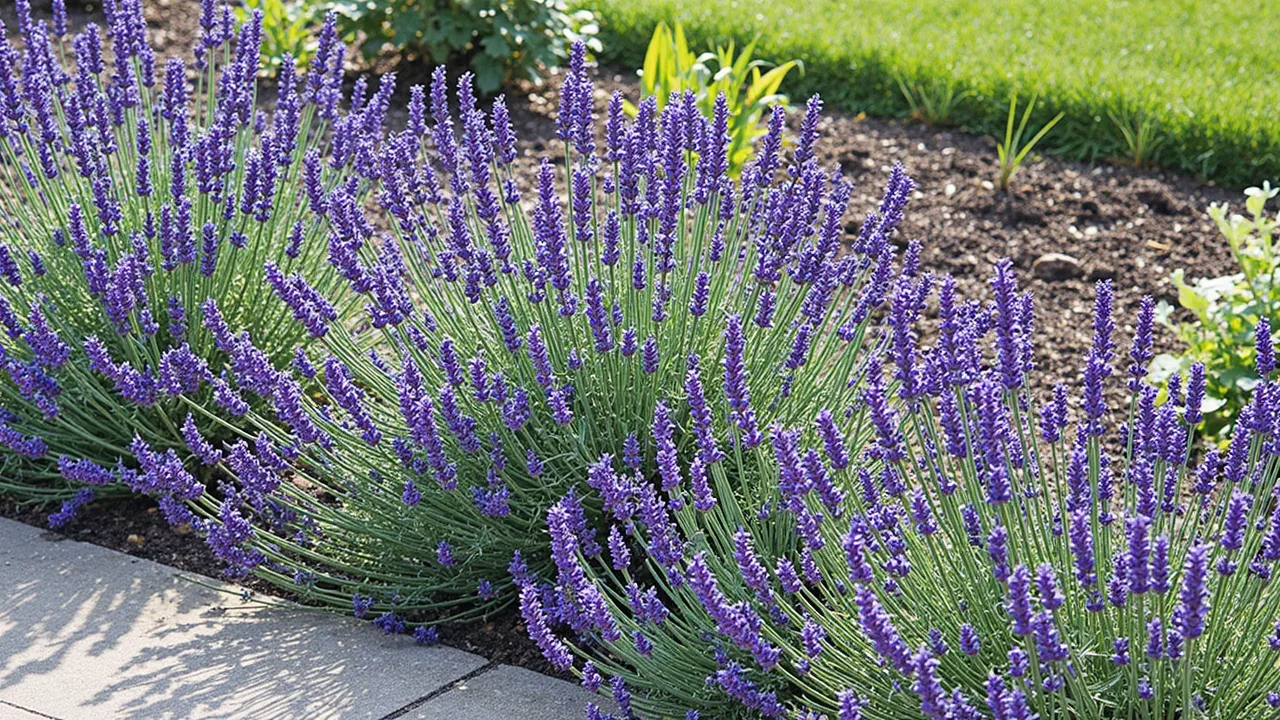
'Hidcote' is distinguished from the species by a denser, more compact habit and a slightly smaller overall size, typically reaching about 50 to 60 cm tall in flower with a similar spread, against the 60 to 90 cm common to the species. The flower spikes are a notably deep violet-blue, darker than the paler lilac-mauve of cultivars such as 'Munstead', and are held on short, stiff stems that sit close to the foliage rather than rising well above it. The leaves carry the same narrow, lance-shaped form as the species but are particularly silvery, owing to a dense covering of fine grey hairs, which gives the mound a pale, almost felted appearance through the year. The overall shape is rounded and uniform, which is the main reason the cultivar is preferred over taller, looser forms where a regular outline is wanted. Lavandula angustifolia 'Hidcote' holds the Royal Horticultural Society's Award of Garden Merit, reflecting its reliability in typical British garden conditions and its consistent performance in trial.
Growing Notes
'Hidcote' shares the cultural requirements of the species but tolerates a slightly wider range of conditions because of its compact, woody base. It performs best in full sun on poor to moderately fertile, free-draining, near-neutral to alkaline soil; on heavy or winter-wet ground it is prone to the same crown rot as other English lavenders and is best avoided or grown on a raised bed. As with the species, hardiness in the United Kingdom can be taken as RHS H5, meaning it tolerates typical UK winter temperatures in most lowland and many upland sites; young or freshly pruned plants in cold districts benefit from a light, free-draining mulch of coarse grit rather than organic matter. The cultivar usually flowers well in its first year from a spring-planted pot-grown specimen, particularly if trimmed lightly in late summer to encourage a bushy framework. Pruning follows the species pattern: trim back to within 2 to 3 cm of the current season's leafy growth immediately after flowering, avoiding cuts into old bare wood, and remove any frost-damaged tips in early spring. Seed is not used to raise 'Hidcote', as offspring will not come true; propagation is by semi-ripe cuttings in midsummer, which root readily in a gritty, free-draining compost.
Best Used For
'Hidcote' is the form most often chosen for low, formal lavender hedges along paths, terraces and kitchen-garden borders, where its compact habit and uniform mounds make a crisp, even edge. It suits cottage and gravel gardens, Mediterranean-style plantings and the front of a sunny border, and it is equally at home in containers of 30 cm or more diameter filled with a gritty, low-fertility mix. The deep violet-blue spikes dry well on the plant and can be cut for sachets, small bouquets and culinary use, although for high-oil commercial production other forms are more often grown. The flowers are a reliable nectar source for bees, hoverflies and butterflies through the main summer flush, making the cultivar a good choice for pollinator plantings in any sunny, well-drained part of a UK garden. It is not suitable for dense shade, for permanently damp ground, or for heavily fertilised borders where soft growth becomes vulnerable to winter damage.
Pests and Diseases
| Problem | Symptoms | Management |
|---|---|---|
| Root rot (Phytophthora) | Foliage turns brown and wilts despite moist soil, often following winter wet or heavy clay conditions. | Plant in free-draining soil with good air circulation and avoid overwatering during dry spells. |
| Rosemary beetle | Small black beetles with orange markings chew irregular holes in leaves, causing significant defoliation. | Hand-pick adults and larvae regularly or apply a biological control like nematodes if infestations are severe. |
| Grey mould (Botrytis) | A fuzzy grey fungal growth appears on stems and flowers, particularly in damp, humid weather. | Ensure good air circulation by pruning out crowded growth and avoid wetting foliage when watering. |
| Vine weevil | Notches appear on leaf margins during the day, while larvae feed on roots underground causing plant decline. | Apply biological nematodes to the soil in late summer and autumn to control root-feeding larvae. |
| Winter dieback | Stems become soft, brown, and mushy after exposure to cold, wet conditions without adequate drainage. | Avoid pruning in late autumn in wet regions and ensure plants are situated in well-drained, sunny positions. |
Or browse the full plant problem solver to diagnose an issue by symptom.
Lavender 'Hidcote' in our guides
As an Amazon Associate, GardenWizz earns from qualifying purchases made through links on this page (including links within the article). This does not affect the price you pay. See our disclaimer for details.