Basil
Ocimum basilicum · great basil
At a Glance
| Botanical name | Ocimum basilicum |
|---|---|
| Common name(s) | great basil |
| Family | Lamiaceae |
| Plant type | annual (can be grown as a short-lived perennial or biennial in warmer horticultural zones with tropical or Mediterranean climates) |
| Height × Spread | 30–150 cm × — |
| Hardiness | — |
| Position | Full sun |
| Soil | well-drained organic soils |
| Flowering | June–September |
| Toxicity | — |
| Native range | tropical regions from Central Africa to Southeast Asia |
Overview
Basil (Ocimum basilicum), also known as great basil, is a culinary herb belonging to the family Lamiaceae (mints). It is a tender plant widely used in global cuisines. In Western cuisine, the term "basil" typically refers to Genovese basil or sweet basil. Native to tropical regions from Central Africa to Southeast Asia, it is treated as an annual in temperate climates, though it can be grown as a short-lived perennial or biennial in warmer zones with tropical or Mediterranean climates.
Botanical Description
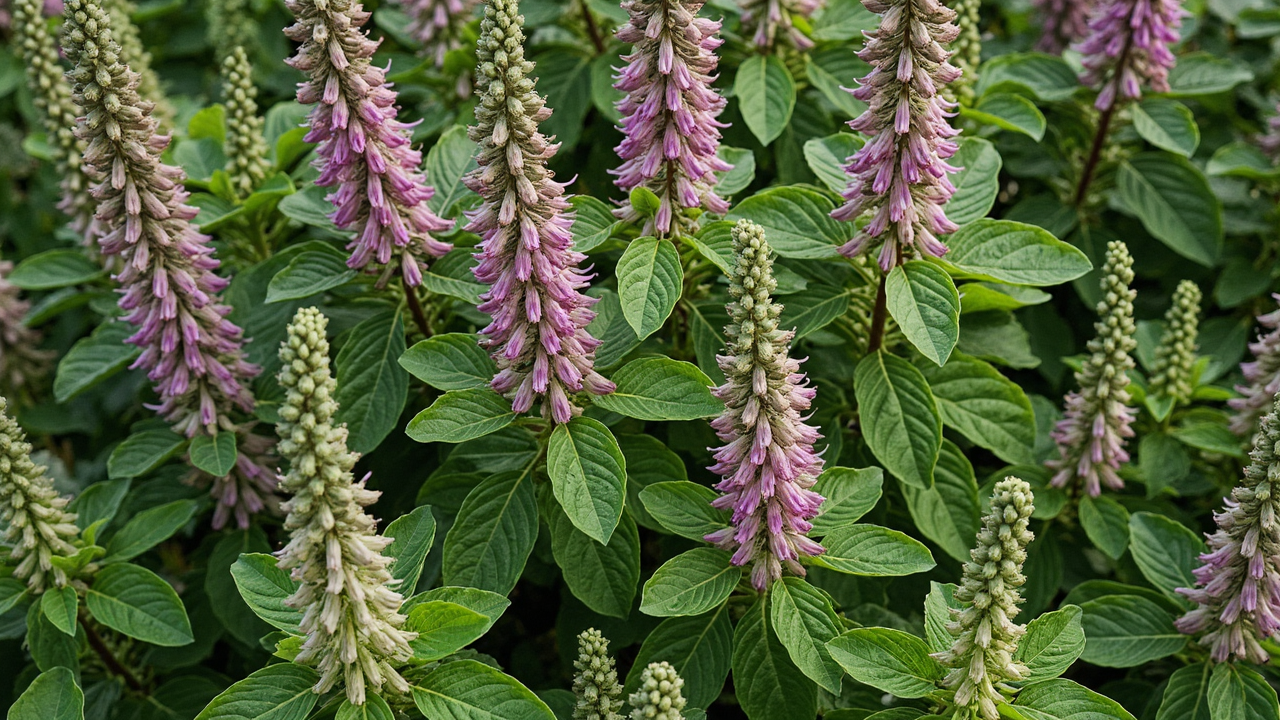
Basil is an annual, or sometimes perennial, herb. Depending on the variety, plants reach heights of 30 to 150 centimetres (1 to 5 feet). Leaves are glossy, ovulate, with smooth or slightly toothed edges that typically cup slightly, arranged oppositely along square stems. Leaf colour varies between green and purple. Flowers are small and white, growing from a central inflorescence or spike emerging from the central stem. The floral structure differs from typical Lamiaceae, with stamens and pistil lying over the inferior corolla lip rather than under the upper lip. After pollination, the corolla falls, leaving four round achenes within the bilabiate calyx.
Origin and Habitat
Basil is native to tropical regions stretching from Central Africa to Southeast Asia, including India. It has become globalised through human cultivation and is now grown worldwide in Mediterranean, temperate, and subtropical climates.
Cultivation
Basil prefers hot, dry conditions and grows best under full sun. It requires well-drained organic soils for optimal root development, as poor drainage can cause root hypoxia, negatively affecting growth and essential oil yield. In temperate regions like Northern Europe, Canada, northern US states, and South Island New Zealand, it is typically sown under glass in peat pots before planting out in late spring/early summer to avoid frost. It can also be sown directly in soil after the last frost. Basil thrives in sunny windowsills indoors, away from cold drafts, and can be grown under supplemental lighting or in greenhouses. It tolerates cultivation in basements under fluorescent lights.
Care and Maintenance
Pinch off flower stems before full maturity to prevent foliage production decline on that stem, stem woodying, and reduced essential oil production. Picking leaves promotes new growth by encouraging the conversion of leaflets into new stems. If allowed to flower, basil produces seed pods containing small black seeds, which can be saved for sowing the following year. Plants may regrow the next year if allowed to go to seed.
Uses
Basil is primarily used fresh in culinary applications, added last to recipes to preserve flavour. Common Mediterranean cultivars include Genovese, Purple Ruffles, Mammoth, Cinnamon, Lemon, Globe, and African Blue. It is a key ingredient in pesto and used in sauces, salad dressings, soups, and to infuse oils, vinegars, cream, or milk for desserts. Lemon basil, rich in citral, is used in Indonesian cuisine (kemangi) and Asian drinks like faluda or sharbat-e-rihan. Basil seeds, when soaked, become gelatinous and are used in desserts and beverages. It is also utilised in folk medicine practices such as Ayurveda and traditional Chinese medicine, and its essential oil exhibits insecticidal and repellent properties.
#Basil #Ocimumbasilicum #CulinaryHerb #Lamiaceae #HerbGardening #UKGardening #GardenWizz #BasilUses #HerbCare #PlantTaxonomy
Cultivars and Varieties
| Cultivar | Height | Flower | Notes | AGM |
|---|---|---|---|---|
| 'Anise basil, Licorice basil, or Persian basil (O. basilicum ' | — | — | — | |
| 'Cinnamon basil (Ocimum basilicum 'Cinnamon')' | — | — | — | |
| 'Dark opal basil (Ocimum basilicum 'Dark Opal')' | — | — | — | |
| 'Genovese basil or Sweet Basil (Ocimum basilicum)' | — | — | — | |
| 'Globe basil, dwarf basil, French basil (Ocimum basilicum 'Mi' | — | — | — | |
| 'Greek basil (Ocimum basilicum var. minimum)' | — | — | — | |
| 'Lettuce leaf basil (Ocimum basilicum 'Crispum')' | — | — | — | |
| 'Purple Delight' | — | — | purple leaves |
Pests and Diseases
| Problem | Symptoms | Management |
|---|---|---|
| Fusarium wilt | soil-borne fungal disease that will quickly kill younger basil plants | — |
| Pythium damping off | seedlings may be killed by Pythium damping off | — |
| Gray mold (Botrytis cinerea) | common foliar disease of basil | — |
| Black spot (Colletotrichum genus) | seen on basil foliage | — |
| Downy mildew (Peronospora belbahrii) | significant disease | — |
Quick Care Summary
| Sunlight | Full sun |
|---|---|
| Soil | well-drained organic soils |
| Hardiness | — |
| Sow | March–October |
| Plant | March–October |
| Prune | June–September |
Facts sourced from Wikipedia / Ocimum basilicum (https://en.wikipedia.org/wiki/Ocimum_basilicum)
As an Amazon Associate, GardenWizz earns from qualifying purchases made through the links above. This does not affect the price you pay. See our disclaimer for details.