
Willow
Salix viminalis
At a Glance
| Botanical name | Salix viminalis |
|---|---|
| Common name(s) | Willow |
| Family | Salicaceae |
| Plant type | shrub (Deciduous; dioecious with male and female catkins on separate plants.) |
| Height × Spread | 300–600 cm × — |
| Hardiness | H7 (to -20.0 °C) |
| Position | Full sun |
| Soil | Moist but well-drained; grows in most moist soils except those that are alkaline. Tolerates clay, loam, and sand. |
| Flowering | March–May |
| Toxicity | — |
| Native range | Europe, Western Asia, and the Himalayas |
Overview
Common osier (Salix viminalis), often called basket willow, is a vigorous deciduous shrub or small tree grown throughout the United Kingdom for its long, flexible rods and its value to wildlife. The following quick-care table summarises the essentials for UK growers; the full article below covers each in detail.
Salix viminalis is a fast-growing willow native across much of Europe and western Asia and long naturalised in lowland Britain, where it thrives in damp ground, riverbanks, ditches and the edges of wet woodland. In the wild it forms a multi-stemmed shrub or small tree 4 to 8 m tall, but in cultivation it is almost always grown as a coppice, cut back hard to ground level on a one- to three-year cycle to produce a steady supply of straight, pliable rods. These rods, traditionally called "withies" or "osiers", have been cut and woven in Britain since at least the Roman period and remain the raw material for baskets, hurdles, living structures and biomass. The species is one of the parents of many commercial basket-willow cultivars and is also planted widely for soil stabilisation, riverbank reinforcement, flood mitigation and as a pollen and nectar source for bees and other early-flying insects. The Royal Horticultural Society recognises it as a reliable garden and landscape plant for the whole of the United Kingdom.
Appearance
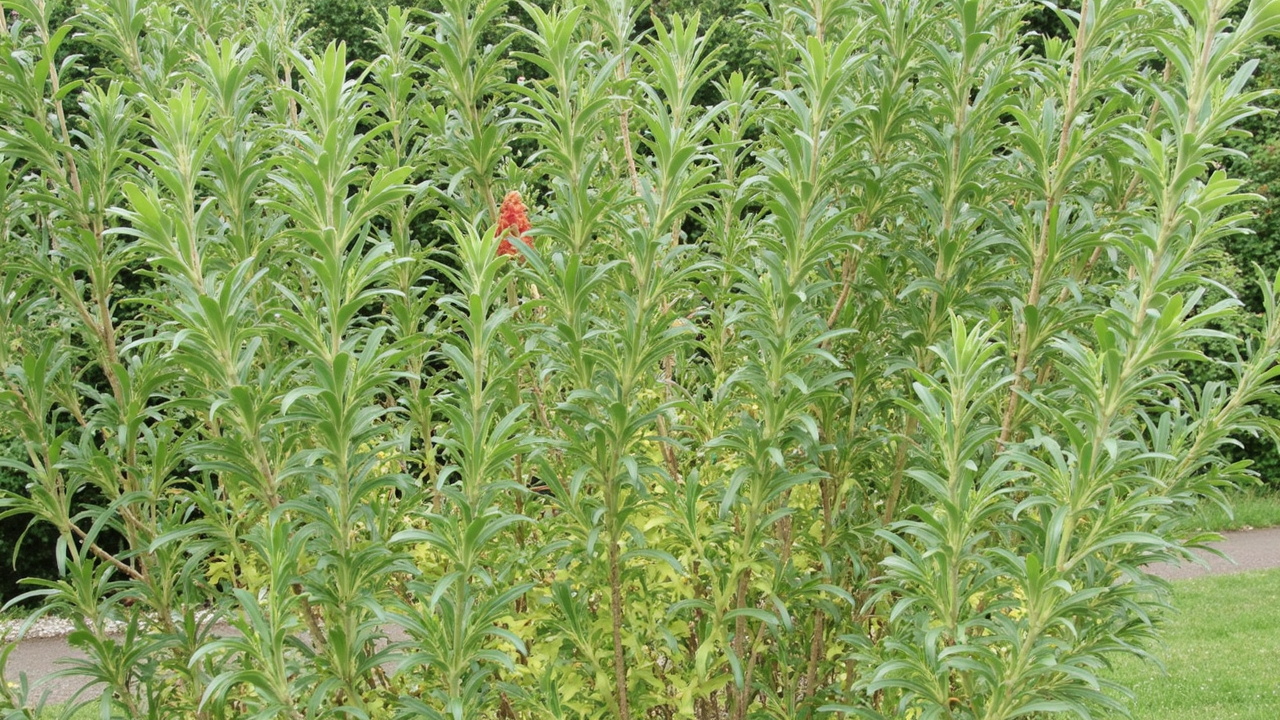
In its uncoppiced form, Salix viminalis develops a loose, upright habit with multiple slender trunks rising from ground level. Mature bark is grey-brown, smooth on young stems and shallowly fissured on older wood. The shoots grown in a single season are the most distinctive feature of the plant: long, straight, flexible and lightly downy when young, maturing to a polished yellow-green or olive-brown and reaching 2 to 3 m in a single growing season under coppice. Buds are alternate, narrow, pressed close to the stem, and flushed red-brown. The leaves are narrowly lance-shaped, 10 to 25 cm long and 1 to 3 cm wide, with an untoothed or very finely wavy margin, a pointed tip and a silvery underside covered in fine silky hairs. The upper surface is a dull dark green. When coppiced, the plant produces a dense stool of vigorous new rods each year, with leaves clustered along their full length and a fine fountain of foliage at the cut height. Catkins appear in April and May, before or alongside the new leaves: male catkins are cylindrical, yellow and conspicuous, 2 to 4 cm long, and borne in profusion; female catkins are longer, greener and less showy. The two sexes occur on separate plants, and named cultivars in cultivation are almost always male, selected for vigorous rod production rather than for ornamental flower value. The overall impression of a well-grown stool in summer is of a tall, leafy fountain of narrow silver-backed foliage that rustles in the slightest breeze.
Growing Conditions
Common osier performs best in full sun, in deep, moist to permanently damp loam. It is one of the most tolerant of all willows in wet ground and is widely planted beside ponds, along ditches, on the margins of streams and in deliberately waterlogged land where little else will grow. The species tolerates a wide pH range, from roughly pH 4.5 to 8.0, and grows well in clay, silt and peaty soils provided they do not dry out completely in summer. Established plants will also cope with occasional short periods of drought, although rod quality and length suffer in dry seasons. In the United Kingdom the Royal Horticultural Society rates Salix viminalis as hardy to H6, meaning it tolerates winter temperatures of -15 to -20 °C and can be grown reliably in every lowland region of Britain and Ireland, including upland and exposed northern sites. The species has a strong preference for open ground; in dense shade it grows thin and leggy and produces poor rods. Cold, exposed wind is not a problem once the plant is established, though a very exposed position will shorten the rods through die-back at the tips. Common osier is unsuitable only for permanently dry, sandy or shallow soil over rock, and for very alkaline, free-draining chalk that dries out in summer; on such sites the closely related Salix purpurea or Salix triandra is generally a better choice. Wind-pollinated and prolific in pollen and nectar, osier catkins provide one of the earliest substantial sources of food for bumblebees, solitary bees, hoverflies and small butterflies in the British spring.
Planting and Care
Plant bare-root whips or pot-grown specimens between November and March, spacing them 30 to 50 cm apart for a dense rod-producing coppice or 1 to 1.5 m apart for an uncut wildlife shrub. Set the plants to the depth of the nursery soil mark, firm in well, and water thoroughly if the ground is dry; thereafter, watering is rarely needed except in the first summer after planting. Annual maintenance is straightforward and follows a clear seasonal rhythm. Watering is seldom required on suitable damp ground; in unusually dry summers on free-draining soil, a deep soak once a fortnight keeps the foliage from flagging. Feeding is light: a mulch of well-rotted farmyard manure or garden compost in late winter, or a single application of a general-purpose fertiliser in early spring, is sufficient, and over-rich feeding produces soft growth that is more susceptible to disease and breakage. Pruning and coppicing are the central tasks. For rod production, cut the entire stool back to within 5 to 10 cm of ground level every one to three years in late winter, between January and March before the sap rises, using sharp secateurs or loppers for small stools and a billhook or bow saw for large ones. The cut stems dry slowly if bundled and stood in a cool, airy shed, and can be stored for many months before use. For an uncut landscape shrub, remove a proportion of the oldest stems to ground level each winter to encourage vigorous new growth and prevent the centre of the plant from becoming bare. Propagation is easy from hardwood cuttings taken in winter: 20 to 30 cm sections of one-year-old rod, pushed two-thirds deep into moist soil, root freely in a single growing season with no need for hormone or a propagator. Softwood cuttings in early summer also root well under mist or in a shaded cold frame. Pests and diseases of willows generally are covered in the next section; routine care otherwise is light. Seasonal care in the UK is, in summary: plant between November and March, mulch in late winter, coppice or thin in late winter if required, and water only in the first year or in prolonged drought.
Common Problems
Common osier is vigorous and largely trouble-free in the right conditions, but a small number of pests and diseases are worth knowing. Willow anthracnose (caused by the fungus Marssonina salicicola) is the most frequent foliar problem and shows as small dark brown to black spots on the leaves, premature leaf fall and, in severe seasons, die-back of shoot tips; collecting and burning fallen leaves in autumn and pruning out badly affected rods in late winter are usually sufficient in a garden setting, and resistant cultivars are available. Willow scab (Venturia saliciperda) and black canker (Glomerella miyabeana) often occur together and produce similar black lesions on leaves, shoots and catkins; again, prompt removal of affected material and good air movement through the stool are the main controls. The willow bean-gall sawfly (Pontania proxima) causes smooth, bean-shaped red galls on the leaves in summer; the galls are unsightly but rarely affect the long-term vigour of the plant. Larger pests include the goat moth caterpillar, the larvae of the eyed hawk-moth and, on young stems, the willow weevil; none is usually serious on a vigorous stool. In waterlogged ground with poor air movement, crown and root rots can occur, particularly on sites that have grown willows or poplars previously, where replant disease is a known risk; the standard remedy is to plant a non-willow cover crop for two or three years before replanting, or to choose a fresh site. Brittle shoots and storm damage are usually a sign of overcrowded stools, drought stress or old wood; routine coppice prevents all three. The plant is not considered toxic to humans or to dogs and cats, although, like most willows, it contains salicin and small amounts of salicylic-acid-related compounds, and livestock should not be allowed unrestricted access to freshly cut stumps.
Popular Varieties
Salix viminalis itself is usually sold as a species, but a small number of named clones and hybrids are widely available in the United Kingdom for specific purposes. 'Bowles's Black' is a vigorous selection with particularly dark green stems and a slightly more open habit, often planted as a landscape shrub for its winter stem colour; the Royal Horticultural Society has not, to current knowledge, awarded it the Award of Garden Merit, and ratings should be checked before quoting them. 'Read' and 'Dark Newkind' are traditional basket-willow clones grown in Somerset and the East Anglian fens for many decades, selected for long, straight, unbranched rods in a single season and widely used by professional basket-makers. 'Q83' is a biomass selection bred for high yield on short coppice rotations and is the standard commercial variety in many UK short-rotation coppice plantings. Hybrids such as Salix × smithiana (S. viminalis × S. caprea) and the complex hybrids sold as Salix × dasyclados combine the vigour and rod length of common osier with the broader leaves and denser growth of goat willow, and are commonly grown in larger-scale coppice and biomass schemes. For garden planting where a shorter, more ornamental shrub is preferred, the closely related Salix purpurea 'Nancy Saunders' and Salix triandra 'Black Maul' are often better choices than Salix viminalis itself, and they are covered in their own entries on GardenWizz. Where a specific cultivar is to be named in a planting scheme, growers should confirm the clone with the supplier, as many named basket-willow selections are regional and not all are available through general garden centres.
Pests and Diseases
| Problem | Symptoms | Management |
|---|---|---|
| Anthracnose | Leaves develop brown spots and may drop prematurely, with sunken cankers appearing on stems in severe cases. | Prune out infected shoots promptly and rake up fallen leaves to reduce the source of fungal spores. |
| Willow rust | Dusty orange, brown or black pustules appear on the upper leaf surface with small orange spots underneath. | Control is rarely needed as damage is minimal; remove fallen leaves in autumn to reduce resting spores. |
| Large willow bark aphid | Dense colonies of greyish-black aphids form on the bark during summer and autumn, potentially causing sticky honeydew. | Usually harmless and part of garden biodiversity; tolerate unless infestation is severe, then use natural predators. |
| Willow scab | Dark, sunken lesions or cankers develop on the stems and branches, resembling black canker. | Maintain good garden hygiene by removing diseased growth and debris to prevent spread. |
| Vine weevil | Young willow rods or potted plants show notched leaf margins at night and root damage leading to wilting. | Apply nematodes to the soil in late summer or use physical barriers like sticky bands around pots. |
Quick Care Summary
| Sunlight | Full sun |
|---|---|
| Soil | Moist but well-drained; grows in most moist soils except those that are alkaline. Tolerates clay, loam, and sand. |
| Hardiness | H7 (-20.0 °C) |
| Sow | — |
| Plant | January, February, December |
| Prune | January, February, December |

As an Amazon Associate, GardenWizz earns from qualifying purchases made through the links above. This does not affect the price you pay. See our disclaimer for details.