
Wisteria
Wisteria sinensis · Chinese wisteria
At a Glance
| Botanical name | Wisteria sinensis |
|---|---|
| Common name(s) | Chinese wisteria |
| Family | Fabaceae |
| Plant type | climber |
| Height × Spread | 2000–3000 cm × — |
| Hardiness | — (to -20.0 °C) |
| Position | Full sun |
| Soil | — |
| Flowering | April |
| Toxicity | Wisterine |
| Native range | China (Guangxi, Guizhou, Hebei, Henan, Hubei, Shaanxi, Yunnan) |
Overview
Wisteria sinensis, commonly known as Chinese wisteria, is a deciduous climber in the pea family. It is widely cultivated in temperate regions for its twisting stems and masses of scented flowers produced in spring. The plant grows to a height of 20–30 m (66–98 ft) and is native to China.
Botanical Description
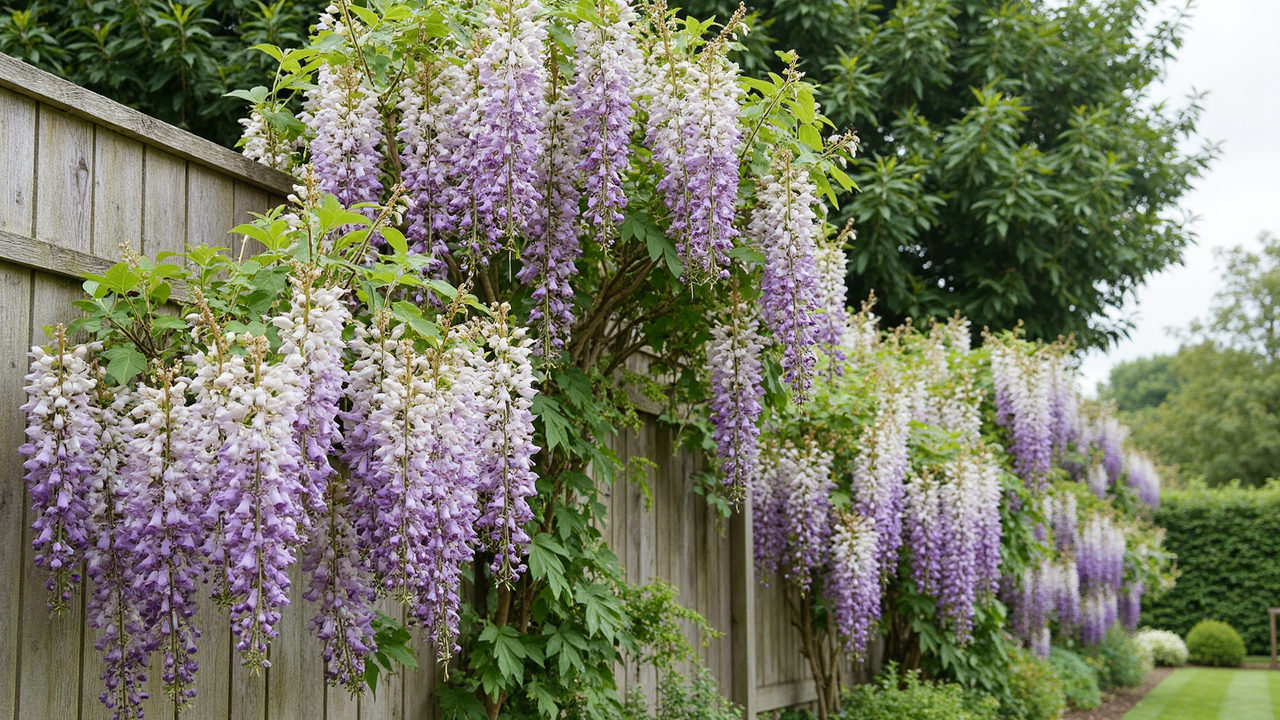
Wisteria sinensis clings to supports via counterclockwise-twining stems. Its leaves are shiny, green, and pinnately compound, measuring 10–30 cm in length, with 9–13 oblong leaflets each 2–6 cm long. The flowers are white, violet, or blue, borne on 15–20 cm racemes before leaf emergence in spring. They open simultaneously, emit a distinctive grape-like fragrance, and are produced in greater quantity than Wisteria floribunda despite shorter racemes. The fruit is a flattened, brown, velvety bean-like pod 5–10 cm long containing thick disk-like seeds. All parts contain the toxic glycoside wisterine, causing nausea, vomiting, stomach pains, and diarrhea if ingested.
Origin and Habitat
Native to China, Wisteria sinensis is found in the provinces of Guangxi, Guizhou, Hebei, Henan, Hubei, Shaanxi, and Yunnan. It thrives in temperate climates and has become invasive in parts of the eastern United States where the climate resembles its native range.
Cultivation
Wisteria sinensis was introduced to Europe from China in 1816 by agents of the East India Company. It is now a staple ornamental vine in temperate gardens worldwide. The plant is most commonly trained along garden walls, building exteriors, or pergolas to create overhanging blossom displays, and may also be trained as a freestanding tree. It is sensitive to cold, being root hardy to USDA Zone 5 but susceptible to dieback during severe frosts. A 200-year-old specimen at Griffin’s Brewery, Chiswick, London, is cited as the UK’s oldest living wisteria. The Sierra Madre Wisteria in California, planted in 1892, holds the Guinness World Record for the largest blossoming plant, covering 0.4 ha (1 acre) with branches 152 m (500 ft) long by 1994.
Care and Maintenance
Prune after flowering to maintain shape and encourage future blooms. In colder regions (USDA Zones 5–6), spring frosts may kill latent flower buds, resulting in sporadic flowering. Avoid planting in areas prone to late frosts to prevent bud damage.
Uses
Primarily cultivated as an ornamental climber for its abundant, fragrant spring flowers and architectural growth habit. Several cultivars, including 'Alba', 'Prolific', 'Amethyst', and 'Jako', have gained the Royal Horticultural Society’s Award of Garden Merit for their ornamental qualities.
Cultivars and Varieties
| Cultivar | Height | Flower | Notes | AGM |
|---|---|---|---|---|
| 'Alba' | — | white | — | |
| 'Amethyst' → | — | reddish violet | extremely fragrant | ✓ |
| 'Prolific' → | — | purple | more abundant with larger racemes, blooms at an earlier age than the traditional cultivar | ✓ |
Pests and Diseases
| Problem | Symptoms | Management |
|---|---|---|
| invasive species | — | — |
| cold sensitivity | serious dieback during cold snaps, sporadic blooming due to spring frosts | — |
Quick Care Summary
| Sunlight | Full sun |
|---|---|
| Soil | — |
| Hardiness | — (-20.0 °C) |
| Sow | — |
| Plant | — |
| Prune | — |
Facts sourced from Wikipedia / Wisteria sinensis (https://en.wikipedia.org/wiki/Wisteria_sinensis)
As an Amazon Associate, GardenWizz earns from qualifying purchases made through the links above. This does not affect the price you pay. See our disclaimer for details.