
Beetroot
Beta vulgaris · beet
The Gardening Year
Best months in UK gardens · full planting calendar →
🖨 Printable care card (PDF)At a Glance
| Botanical name | Beta vulgaris |
|---|---|
| Common name(s) | beet |
| Family | Amaranthaceae |
| Plant type | perennial (rarely, biennial) |
| Height × Spread | 1.2–2 m × 10–50 cm |
| Position | Full sun, Partial shade |
| Soil | Moist but well-drained; fairly rich. |
| Flowering | — |
| Toxicity | No specific toxicity is listed by the RHS. This is not a guarantee of safety — check with a vet or the ASPCA before pets or children eat any plant. |
| Native range | southwestern, northern and Southeast Europe along the Atlantic coasts and the Mediterranean Sea, in North Africa, Macaronesia, to Western Asia |
Overview
Beetroot (Beta vulgaris) is a biennial root vegetable cultivated as an annual, grown in the UK for its swollen storage root and edible leaves. It belongs to the Amaranthaceae family (formerly Chenopodiaceae) and is closely related to chard, spinach and sugar beet. The species also encompasses leaf beet, Swiss chard and fodder beet, all forms of the same species developed for different edible parts. Beets are generally very easy to grow on British soil, performing well from spring sowings right through to autumn harvests, and they are a staple of the allotment and kitchen garden.
Beetroot has been cultivated in Britain for several centuries, with the familiar deep red, globe-shaped forms dating largely from the 19th century. The plant tolerates cool conditions and is well suited to the British climate, where it is sown from early spring under cloches or from April onwards in the open ground. Modern cultivars are bred for sweet flavour, uniform round roots, resistance to bolting and resistance to leaf diseases such as downy mildew and Cercospora leaf spot.
In UK gardens beetroot is grown for its roots, for baby salad leaves harvested young, and for chard-type leaves where chard cultivars are used. The roots are eaten boiled, roasted, pickled and raw, and the young tops are treated as a leafy green similar to spinach.
Appearance
Beetroot develops a swollen taproot that sits largely at or just above soil level, with a rosette of leaves rising directly from the crown. Root shapes vary by cultivar group: globe types produce rounded roots typically 5–8 cm across, long or tapering types produce cylindrical or tapered roots 15–25 cm long, and intermediate or "oblong" types sit between the two. Skin colour is most commonly deep purplish-red, but cultivars also exist in golden yellow, white, pink-striped (chioggia-type) and orange. The flesh is usually strongly pigmented in matching colours, with the exception of chioggia-types, which show concentric pink and white rings when sliced.
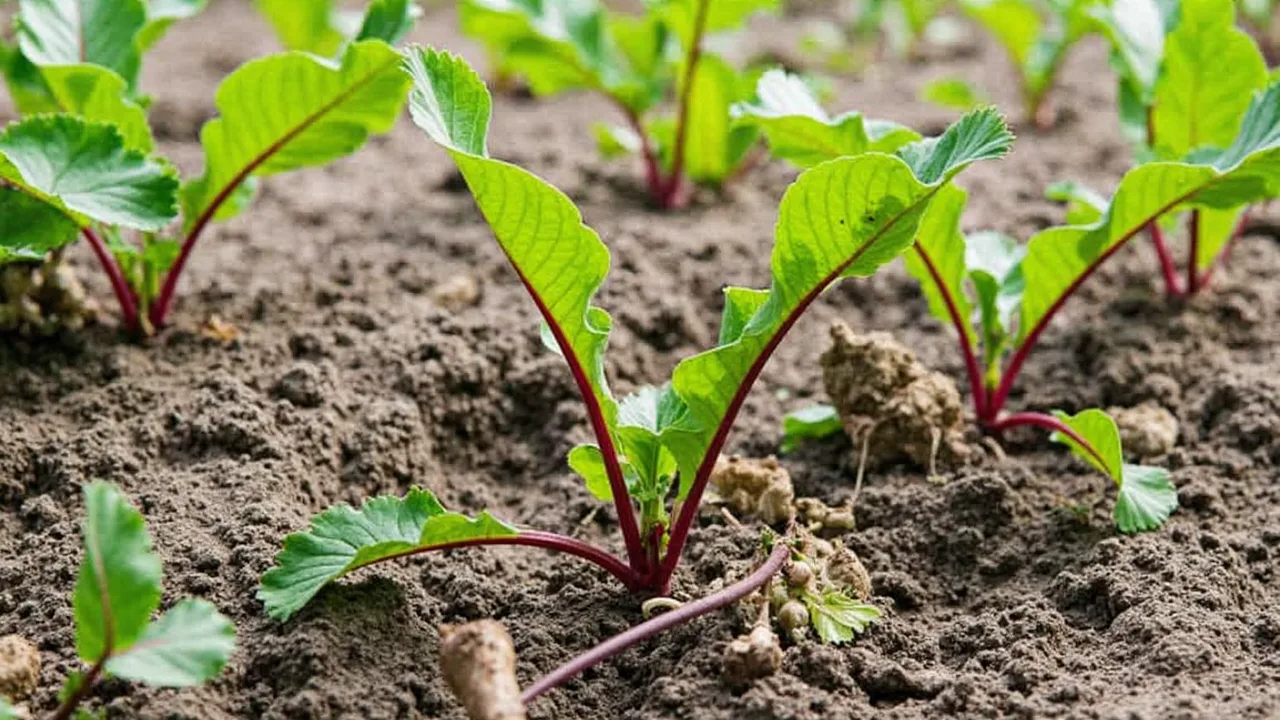
Leaves are glossy, ovate to heart-shaped, with prominent veining and a long, fleshy petiole. Leaf colour is green to dark green, often flushed with red or purple along the veins and stem. Foliage can reach 30–40 cm tall in mature plants, and the whole plant often stands 25–45 cm high including the root crown. The petioles and leaf veins of red cultivars carry the same betacyanin pigment as the root.
If a plant is left to overwinter or is not harvested in its first year, it bolts in its second season, sending up a branched flower stem up to 1.2 m tall. The flowers are small, greenish, and wind-pollinated, producing small, hard, kidney-shaped seed clusters that actually contain several true seeds. This multigerm seed is the traditional form; monogerm cultivars, where each cluster germinates as a single seedling, are now also widely available.
Growing Conditions
Beetroot grows well across most of the UK, from the milder southwest to the cooler north. It prefers a sunny, open position but tolerates light shade, particularly in midsummer. Soil should be fertile, moisture-retentive and free-draining, with a pH of around 6.5 to 7.5. Acidic soils below pH 6.0 may cause poor growth and may benefit from liming; very alkaline soils are tolerated but reduce availability of some micronutrients. The RHS classifies Beta vulgaris as hardy in the UK, generally rated H5 (hardy in most of the UK down to around -10 to -15 °C) for the root in the ground through winter, though hardiness of overwintered roots depends on cultivar and exposure.
Soils recently manured tend to produce forked or hairy roots; ground manured the previous autumn is ideal. Heavy clay can be improved with organic matter and raised beds to encourage straight, well-shaped roots. Sandy soils are suitable provided irrigation is reliable, as moisture stress leads to woody, poor-flavoured roots and premature bolting.
Beetroot is tolerant of cool conditions. Germination occurs from 7 °C upwards, with optimum germination around 15–21 °C. Mature roots withstand several degrees of frost and can be left in the ground through winter in much of southern and central England, particularly under a thick mulch of straw. In colder regions and in Scotland, late crops are usually lifted and clamped in autumn.
Planting and Care
Sowing. Direct sow where the plants are to grow; beetroot does not transplant well. Sow from March to July for a continuous harvest. Early sowings in February and March benefit from cloche protection or fleece. Sow in drills 2.5 cm deep, with rows 25–30 cm apart for globe types and 30–35 cm apart for long types. Thin seedlings to 7–10 cm apart for small salad roots or 10–15 cm apart for larger maincrop roots. Because traditional seed is multigerm, two or three seedlings often emerge from one cluster; thin to the strongest, or transplant the thinnings carefully with their taproot intact.
Watering. Keep soil consistently moist during germination and early growth. Drought stress leads to bolting, woody texture and poor flavour. As a guide, water deeply once or twice a week in dry spells rather than sprinkling lightly each day. Mulching with organic matter between rows helps conserve moisture and suppress weeds.
Feeding. Beetroot is a moderate feeder. On reasonably fertile ground, a single application of a general-purpose fertiliser such as growmore at sowing, or a top-dressing of blood, fish and bone in late spring, is sufficient. Avoid fresh, high-nitrogen feeds, which encourage excessive leaf growth at the expense of roots. Soils low in boron can produce internal brown spotting of the root (heart rot or "speckled yellows"); a pinch of borax dissolved in water applied once per square metre corrects this, but do not exceed the dose as boron is toxic in excess.
Pruning and thinning. Apart from thinning seedlings, no pruning is needed. Remove yellowing or heavily mildewed leaves to keep the crop clean and to improve air circulation. Cut, do not pull, the leaves when harvesting for the kitchen, leaving the growing point intact if the root is to be kept.
Propagation. Beetroot is propagated by seed. For most gardeners this means fresh seed purchased each year, as viability drops noticeably after two to three years. To save your own seed, leave a few overwintered roots to bolt and flower in their second year, isolate from other Beta vulgaris flowering crops (chard, perpetual spinach, mangel) to maintain purity, and collect the seed clusters once they have dried on the plant. Rub the clusters to release the seeds and store in a cool, dry place.
Seasonal care. Sow successionally from March to July at three- to four-week intervals for a continuous harvest. Pull baby roots at golf-ball size from June onwards, maincrop roots from July to October, and store or clamp later harvests. In milder regions, leave roots in the ground under a thick straw mulch through winter, lifting as needed; otherwise lift in October or November, twist off the tops, and store in boxes of damp sand or leaf mould in a cool shed. Overwintered roots bolt in spring and should be used before flowering or left for seed.
Common Problems
Bolting. Early sowings, drought and root disturbance can all cause plants to run to flower in their first year. Choose bolt-resistant cultivars for early sowings, water consistently, and thin carefully. Bolted plants are still edible as baby leaves but produce tough, inedible roots.
Fungal leaf spots. Cercospora leaf spot (purple-bordered grey spots) and downy mildew (yellow patches with grey down beneath) are the most common foliar diseases in UK beets, particularly in wet summers. Improve air circulation by adequate spacing, water at the base of plants rather than overhead, clear up infected leaves, and grow resistant cultivars where available.
Beet leaf miner and leaf spot. The leaf miner fly (Pegomya hyoscyami) lays eggs on the undersides of leaves; the larvae tunnel within the leaf, producing pale blotches. Remove and destroy affected leaves; in severe cases cover crops with fine insect mesh. Flea beetles can pepper young leaves with small holes; damage is usually cosmetic and plants grow through it.
Root disorders. Forked or fanged roots are caused by stones, fresh manure or compaction. Internal black or brown spots (heart rot) indicate boron deficiency. Hollow roots can follow uneven watering. None of these render the crop inedible, and the underlying cause can be corrected the following season.
Pigeons and slugs. Wood pigeons can strip young foliage in winter and early spring; netting is the most reliable deterrent. Slugs attack seedlings and the crowns of mature roots, especially in damp conditions.
Toxicity. Beetroot is widely grown as a food and forage crop. The leaves contain oxalates in moderate amounts and are best eaten cooked; the safety of large quantities of raw leaves is not well established in humans. GardenWizz is not aware of any specific toxicity hazard to humans from normal culinary use of roots or cooked leaves. Beets are not generally listed as toxic to dogs or cats in small amounts, but as with any garden produce, large quantities can cause digestive upset, and the pet-specific literature is limited; if concerned, consult a veterinarian.
Popular Varieties
Several reliable, UK-available cultivars cover the main beetroot shapes and colours. The following are widely sold in British seed catalogues and garden centres.
- 'Boltardy' – the classic British globe beetroot. Smooth, deep red roots, sweet flavour, and good resistance to bolting that makes it the standard choice for early sowings.
- 'Detroit 2' (sometimes sold as 'Detroit Dark Red') – a heritage globe type with uniform, deep red roots and a fine flavour. Reliable, widely available and a good maincrop choice.
- 'Chioggia' – an Italian heirloom with pink-skinned roots and concentric pink-and-white rings inside. Sweet, mild flavour and an attractive slicing beet for salads.
- 'Burpee's Golden' – a golden-yellow globe beet with yellow flesh that does not bleed when cooked. Good flavour and a useful alternative to red types.
- 'Cylindra' (also sold as 'Formanova') – a long, cylindrical, deep red beet ideal for slicing; produces uniform slices of equal size, popular for pickling.
- 'Pablo' – an F1 hybrid globe type with very uniform, smooth roots, often grown as a baby or golf-ball-size beet. Strong resistance to bolting and good for early sowings.
- 'Bull's Blood' – grown primarily for its dark red-purple leaves, used as a salad leaf, though it also produces edible small red roots.
Cultivars and Varieties
| Cultivar | Height | Flower | Notes | AGM |
|---|---|---|---|---|
| 'Altissima Group' | — | — | sugar beet | |
| 'Cicla Group' | — | — | spinach beet or chard | |
| 'Conditiva Group' | — | — | beetroot or garden beet | |
| 'Crassa Group' | — | — | mangelwurzel | |
| 'Flavescens Group' | — | — | swiss chard |
Pests and Diseases
| Problem | Symptoms | Management |
|---|---|---|
| lack of boron | meristem and the shoot to languish, eventually leading to heart rot | — |
Or browse the full plant problem solver to diagnose an issue by symptom.
Beetroot in our guides
- Containers for Growing Vegetables
- Growing Vegetables from Seed
- Summer Vegetable Garden: What to Grow and When
As an Amazon Associate, GardenWizz earns from qualifying purchases made through links on this page (including links within the article). This does not affect the price you pay. See our disclaimer for details.