
Hydrangea
Hydrangea macrophylla · bigleaf hydrangea · lacecap hydrangea · mophead hydrangea · hortensia
The Gardening Year
Best months in UK gardens · full planting calendar →
🖨 Printable care card (PDF)At a Glance
| Botanical name | Hydrangea macrophylla |
|---|---|
| Common name(s) | bigleaf hydrangea, lacecap hydrangea, mophead hydrangea, hortensia |
| Family | Hydrangeaceae |
| Plant type | shrub (deciduous) |
| Height × Spread | 3 m × 2.5 m |
| Position | Full sun, Partial shade |
| Soil | moist but well-drained soil |
| Flowering | June–November |
| Toxicity | hydrangine |
| Native range | Japan |
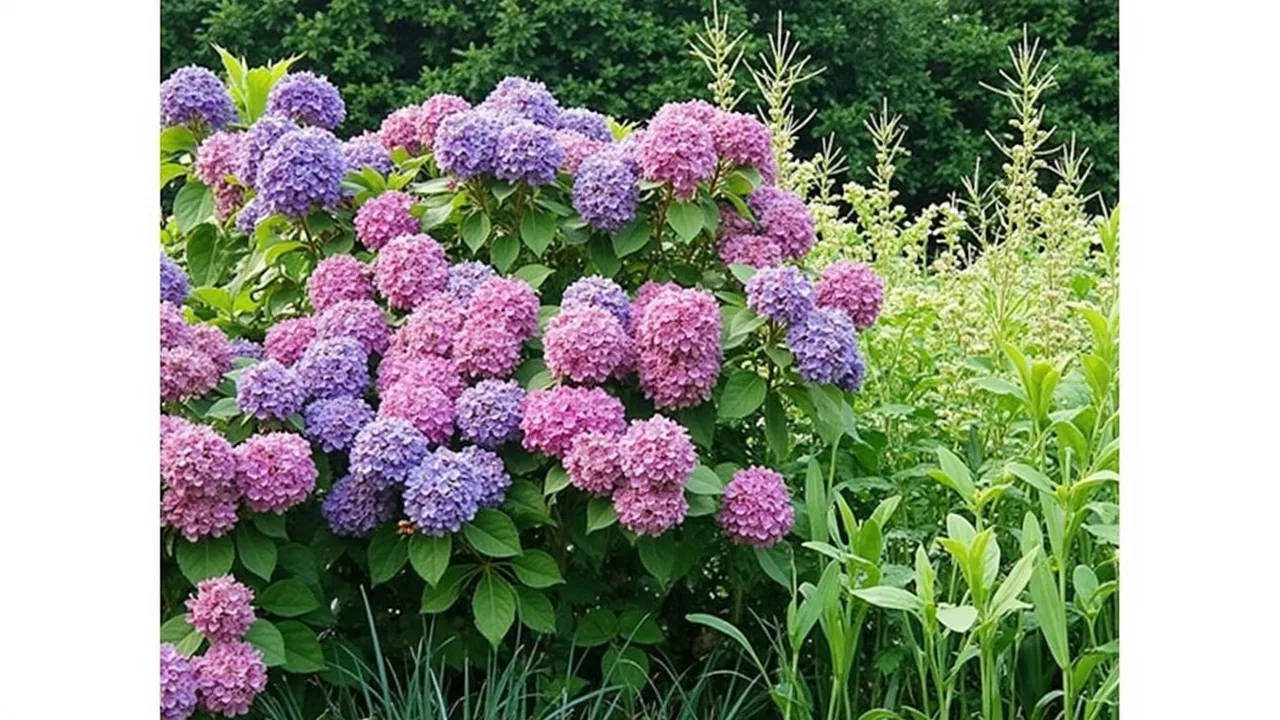
Bigleaf hydrangea (Hydrangea macrophylla) is a deciduous flowering shrub native to coastal Japan and parts of Korea and eastern China. It is widely grown in British gardens for its bold, summer-long display of large flower heads, which may be mophead (rounded, ball-like clusters) or lacecap (flat with a ring of showy florets around smaller central buds). In acidic soils the flowers tend towards blue, while neutral to alkaline soils produce pink or red shades; white-flowered cultivars are largely unaffected by soil pH.
Overview
Hydrangea macrophylla is one of the most popular garden shrubs in the UK, valued for its long flowering period, its tolerance of coastal conditions, and its ability to thrive in dappled shade where many summer-flowering shrubs struggle. It is well suited to milder regions including the south-west, Wales, the south coast and much of Ireland, and it performs reliably in sheltered urban gardens further north. In cold inland districts and exposed sites in Scotland and northern England, late spring frosts can damage young growth and flower buds, which is the main reason flowering is sometimes disappointing in those areas.
The species was introduced to European horticulture in the late 18th and early 19th centuries, and breeding since then has produced a wide range of cultivars with improved hardiness, compact habit, and reblooming tendencies. Old-style "mophead" varieties flower on the previous year's wood, which makes pruning technique important; newer "remontant" or "Endless Summer-type" cultivars flower on both old and new wood and are more forgiving.
The most commonly asked practical question is how to change flower colour. For mophead and lacecap cultivars that are not fixed-white, aluminium availability in the soil drives the blue end of the spectrum. Acidic soil (pH below about 5.5) with free aluminium produces blue flowers; neutral to alkaline soil (pH 6.5 and above) locks up aluminium and gives pink or red. Gardeners can shift the balance with aluminium sulphate (to blue) or with lime (to pink), though changes take a season or two and are not always reliable in containers.
Appearance
Bigleaf hydrangea forms a rounded, multi-stemmed shrub with stout, often suckering branches. The leaves are the most useful identification feature: they are large, broadly oval to elliptical, 10–20 cm long, with a pointed tip, a coarsely toothed margin, and a slightly leathery, glossy surface. The upper leaf surface is a fresh mid-green; the underside is paler and sometimes faintly downy along the veins. In autumn the foliage often turns dull yellow before falling, though it is not a notable autumn feature.
The flowers appear in dense terminal clusters at the ends of the current season's laterals. In mophead types the whole inflorescence is made up of sterile, four-petalled florets packed into a globe, typically 12–20 cm across. In lacecap types the central part of the cluster is composed of small, fertile buds surrounded by a ring of showy sterile florets, giving a flatter, more open head about 10–15 cm across. Colours range from pure white through cream, pink, rose, red, lilac, mauve, violet, and a clear blue, depending on cultivar and soil chemistry. Flowers dry on the plant and often remain attractive well into winter.
Growing Conditions
Hydrangea macrophylla grows best in a sheltered spot with morning sun and afternoon shade, or in light dappled shade beneath taller trees. It dislikes hot, dry root runs and is prone to wilting in sandy soil in midsummer. The ideal soil is moist but well-drained, rich in organic matter, and slightly acidic to neutral. A thick mulch of leafmould, garden compost or well-rotted bark helps to keep roots cool and moist through summer.
In most of lowland Britain, established plants in the right place need little attention once established, but cold sites and thin, chalky soils are the two situations to avoid. On thin chalk the plant will survive but typically shows chlorosis (yellowing between the leaf veins) and flowers poorly; a deep, improved planting pocket helps. In cold inland gardens, planting against a warm south- or west-facing wall, and avoiding east-facing sites where late frosts catch early growth, makes a real difference. Container culture is straightforward provided the pot is large enough (at least 40 cm across), kept consistently moist, and given a balanced slow-release fertiliser in spring.
Planting and Care
Watering. Consistent moisture is the single most important factor. Plants in the ground should receive a thorough soak during dry spells in May, June and July, when next year's flower buds are forming. Container-grown plants may need watering daily in warm weather. Rainwater is preferable in hard-water areas, particularly for blue-flowered cultivars, because mains water tends to raise the pH of the compost over time.
Feeding. A general-purpose shrub fertiliser applied in spring is usually sufficient. For blue cultivars in pots, an acid-loving (ericaceous) feed helps maintain acidity. Avoid heavy high-nitrogen feeds, which promote soft leafy growth at the expense of flowers and can reduce hardiness.
Pruning. Most mophead and lacecap H. macrophylla cultivars flower on wood produced the previous year, so the traditional advice is to do only minimal pruning: in mid-spring, cut back the old flower heads to just above a strong pair of buds, remove any weak or crossing shoots, and thin out perhaps a quarter of the oldest stems at the base on mature plants. Hard pruning reduces flowering for at least one season. Reblooming cultivars such as those in the Endless Summer and "Forever & Ever" series will flower on the current year's growth as well, so a lighter annual tidy is usually enough. [Note: the exact size and timing differences between specific reblooming series vary by breeder; consult the plant label for the individual cultivar.]
Propagation. The easiest method is softwood or semi-ripe cuttings in early to mid-summer: take non-flowering shoots about 10 cm long, trim below a leaf node, remove the lower leaves, and root in a 50:50 mix of peat-free compost and perlite under a clear cover. Layering of low branches also works well but is slower.
Seasonal care. In March or April, mulch with a 5–7 cm layer of organic matter and apply fertiliser. Deadhead in spring rather than autumn to protect buds from frost. Watch for slugs and snails on young growth in April and May. In cold areas, a fleece cover during hard spring frosts can prevent damage to emerging shoots. Container plants benefit from being moved to a sheltered corner or cold greenhouse over winter, particularly in the north.
Common Problems
Frost damage to buds. The most common cause of poor flowering in the UK is late spring frost damaging the overwintered flower buds. Plants in cold or exposed sites, or those pruned too hard in autumn, are most affected. The remedy is site selection and a light, spring-only pruning regime.
Powdery mildew. White fungal coating on leaves in late summer, especially on plants in dry shade or with poor air circulation. Improve airflow, avoid overhead watering, and remove affected leaves. Mildew-resistant cultivars are now widely available.
Leaf spot and grey mould (Botrytis). Brown spots on leaves or a grey fuzz on flowers in damp seasons. Generally cosmetic; remove and bin affected material and avoid overhead watering.
Chlorosis. Yellowing leaves with green veins usually indicates iron or manganese lock-out, often on chalky soils or in pots that have become too alkaline. Treat with a chelated iron drench and, long term, improve the soil or switch to ericaceous compost.
Pests. Aphids may appear on soft new growth in spring; hydrangea scale insect is occasionally seen in the south. Both are usually controlled by natural predators in a healthy garden, with insecticidal soap as a fallback if numbers build up.
Toxicity. Like many Hydrangea species, H. macrophylla contains cyanogenic compounds, particularly in the leaves and buds, and is regarded as mildly toxic if eaten in quantity. Some sources report that the plant can cause contact dermatitis in sensitive individuals. Gardeners handling large quantities of prunings or with grazing pets nearby should take sensible precautions; this summary should not be treated as a complete toxicology reference.
Popular Varieties
The following are real, widely available cultivars sold in UK garden centres and online nurseries. Flower colour is given as a typical result in neutral garden soil; blue types usually need acidic soil to perform true.
- 'Annabelle' — strictly speaking this is a smooth hydrangea (H. arborescens), but it is so often grouped with H. macrophylla in retail that it deserves mention: huge creamy-white mopheads on a compact, shade-tolerant shrub, around 1.2 m tall. (Listed here for clarity; not a true macrophylla.)
- 'Endless Summer' (The Original) — a reblooming mophead, flowering on both old and new wood, with large blue or pink heads depending on soil pH. Around 1.2–1.5 m.
- 'Nikko Blue' — a traditional mophead with large, rich blue flowers in acidic soil (pink in alkaline), broadly 1.2–1.5 m tall.
- 'Madame Émile Mouillère' — an old French lacecap, one of the most reliable whites, with pale pink or blue eye depending on soil. About 1.5 m, holds the RHS Award of Garden Merit in the UK.
- 'Möwe' (also sold as 'Glowing Embers') — a compact mophead with deep rose-pink to red flowers, good in pots, around 1 m.
- 'Lanarth White' — a tough, free-flowering lacecap with pure white ray florets, often considered one of the best whites for UK gardens. About 1.2 m.
- 'Veitchii' — a classic lacecap with pale blue to pink ray florets, widely sold and reliable, around 1.5 m.
A small number of cultivar names in the trade are known to vary between suppliers, and a few are sold under more than one name (for example 'Glowing Embers' and 'Möwe' are often treated as the same plant). Where a particular cultivar is critical to a planting plan, it is worth buying from a specialist nursery that can confirm the stock plant's identity.
Cultivars and Varieties
| Cultivar | Height | Flower | Notes | AGM |
|---|---|---|---|---|
| 'lacecap hydrangea' | — | small flowers surrounded by a halo of large sterile flowers | — | |
| 'mophead hydrangea' | — | large, sterile or mostly sterile tetramerous flowers | — |
Pests and Diseases
| Problem | Symptoms | Management |
|---|---|---|
| Slugs and snails | Irregular holes chewed in leaves and stems, often accompanied by silvery slime trails. | Use physical barriers like copper tape or crushed eggshells, and apply iron phosphate pellets. |
| Hydrangea scale | White oval waxy patches on stems and leaves, leading to yellowing foliage and reduced vigour. | Prune out heavily infested branches and treat with horticultural oil during the crawler stage. |
| Powdery mildew | A white, dusty fungal growth appears on leaves and flower buds, causing distortion. | Improve air circulation, avoid overhead watering, and apply a sulphur-based fungicide if severe. |
| Leaf spot | Dark brown or black spots with yellow halos develop on leaves, which may eventually drop. | Remove affected foliage and avoid wetting leaves when watering to reduce fungal spread. |
| Vine weevil | Notched edges on leaves during the day and root damage causing wilting at night. | Apply systemic insecticide granules to the soil in spring and autumn to control larvae. |
For step-by-step help, read Dealing with Slugs and Snails, Treating Powdery Mildew and Tackling Black Spot on Roses. Or browse the full plant problem solver to diagnose an issue by symptom.
Hydrangea in our guides
- Best Climbing Plants for UK Walls and Fences
- Gardeners urged to add one ingredient to water to stop plants wilting
As an Amazon Associate, GardenWizz earns from qualifying purchases made through links on this page (including links within the article). This does not affect the price you pay. See our disclaimer for details.