Lily of the Valley
Convallaria majalis
At a Glance
| Botanical name | Convallaria majalis |
|---|---|
| Common name(s) | Lily of the Valley |
| Family | Asparagaceae |
| Plant type | perennial (Herbaceous perennial that forms extensive colonies by spreading underground stems called rhizomes. Deciduous.) |
| Height × Spread | 15–35 cm × — |
| Hardiness | H7 (to -20.0 °C) |
| Position | Full shade, Partial shade |
| Soil | Fertile, humus-rich moist soil; loam; moist but well-drained or poorly-drained; pH acid, alkaline, or neutral. |
| Flowering | March–June |
| Toxicity | Highly poisonous/toxic if consumed by humans or animals due to cardiac glycosides. All parts including red berries are poisonous. |
| Native range | Europe, Western Asia and Northern Asia |
Overview
Lily of the Valley (Convallaria majalis) is a low-growing, rhizomatous perennial native to cool, shady woodland across Europe and parts of Asia, and one of the most recognisable spring-flowering plants in British gardens. It is grown chiefly for its strongly scented, nodding white bell flowers in May and for its ability to form dense, weed-suppressing colonies beneath deciduous trees and shrubs. The plant has been cultivated in British gardens since at least the sixteenth century and remains a fixture of cottage gardens, shaded borders and wild areas. All parts of the plant are toxic if ingested, a fact that has shaped both its folklore and its garden use.
Appearance
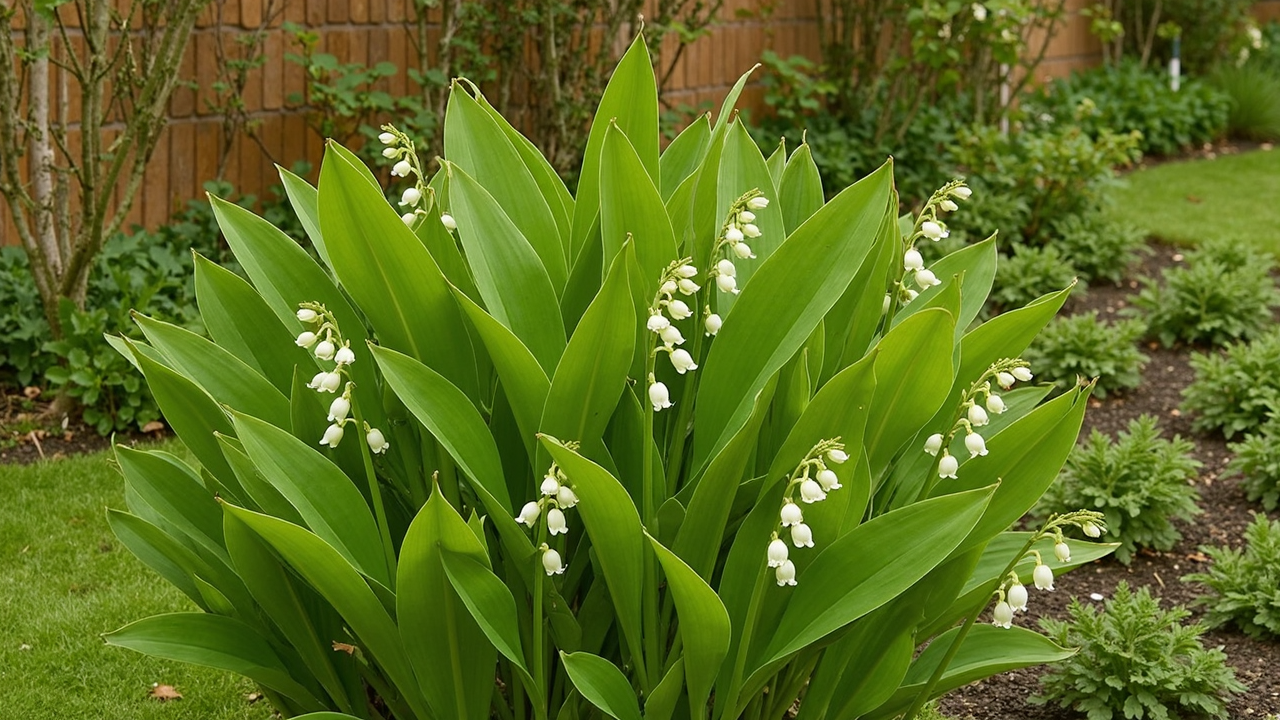
Convallaria majalis is a small, colony-forming perennial that builds into broad mats once established. Each shoot carries two, occasionally three, smooth, lance-shaped leaves 10–25 cm long and 4–7 cm wide, of a uniform deep green with a pronounced parallel midrib. The leaves emerge in early spring in tightly rolled spears, then open flat as the flowering stems rise. The flowers appear in mid to late spring, held on arching, one-sided racemes of five to fifteen small, globular, bell-shaped blooms. Each flower is roughly 5–8 mm across, with six fused white tepals and recurved teeth at the mouth. They are powerfully and sweetly scented, the perfume travelling well in cool, still air.
After pollination, the flowers develop into small, spherical berries, red or occasionally orange, each containing one to six seeds. The berries are decorative but, like the rest of the plant, are toxic if eaten. The foliage remains green through summer and turns yellow then brown in autumn, with the plant dying back to overwintering rhizomes just below the soil surface. New growth emerges in early spring from buds set on these rhizomes, and a mature patch can extend several metres across in favourable conditions, although it spreads slowly in the first two or three years.
Growing Conditions
Lily of the Valley thrives in partial to full shade, particularly in the dappled light beneath deciduous trees and shrubs where it receives spring sunshine before the canopy closes. It also grows well on the shaded, north- or east-facing side of buildings, in woodland margins and in shaded pockets of the rock garden. Dense, dry shade under evergreens tends to produce sparse flowering and should be avoided.
The plant prefers a moist but well-drained, humus-rich soil that mimics its native woodland floor. Loam and improved clay are both suitable; pure sand, very free-draining chalk and permanently waterlogged soils are not. A slightly acidic to neutral pH of around 5.5 to 7.0 is ideal, although the species tolerates a wider range provided the soil does not dry out badly in summer or sit wet in winter. The Royal Horticultural Society rates Convallaria majalis as H7, the hardiest category, meaning it tolerates winter temperatures below −20 °C and is fully hardy throughout the UK, including upland and northern Scotland.
In the UK, the active growing season runs from March to October, with flowering concentrated in May. The plant benefits from the cool, damp springs and mild summers typical of British conditions, and suffers in hot, dry sites. In southern and eastern England additional watering may be needed in prolonged dry spells; in the wetter north and west it generally looks after itself once established.
Planting and Care
Plant container-grown stock or freshly lifted rhizomes in autumn or early spring, setting the rhizomes (often called "pips") just below the soil surface, 2–3 cm deep, and spacing them 10–15 cm apart for a quick ground-cover effect, or 20–25 cm apart where a slower, more deliberate spread is preferred. Potted plants establish at any time during the growing season but settle in best when dormant. Water in well and keep the soil just moist through the first spring and summer.
Once established, Lily of the Valley needs little routine care. Water during prolonged dry spells, particularly in late spring as the foliage is at its peak, but allow the soil to dry slightly between waterings. An annual mulch in early spring of leaf mould or well-rotted garden compost, applied 3–5 cm deep, conserves moisture, slowly feeds the soil and mimics the leaf-litter conditions of the plant's natural habitat. Additional fertiliser is rarely required, and high-nitrogen feeds produce soft, leafy growth at the expense of flowers.
Pruning is minimal. The foliage can be left to die back naturally in autumn or tidied in late autumn once it has turned yellow; cutting it back too early weakens the rhizomes. In spring, any remaining dead leaves can be pulled away as the new shoots push through.
Propagation is straightforward by division of established clumps in autumn or immediately after flowering. Lift a section of rhizome with roots and at least one strong bud, replant at the same depth and water in. Seed propagation is possible but slow, often taking two to three years to reach flowering size, and is used mainly by specialist growers.
In ideal conditions the plant spreads vigorously, and in a small or formal bed it can become invasive. Containment with a deep root barrier (a 30 cm vertical strip of rigid plastic or corrugated metal buried around the bed) or by siting it where its spread is bounded by paving, walls or tree roots is usually more effective than repeated digging. Many gardeners, however, actively welcome the spread, particularly in difficult shaded areas where little else thrives.
Common Problems
Lily of the Valley is generally trouble-free, but a few issues are worth watching for. Rust, caused by Puccinia species, appears as orange-brown pustules on the underside of the leaves in warm, humid weather. Remove and destroy affected foliage, improve air circulation by thinning overcrowded patches, and avoid overhead watering. Grey mould (Botrytis cinerea) coats leaves and flowers in a fuzzy grey growth during wet springs; cut back affected material and thin clumps to let air move through.
Slugs and snails may graze young shoots in damp conditions, particularly in early spring; the usual range of controls — copper tape around raised beds, hand-picking at dusk, or ferric phosphate pellets — is effective. Phytophthora root rot can occur in waterlogged soils, causing sudden wilting and collapse; this is prevented rather than cured, by ensuring free drainage and avoiding planting in damp hollows.
The plant's principal hazard is its toxicity. All parts — leaves, flowers, berries and rhizomes — contain cardiac glycosides (including convallatoxin) and are poisonous to humans, dogs, cats, rabbits and most livestock. Ingestion of even a small amount can cause nausea, vomiting and, in serious cases, cardiac arrhythmia. Site the plant away from children's play areas, wear gloves when handling large quantities of cut flowers or rhizomes, and wash hands afterwards. The toxicity is, however, the plant's chief defence: deer and rabbits generally leave it alone.
Failure to flower is usually a sign of one of three conditions: too much sun and not enough moisture, an over-rich or recently disturbed soil, or simply immaturity, as divisions may take a year or two to settle. The plant also declines in dense, dry shade under evergreens and in compacted soil.
Popular Varieties
Convallaria majalis 'Bordeaux' is a modern selection bred for the cut-flower industry, with noticeably larger bells and longer, sturdier stems than the species; it is the form most commonly sold by florists in the UK and is also a strong garden plant. Convallaria majalis var. rosea is a pink-flowered form, the colour varying from a pale blush to a clear rose-pink depending on site and stock; it is best grown in cooler, lightly shaded conditions where the colour develops cleanly. Convallaria majalis 'Fortin's Giant' is a vigorous, taller form reaching 25–30 cm, with larger leaves and broader flowers, useful for naturalising in larger woodland plantings where the species can look insubstantial.
Convallaria majalis 'Hardwick Hall' is a variegated clone with leaves edged and streaked in creamy yellow; it is slower to spread than the green-leaved forms and is usually grown as a feature plant in a shaded border rather than for ground cover. Convallaria majalis 'Prolificans', sometimes sold as 'Plena' or 'Flore Pleno', bears fully double, slightly larger white bells on shorter stems and is a historic garden plant. The plain species remains the most widely planted and is the form to choose where a vigorous, scented ground cover is the priority.
Pests and Diseases
| Problem | Symptoms | Management |
|---|---|---|
| Grey mould (Botrytis) | Leaves and flower stems collapse with a fuzzy grey fungal growth, particularly in damp conditions. | Improve air circulation around plants and remove affected material to reduce humidity. |
| Leaf spot | Distinct dark or brown spots appear on the foliage, potentially causing leaves to yellow or die back. | Remove infected leaves and avoid overhead watering to keep foliage dry. |
| Swift moth caterpillar | Small green caterpillars feed on the leaves, causing notching or general defoliation. | Hand-pick caterpillars if numbers are low; severe infestations may require biological controls. |
| Root rot | Plants fail to thrive or die back due to waterlogged, cold soil conditions over winter. | Ensure soil is moist but well-drained and avoid planting in heavy, water-logging clay. |
| Slugs and snails | Irregular holes chewed into young leaves and emerging shoots, often accompanied by slime trails. | Use physical barriers like copper tape or apply slug pellets sparingly around new growth. |
Quick Care Summary
| Sunlight | Full shade, Partial shade |
|---|---|
| Soil | Fertile, humus-rich moist soil; loam; moist but well-drained or poorly-drained; pH acid, alkaline, or neutral. |
| Hardiness | H7 (-20.0 °C) |
| Sow | — |
| Plant | September–November |
| Prune | — |





As an Amazon Associate, GardenWizz earns from qualifying purchases made through the links above. This does not affect the price you pay. See our disclaimer for details.