Penstemon
Penstemon · Beardtongue
At a Glance
| Botanical name | Penstemon |
|---|---|
| Common name(s) | Penstemon, Beardtongue |
| Family | Plantaginaceae |
| Plant type | perennial (Most form a durable woody stem (a caudex) and have persistent basal leaves, but some are fully deciduous perennials, the remainder being shrubs or subshrubs.) |
| Height × Spread | 10–300 cm × — |
| Hardiness | — (to -10.0 °C) |
| Position | Full sun |
| Soil | well-drained soil |
| Flowering | — |
| Toxicity | Relatively little is known about toxicity in penstemons and there are no reports of poisonings. However, species such as dusky penstemon (Penstemon whippleanus) are known to contain several alkaloids. |
| Native range | North America from northern Canada to Central America |
Overview
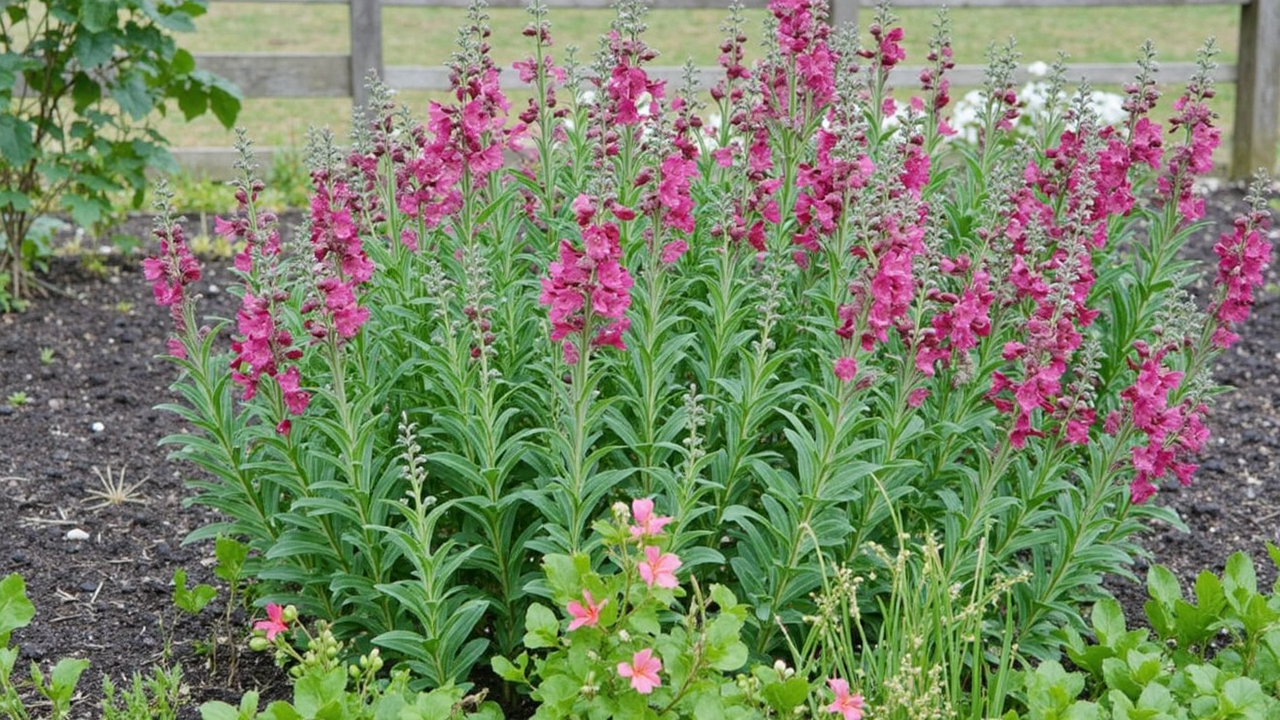
Penstemon is a large genus of herbaceous and semi-evergreen perennials in the family Plantaginaceae, native primarily to North America with a few species found in Central America and northeast Asia. Commonly known as beardtongues, penstemons are valued in UK gardens for their long flowering season, drought tolerance once established, and ability to attract bees and other pollinators. The genus contains several hundred species, of which a relatively small number — and their hybrids — form the backbone of British garden planting.
In UK horticulture, the most widely grown penstemons are complex hybrids derived largely from Penstemon barbatus, P. hartwegii, P. cobaea, and P. heterophyllus. These hybrids, often sold under the collective name Penstemon 'Hybrid Cultivars' or simply listed by cultivar name, give the modern border a reliable, long-flowering perennial that combines well with salvias, nepetas, grasses, and late-season roses. They are particularly useful for extending colour from midsummer into October, a period when many traditional border perennials are past their best.
Penstemons sit comfortably in cottage, prairie, gravel, and contemporary planting styles. Their tubular, two-lipped flowers are borne on tall, often branched stems above narrow, lance-shaped leaves. The colour range spans white, pink, red, purple, and bicolours, with newer cultivars expanding the blue end of the spectrum. For gardeners wanting a pollinator-friendly, low-maintenance perennial with a long season of interest, penstemon is one of the most dependable choices available.
Appearance
Penstemons are clump-forming perennials with a relatively loose, upright habit. Mature plants typically reach 60–90 cm in height when in flower, with a spread of 45–60 cm, though dwarf cultivars stay closer to 30–45 cm. The rootstock is woody at the base in older plants, with soft, often slightly glaucous green leaves arranged in opposite pairs along the stems.
The leaves are generally lance-shaped to narrowly oval, 5–12 cm long, with smooth or finely toothed margins. In most garden hybrids the foliage is semi-evergreen, holding on the lower parts of the plant through mild winters and dying back from the upper stems after hard frosts. The foliage colour is typically mid- to deep green, occasionally with a bluish cast.
The flowers are the main ornamental feature. Each bloom is tubular, around 3–5 cm long, with a two-lipped corolla — the upper lip has two lobes and the lower lip has three. The throat of the flower is often paler than the outer surface and frequently marked with darker guide lines that direct pollinators towards the nectar. Flowers are carried in loose panicles at the tops of the stems from early summer through to the first frosts, with peak display usually in July and August.
The common name "beardtongue" refers to a prominent sterile stamen (the staminode) inside each flower, which is often hairy and projects from the throat — a useful identification feature when comparing penstemons to the superficially similar foxglove or physostegia.
Growing Conditions
Penstemons grow best in full sun, where they flower most freely and produce the strongest stems. They tolerate very light shade for part of the day, but flowering will be reduced and the plants can become leggy. A sheltered position is helpful, particularly in colder or more exposed parts of the UK, because the stems are somewhat brittle and the crowns can be damaged by prolonged wet combined with hard frost.
Soil should be free-draining. Penstemons originate largely from dry, rocky habitats in western North America, and in cultivation they perform poorly in heavy, waterlogged ground, especially over winter. Light loams, sandy soils, and improved clay soils all work well, provided winter drainage is good. On heavier ground, planting on a slight mound or raising the bed by 10–15 cm is often enough to prevent crown rot.
Most garden penstemon hybrids are reliably hardy across the milder parts of the UK, with an RHS hardiness rating generally regarded as H4 to H5 (hardy to between -10 °C and -15 °C in sheltered conditions). Cultivar ratings vary, and exact RHS hardiness ratings for individual cultivars are not always published, so where a definitive rating is required the RHS Plant Finder or the latest RHS Plant Finder database should be consulted. In colder inland districts, northern England, and most of Scotland, plants benefit from a dry winter mulch of coarse grit or bark over the crown.
Soil pH is not critical: penstemons tolerate slightly acidic to neutral conditions (roughly pH 6.0–7.5) without issue. They are not heavy feeders and grow well in moderately fertile ground; over-rich soils tend to produce soft, leafy growth that flowers poorly and is more vulnerable to winter damage.
Planting and Care
Watering. Newly planted penstemons need regular watering through their first growing season to establish a deep root system. Once established, they are notably drought tolerant and only need supplementary watering during prolonged dry spells in summer. Overwatering, particularly in autumn and winter, is the most common cause of plant loss.
Feeding. A single application of a balanced slow-release fertiliser in spring is usually sufficient. Mulching with garden compost in late winter or early spring helps maintain soil fertility and structure. Avoid high-nitrogen feeds, which encourage soft growth at the expense of flowers and winter hardiness.
Pruning. Penstemons benefit from two distinct pruning moments. In spring, typically from mid-March once the worst frosts have passed, cut the old stems back hard to a low framework of healthy growth near the base of the plant. This encourages strong new shoots and a tidy shape. A lighter autumn tidy — removing spent flower stems to a strong pair of side shoots — can extend the display and reduce wind rock, but the main structural cut should wait until spring because the old stems help protect the crown from winter wet.
Propagation. Penstemons are easily increased from softwood cuttings taken in late spring or early summer. Non-flowering side shoots 5–8 cm long root readily in a 50:50 mix of peat-free compost and perlite, usually within 3–4 weeks. Cuttings are an insurance policy in colder gardens, allowing replacement plants to be overwintered under cold glass. Established clumps can also be lifted and divided in spring, though penstemons do not respond to division as readily as many other perennials and are best replaced every four or five years.
Seasonal care. Spring is the main pruning and feeding window. Summer is the main display, with deadheading of individual flower spikes encouraging further flushes well into autumn. In autumn, leave the old growth in place over winter as frost protection and clear it in spring. In cold regions, a 5–8 cm mulch of coarse grit or bark over the crown after the first hard frosts gives worthwhile protection.
Common Problems
Crown rot and winter wet. The single biggest cause of failure in UK gardens. Penstemons resent cold, wet conditions at the crown, and losses during a wet winter are common on heavy or poorly drained soils. Prevention through good drainage and a spring pruning that opens up the plant is more effective than any treatment once rot has set in.
Powdery mildew. A fungal disease that coats the leaves in a white, powdery film during dry, warm summers, particularly on plants under stress. Improving air circulation, avoiding overhead watering, and removing badly affected growth usually controls it. Resistant cultivars are increasingly available.
Slugs and snails. Young spring growth is attractive to slugs and snails, which can shred emerging shoots. Protection with biological controls, wildlife-friendly pellets, or hand-picking is worthwhile in the first few weeks of growth.
Frost damage. Late spring frosts can blacken new growth, particularly on early-flowering cultivars. Cut back damaged shoots to healthy growth; plants usually recover strongly.
Short lifespan. Hybrid penstemons are not the longest-lived of perennials and often begin to decline after three to five years. Regular propagation from cuttings every two or three years is the most reliable way to maintain a stock of vigorous plants in the garden.
No specific toxicity concerns are widely documented for Penstemon in UK reference sources; the genus is not generally listed as toxic to humans, dogs, or cats in the major plant toxicity databases, though as with all garden plants material should not be ingested. Where definitive safety information is required, a veterinary or medical source should be consulted.
Popular Varieties
'Sour Grapes' (also sold as 'Sour Grapes' M. Fish). One of the most distinctive and widely grown cultivars, with large, vivid purple-blue flowers borne over a long season. Reaches around 60–75 cm tall and is reliably hardy in most UK districts.
'Garnet' (also sold as 'Andenken an Friedrich Hahn'). A stalwart of British gardens, with deep wine-red flowers and a particularly long flowering period from July to October. Reaches 70–90 cm tall and combines well with silver-leaved plants and pale nepetas.
'White Bedder' (also sold as 'Snowstorm' in some lists). A clean, pure white cultivar of moderate height, useful for lighting up shadier parts of the border and for cutting. Flowers from July into September.
'Raven' (also sold as 'Dark Towers'). A relatively recent cultivar with very dark, almost black-purple foliage and red-purple flowers. Provides a longer season of interest than green-leaved forms, with the foliage colour held from spring.
'Hidcote Pink'. A compact, pink-flowered cultivar reaching 50–60 cm, often associated with Hidcote Manor Garden in Gloucestershire. A good choice for smaller borders and container plantings.
'Osprey'. A bicolour cultivar with white flowers flushed and edged in pink, growing to around 70 cm. One of the more striking of the bicoloured forms and widely available in UK nurseries.
'Rich Ruby'. A strong-growing red cultivar bred for compact habit and good weather resistance, reaching around 60–75 cm. Useful where a clear, true red is required in the mid-border.
Pests and Diseases
| Problem | Symptoms | Management |
|---|---|---|
| Slugs and snails | Irregular holes chewed in leaves and stems, often accompanied by silky trails. | Use physical barriers like copper tape or apply iron phosphate pellets around the base. |
| Aphids | Clusters of small green or black insects on new growth causing distorted leaves. | Squash by hand, blast off with water, or use insecticidal soap for severe infestations. |
| Powdery mildew | White powdery fungal growth on leaves and stems, potentially causing leaf distortion. | Improve air circulation and avoid wetting foliage; treat with a sulphur-based fungicide if necessary. |
| Grey mould (Botrytis) | Fuzzy grey fungal growth on dying flowers, leaves, or stems in damp conditions. | Remove affected plant parts immediately and ensure good air circulation to reduce humidity. |
| Leaf and bud eelworms | Distorted, stunted growth with swollen or misshapen buds and leaves. | Dig up and destroy infected plants; avoid replanting penstemons in the same soil. |
Quick Care Summary
| Sunlight | Full sun |
|---|---|
| Soil | well-drained soil |
| Hardiness | — (-10.0 °C) |
| Sow | — |
| Plant | March–May |
| Prune | March |


As an Amazon Associate, GardenWizz earns from qualifying purchases made through the links above. This does not affect the price you pay. See our disclaimer for details.