Hawthorn
Crataegus monogyna
At a Glance
| Botanical name | Crataegus monogyna |
|---|---|
| Common name(s) | Hawthorn |
| Family | Rosaceae |
| Plant type | tree (deciduous) |
| Height × Spread | 1000 cm × — |
| Hardiness | — |
| Position | Full sun, Partial shade |
| Soil | well-drained soil enriched with lots of organic matter; grows in just about all soils types, including chalky and alkaline ones |
| Flowering | May–June |
| Toxicity | — |
| Native range | Europe, northwestern Africa and Western Asia |
Hawthorn is a deciduous shrub or small tree in the rose family, native to the British Isles and across most of Europe. It is one of the most familiar plants in the British countryside, forming the backbone of countless farm hedgerows and appearing in field margins, woodland edges, and waste ground. Its dense, thorny habit, abundant spring blossom, and bright winter berries make it equally useful as a stock-proof barrier or as an ornamental specimen in larger gardens. It supports a remarkable breadth of British wildlife and tolerates the often harsh conditions of UK weather, from coastal salt-laden winds to inland clay and chalk.
Quick-Care Table
Overview
Hawthorn is one of Britain's most important native hedgerow plants. The species name monogyna refers to the single seed (stone) inside each berry, distinguishing it from the closely related Midland hawthorn (Crataegus laevigata), which usually has two. It is long-lived for a hedgerow plant — individuals may live for several hundred years, and some old field trees in Britain are thought to exceed four centuries. As well as its practical and ecological value, hawthorn is steeped in folklore: it was traditionally associated with May Day celebrations, and the old saying "Ne'er cast a clout till May be out" refers to hawthorn blossom as a sign that warmer weather has truly arrived.
In the garden, hawthorn is used in three main ways: as a formal or wildlife hedge, as a single specimen tree on a larger lawn, or as part of a mixed native planting. It is exceptionally tolerant of exposure, poor soils, and pollution, which makes it a reliable choice in difficult urban and coastal sites where fussier plants struggle.
Appearance
Hawthorn typically grows to between 5 and 15 metres tall, depending on how it is trained and sited. Left untrimmed in a hedgerow it forms a dense, rounded thicket; grown as a specimen tree it develops a broad, spreading crown with branches that often droop at the tips under the weight of fruit.
The young stems are grey-brown and bear stout woody thorns, sometimes called spines, which can reach 2.5 cm long. These are modified branches rather than true thorns, and they form the basis of the plant's usefulness as a barrier hedge. Leaves are deeply lobed, 2 to 4 cm long, glossy dark green above and paler beneath, turning a buttery yellow in autumn before falling.
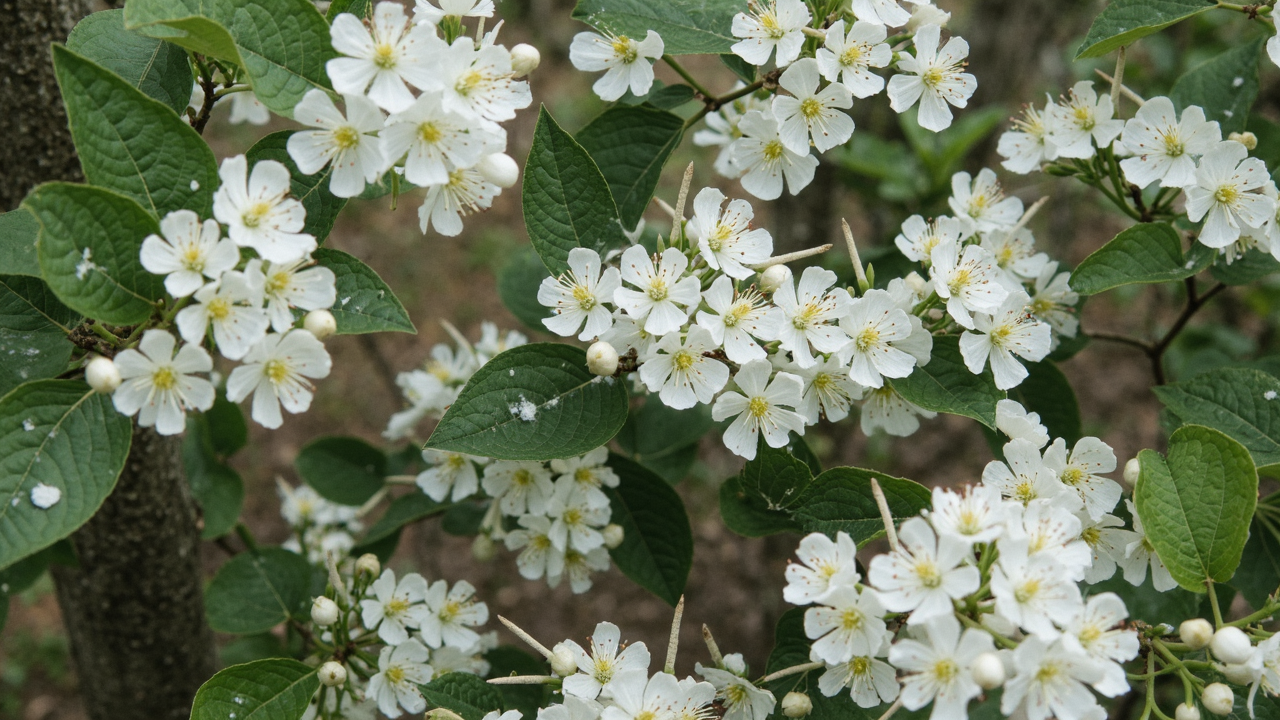
Flowering is the showpiece of the year. In May, sometimes extending into early June, the plant covers itself in dense clusters of small, fragrant flowers, each with five white or pale-pink petals and prominent stamens. The blossom is followed by oval deep-red berries known as haws, 8 to 10 mm across, which often hang on well into winter. The bark is grey-brown and develops shallow fissures with age.
Growing Conditions
Hawthorn is undemanding once established and grows well throughout the UK.
- Soil: Thrives in most well-drained soils, including clay, loam, chalk, and sandy soils, with a pH range of roughly 6.0 to 8.0. It dislikes waterlogged ground but tolerates thin, poor soils better than most garden shrubs.
- Aspect: Full sun gives the heaviest flowering and fruiting, but partial shade is acceptable, particularly for hedging where the base can become shaded.
- Hardiness: Rated RHS H6, fully hardy throughout the UK including the north of Scotland and upland areas.
- Exposure: Excellent tolerance of wind, salt spray, and atmospheric pollution, making it a first-choice plant for coastal gardens, exposed farmland, and urban sites.
- Growth rate: Moderate, typically 20 to 40 cm of new growth per year when young, slowing as the plant matures.
Planting and Care
Planting. Bare-root hawthorn is the most economical option and should be planted between November and March, when the plants are dormant. Container-grown stock can be planted at any time of year provided the ground is not frozen or waterlogged. For a single-row hedge, set plants 30 to 45 cm apart; for a thicker, stock-proof double row, stagger plants 45 to 60 cm apart in two parallel rows about 30 cm apart. Water in thoroughly after planting and apply a 5 to 7 cm mulch of well-rotted organic matter, keeping the mulch clear of the stems.
Watering. Water young plants regularly through their first two growing seasons, particularly during dry spells in late spring and summer. Once established, hawthorn is highly drought-tolerant and rarely needs supplementary watering in the UK climate.
Feeding. Hawthorn generally requires no fertiliser on reasonable garden soil. An annual mulch of well-rotted garden compost or bark in late winter is usually sufficient to maintain vigour.
Pruning. Hedges should be trimmed once a year, in late summer (August or early September) after nesting birds have finished using the hedge. Cut back the current season's growth to keep a tidy shape. For specimen trees, only minimal formative pruning is needed in the early years, removing crossing or damaged branches in late winter. Hard renovation pruning of overgrown specimens is best done in winter while the plant is dormant, although this will reduce flowering the following spring.
Propagation. Hawthorn can be grown from seed, though fresh seed requires a period of cold stratification: sow in autumn in trays of seed compost and leave outdoors over winter for natural chilling. Germination can be slow and erratic, often taking 18 months. Semi-ripe cuttings taken in mid to late summer and placed in a cold frame offer a quicker route, though success rates are variable.
Seasonal care. Apply mulch in late winter, trim hedges in late summer after the birds have finished nesting, and leave the haws on the plant through autumn and winter for wildlife. No routine pest or disease spraying is required on healthy established plants.
Common Problems
- Hawthorn rust (Gymnosporangium spp.): Causes bright orange pustules on the leaves and sometimes on the haws. Pick off and dispose of affected leaves in household waste; do not compost. The alternate host for some species is juniper, so avoid planting susceptible junipers nearby.
- Fireblight (Erwinia amylovora): A notifiable bacterial disease causing wilting, blackening, and a characteristic "shepherd's crook" bend in new shoots. Cut back into healthy wood at least 30 cm below the visible infection and destroy the prunings. Sterilise secateurs between cuts. Fireblight is a serious disease of the Rosaceae family and the infection should be reported to the relevant plant health authority if suspected in a commercial setting.
- Leaf spot (Entomosporium maculatum): Causes brown spots on the leaves, leading to premature leaf drop in damp summers. Improve air circulation by careful pruning, avoid overhead watering, and clear up fallen leaves in autumn.
- Aphids: Hawthorn can host currant aphids and other species in spring, causing some leaf curl. Damage is rarely severe on established plants; on specimen trees a winter wash or spring application of soft soap can help.
- Honey fungus (Armillaria spp.): Can attack hawthorn on very poorly drained or compacted soils. The plant is not particularly susceptible, but planting in well-prepared ground reduces the risk.
Popular Varieties
Cultivars of Crataegus monogyna are relatively few compared with ornamental relatives such as Crataegus laevigata, and the species itself is so well suited to British conditions that seedling-raised native stock is often the best choice for hedging and wildlife planting. The following are established, widely available selections:
- Crataegus monogyna 'Stricta': A narrow, fastigiate form with a tight upright habit, useful where a vertical accent is needed and space is limited. Grows to around 8 to 10 m tall with a spread of only 2 to 3 m. Flowers and fruits freely.
- Crataegus monogyna 'Pendula': A weeping form, often grafted onto a tall stem to create a small weeping specimen tree. Branches arch down from a central leader, with the usual white blossom and red haws in season.
- Crataegus monogyna 'Biflora' (Glastonbury thorn): A historically interesting form that can produce a small flush of flowers in mild winter weather as well as in May. Long associated with the Glastonbury legend, though its actual flowering behaviour varies with the climate of the site.
For gardens where a different look is wanted, hybrids between C. monogyna and C. laevigata (often sold as Crataegus × media) offer pink or double red flowers, although these are generally less useful for wildlife and may not berry as freely as the pure species.
Pests and Diseases
| Problem | Symptoms | Management |
|---|---|---|
| Hawthorn blister aphid | Leaves develop raised, pale green or yellowish blisters that may turn brown and dry out. | Tolerate minor infestations as natural predators usually control them; prune affected shoots if severe. |
| Hawthorn gall mite | Small, red or green blister-like galls appear on the upper surface of leaves. | Remove and destroy heavily infested leaves to reduce populations; chemical control is rarely needed. |
| Hawthorn sawfly | Leaves are skeletonised or eaten away by small, wasp-like larvae feeding in groups. | Hand-pick larvae into soapy water or use a targeted insecticide if damage is extensive. |
| Powdery mildew | A white, dusty fungal growth appears on leaves, shoots, and sometimes flowers. | Improve air circulation by thinning dense growth and avoid overhead watering to keep foliage dry. |
| Anthracnose leaf spot | Small brown or purple spots appear on leaves, which may curl, distort, or drop prematurely. | Rake up fallen leaves in autumn to reduce overwintering spores and ensure good air circulation. |
Quick Care Summary
| Sunlight | Full sun, Partial shade |
|---|---|
| Soil | well-drained soil enriched with lots of organic matter; grows in just about all soils types, including chalky and alkaline ones |
| Hardiness | — |
| Sow | — |
| Plant | January, February, March, November, December |
| Prune | — |



As an Amazon Associate, GardenWizz earns from qualifying purchases made through the links above. This does not affect the price you pay. See our disclaimer for details.