English Ivy
Hedera helix
At a Glance
| Botanical name | Hedera helix |
|---|---|
| Common name(s) | English Ivy |
| Family | Araliaceae |
| Plant type | climber (Evergreen climbing plant with juvenile and adult growth phases; juvenile stems climb using aerial roots, adult stems are shrubby and bear flowers/fruit.) |
| Height × Spread | 2000–3000 cm × — |
| Hardiness | H5 (to -15.0 °C) |
| Position | Full sun, Partial shade, Full shade |
| Soil | Fertile, humus-rich, well-drained, alkaline soil; tolerates a wide range of pH but avoids waterlogged conditions. |
| Flowering | August–November |
| Toxicity | Harmful if eaten; skin irritant/allergen. Sap is mildly poisonous and can irritate skin. |
| Native range | Most of Europe and parts of western Asia (including Ireland to southern Scandinavia, south to Portugal, east to Ukraine, Iran and northern Turkey). |
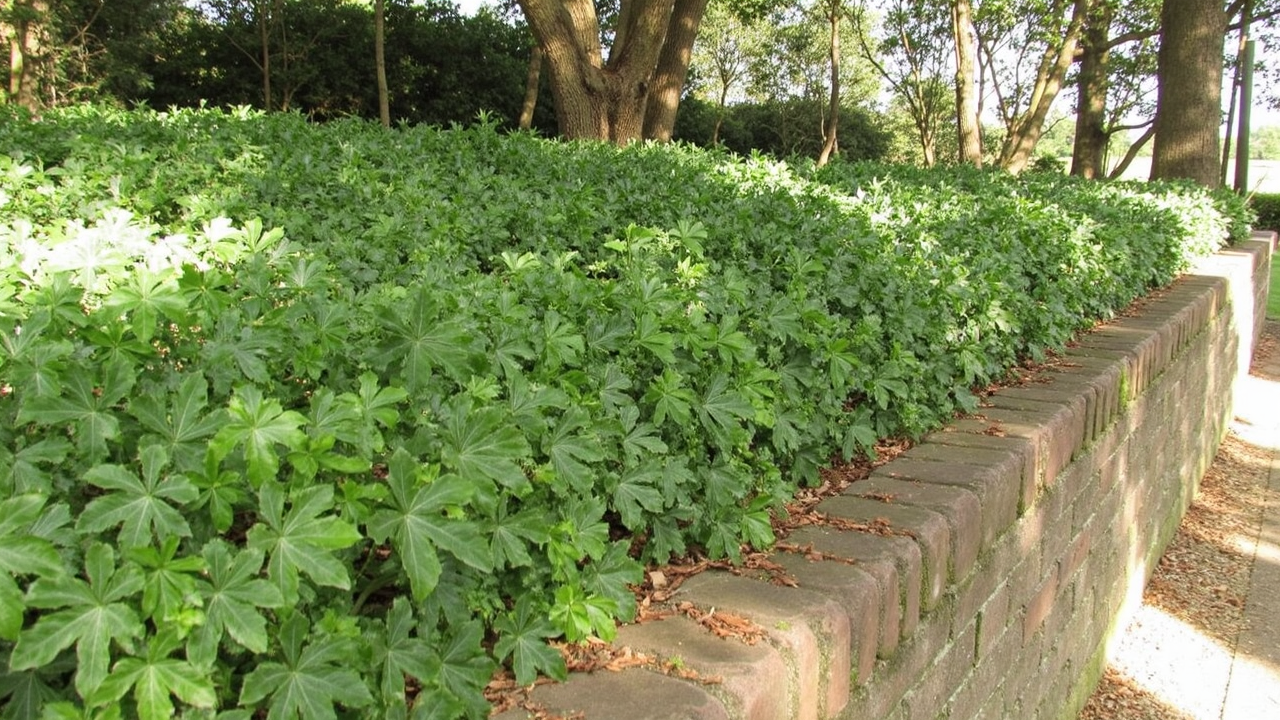
English ivy (Hedera helix) is the UK's most familiar evergreen climber, threading its way up garden walls, fencing and tree trunks for centuries. Equally at home scrambling across shaded ground as a dense weed-suppressing carpet, it is one of the most versatile and lowest-maintenance foliage plants grown in British gardens. Few other plants tolerate deep shade so reliably, and few match ivy's ability to soften bare masonry or cover an unsightly fence with permanent year-round green.
Overview
Hedera helix belongs to the family Araliaceae and is native to much of Europe, including the British Isles. It is a self-clinging, woody, evergreen climber capable of reaching 30 m on a suitable support, though it grows far more slowly on poor or dry sites. The plant is also widely used as ground cover, and in either role it provides permanent structure in gardens where deciduous plants leave gaps in winter.
Ivy is fully UK hardy and particularly valued for north-facing and shaded sites, where many other climbers fail. It is, however, a vigorous plant that needs periodic cutting back to keep it within bounds, especially when allowed to climb established trees or climb into gutters and roof tiles.
Appearance
Ivy has two distinct leaf forms depending on its life stage. Juvenile plants — the familiar garden ivy — carry dark green, palmately lobed leaves with three to five pointed lobes. Once a plant has climbed high enough and reached the adult, reproductive phase (often after many years), the leaves change shape entirely, becoming unlobed, ovate or rhomboid. This adult form flowers and fruits; the flowers are small, greenish-yellow and borne in spherical umbels, appearing in autumn from September to November.
Stems carry adventitious aerial rootlets that act as adhesive pads, gripping masonry, bark and even metal. These rootlets hold ivy firmly to a surface without any need for ties or wires. The fruit is a small black berry that ripens from late winter into spring and is eaten readily by birds, though it is mildly toxic to humans, dogs and cats.
A single mature ivy plant can cover many square metres of wall, and the growth rate once established is typically 20–40 cm per year. Juvenile and adult growth can sometimes appear on the same plant at once, with the upper portions showing the unlobed adult leaves and the lower, shaded portions retaining the lobed juvenile form.
Growing Conditions
English ivy is undemanding about soil provided the ground is not waterlogged. It grows well in clay, loam or sandy soils across a wide pH range (roughly 6.1–7.8) and tolerates both mildly acidic and mildly alkaline conditions. Established plants are reasonably drought-tolerant except on the most free-draining sandy or chalky soils, where summer leaf scorch can occur.
The plant prefers partial to full shade and is one of the best climbers for north-facing walls, where sun-loving species such as wisteria or climbing roses refuse to thrive. It also tolerates full shade under trees, making it a useful ground-cover choice in woodland settings. In dense shade growth is slower but denser, while in brighter positions growth is faster and more vigorous, often to the point of needing frequent cutting back.
Ivy is fully hardy across the UK, rated H5 under the RHS hardiness system, which equates to surviving temperatures between -15 and -10 °C. This covers all but the most exposed high-altitude or north-facing Scottish sites without protection. Avoid planting in highly exposed, frost-pocket positions where cold drying winds can scorch evergreen foliage in winter.
Planting and Care
Container-grown ivy can be planted at any time of year the ground is not frozen or waterlogged. Bare-root plants are available from specialist nurseries in the dormant season, typically November to March. For ground cover, space plants 30–60 cm apart; for wall or fence cover, plant 45–90 cm apart depending on how quickly full coverage is required.
Water newly planted ivy regularly through its first growing season to help it establish. Once the root system has settled into the surrounding soil, supplementary watering is rarely needed except during prolonged summer drought on free-draining ground. Feeding is not generally necessary: ivy thrives on poor soils and excess nitrogen produces leggy, sappy growth at the expense of leaf density.
Pruning is the most important maintenance task. Cut back overgrown or unwanted climbing stems at the base, ideally in spring or autumn, and trim wall growth to keep it clear of windows, roof tiles and gutters. Ivy can be cut back hard and will readily regrow from older wood, which makes it one of the easiest climbers to renovate if it has been left to run wild. On tree trunks, prevent ivy from reaching the canopy, as a heavy mat of ivy can smother the tree and weigh down branches in winter storms.
Propagation is straightforward. Take semi-ripe cuttings in mid-summer or hardwood cuttings in autumn and root them in a sheltered cold frame or directly in a shady border. Layering also works well: peg a low stem into the soil and it will root within a few months. Seed propagation is possible but slow and erratic, and is rarely worthwhile for garden cultivars.
In containers, use a loam-based compost such as John Innes No. 3, keep the compost moist but never waterlogged, and feed sparingly — once or twice during the growing season is plenty. Container-grown ivy benefits from being repotted every two to three years to prevent the root ball becoming congested.
Common Problems
Ivy is generally a trouble-free plant, but a few issues are worth knowing.
Fungal leaf spot can affect ivy, particularly in damp, sheltered sites with poor air movement. Remove and dispose of affected leaves and prune to improve airflow through the plant. Stressed plants occasionally suffer from aphid or scale insect attack on the leaves and stems; these rarely require treatment and are often kept in check by garden predators.
Leaf scorch, shown as brown, papery leaf edges, occurs on plants in hot, dry positions or in cold drying winds during winter. Mulching in spring and watering during prolonged dry spells reduces the problem on exposed sites.
Leggy, sparse growth usually indicates either insufficient light or, paradoxically, over-feeding. Reduce nitrogen inputs and, where light is the issue, accept that growth will be slower rather than attempting to push the plant harder.
Root rot can occur on waterlogged or compacted soils, especially in heavy clay that does not drain freely. Improve drainage before planting, or plant on a low mound to lift the root crown above the worst of the wet.
The most significant management issue is ivy's tendency to spread beyond its allotted space. It can climb into gutters, across roofs and into the canopies of established trees, where it may compete with the host for light. Cut stems at the base and treat regrowth with a glyphosate-based weedkiller where removal needs to be more thorough.
Popular Varieties
Several well-established cultivars of Hedera helix are widely available from UK nurseries. The plain species is vigorous and the best choice where a large area needs covering quickly, but smaller, more decorative cultivars suit pots, topiary frames and smaller garden features.
'Hibernica' (sometimes sold as Irish Ivy or Atlantic Ivy) is a large-leaved, vigorous form traditionally used for ground cover on a grand scale. Its leaves are broader and slightly less deeply lobed than the type.
'Glacier' is a popular silver-variegated cultivar with grey-green leaves edged and splashed with cream and silver-grey. It is less vigorous than the species and works well in containers or as a highlight in a shaded border.
'Goldheart' (also sold as 'Oro di Bogliasco') is one of the most striking variegated ivies, with dark green leaves centred with a bright golden-yellow blotch. It is more sun-tolerant than many variegated forms and provides strong winter colour.
'Ivalace' has small, neatly crimped and curled leaves with a lacy appearance. It is compact, slow-growing and ideal for topiary or small pots.
'Pedata' (known as Bird's Foot Ivy) has narrow, finger-like lobes giving a delicate, almost fern-like appearance. It is hardy and tolerant of cold, exposed sites better than many other cultivars.
'Sagittifolia' has arrow-shaped leaves with backward-pointing basal lobes. It is a vigorous, attractive form often seen covering old garden walls.
Where a less invasive plant is required for a very small garden, any of the variegated cultivars listed above are slower-growing and easier to keep in bounds than the plain species.
Pests and Diseases
| Problem | Symptoms | Management |
|---|---|---|
| Powdery mildew | A white, dusty fungal growth appears on leaves and stems, often causing distortion or yellowing. | Improve air circulation, avoid overhead watering, and treat with a fungicide if severe. |
| Vine weevil | Notches appear on leaf margins while larvae feed on roots in pots, causing wilting. | Use nematodes or insecticidal drenches to control soil-dwelling larvae. |
| Slugs and snails | Irregular holes are eaten into leaves, often accompanied by silvery slime trails. | Apply slug pellets, use beer traps, or hand-pick at night to reduce populations. |
| Root rot | Leaves turn yellow and drop while stems become soft and mushy due to waterlogged soil. | Ensure pots have drainage holes and allow compost to dry slightly between waterings. |
| Scale insects | Small, immobile bumps appear on stems and leaves, often leading to sticky honeydew. | Wipe off with a damp cloth or treat with horticultural oil during the growing season. |
Quick Care Summary
| Sunlight | Full sun, Partial shade, Full shade |
|---|---|
| Soil | Fertile, humus-rich, well-drained, alkaline soil; tolerates a wide range of pH but avoids waterlogged conditions. |
| Hardiness | H5 (-15.0 °C) |
| Sow | — |
| Plant | January–December |
| Prune | March–May |

As an Amazon Associate, GardenWizz earns from qualifying purchases made through the links above. This does not affect the price you pay. See our disclaimer for details.