Common Hazel
Corylus avellana
At a Glance
| Botanical name | Corylus avellana |
|---|---|
| Common name(s) | Common Hazel |
| Family | Betulaceae |
| Plant type | shrub (Deciduous) |
| Height × Spread | 300–800 cm × — |
| Hardiness | H6 (to -20.0 °C) |
| Position | Full sun, Partial shade |
| Soil | Moist but well-drained, fertile soil; ideal for chalky soils. Dislikes waterlogged soils. |
| Flowering | March–May |
| Toxicity | — |
| Native range | Europe and Western Asia |
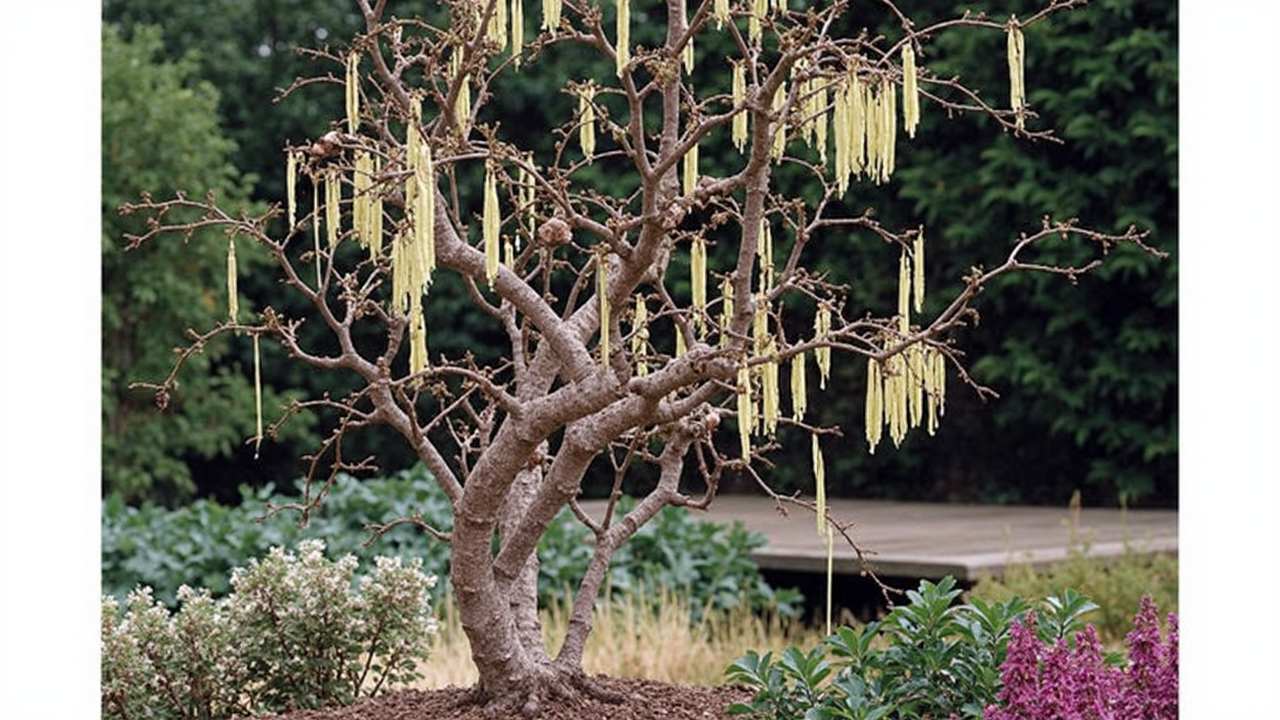
Common Hazel (Corylus avellana) is a deciduous, multi-stemmed shrub or small tree belonging to the birch family (Betulaceae). Native to the UK and most of Europe, it is one of the most ecologically and practically useful woody plants in the British countryside, forming the backbone of traditional mixed hedgerows, supplying edible nuts in autumn, and providing some of the earliest pollen of the year through its pale yellow catkins. In gardens it is equally at home as a specimen shrub, a coppiced feature, or an ornamental — the twisted-stemmed Corylus avellana 'Contorta' being a familiar winter sight in many UK planting schemes.
Overview
Common Hazel is fully hardy throughout the United Kingdom and tolerates a wide range of soils, from chalky downland clays to damp loams, provided drainage is reasonable. It is a suckering plant, which means it naturally produces new shoots from the base, gradually forming a dense thicket. This habit is exploited in traditional coppicing: hazel stools are cut back to ground level on a rotation of roughly seven to ten years, throwing up straight, vigorous rods suitable for fencing, hurdle-making, pea sticks, and thatching spars. In an ornamental or productive context the same species can be trained as a single-stemmed small tree of six to eight metres.
Ecologically, hazel is exceptionally valuable. The pollen-rich catkins open in late winter when little else is in flower, supporting queen bumblebees emerging from hibernation, and the dense year-round cover offers nest sites for birds and small mammals. The caterpillars of several British moths, including the large emerald and the barred umber, feed on its leaves.
Quick-Care Table
Appearance
Common Hazel typically reaches three to eight metres in height and forms a broad, rounded crown. When grown as a coppice stool it stays lower and denser, while a trained single-stem tree can approach twelve metres on good ground. The bark is smooth and grey-brown on young growth, becoming lightly fissured with age. Young twigs carry a fine downy hair and a scattering of pale lenticels.
The leaves are rounded to broadly oval, five to twelve centimetres long, with a softly heart-shaped base and a sharply doubly-serrated margin — a distinguishing feature from the similar-looking hornbeam (Carpinus betulus), which has single-serrated leaves. They emerge soft green in mid-spring, mature to a deeper green through summer, and turn clear yellow in autumn before falling. The variety C. avellana 'Rotblattrige' (often sold as 'Red Filbert' or 'Purple Filbert') carries deep purple-bronze foliage through the growing season.
The flowers are wind-pollinated and appear before the leaves. The conspicuous pale yellow male catkins are pendulous, four to eight centimetres long, and usually visible from January onwards. The female flowers are tiny, red-tipped, bud-like structures, often overlooked but elegant on close inspection. Following fertilisation the familiar hazelnuts develop in clusters of one to four, each enclosed in a ragged leafy husk (the involucre) and ripening from green to pale brown between September and October.
Growing Conditions
Common Hazel succeeds on most well-drained soils found in UK gardens. It is notably tolerant of clay, performs well on chalk, and grows satisfactorily in sandy loam. The one soil type to avoid is permanently waterlogged ground, where roots will rot, and very acidic peaty soils, where growth tends to be poor. A neutral to mildly alkaline pH, somewhere in the range of about 5.5 to 8.0, suits it well. Hazels are also reasonably drought-tolerant once established, particularly when mulched.
The species tolerates light shade and is often found naturally at woodland edge, but fruiting is heaviest and growth most compact in full sun. A sheltered but not over-exposed site reduces catkin damage in late winter gales and helps nut set.
The RHS hardiness rating of H6 indicates it tolerates winter temperatures down to around minus twenty degrees Celsius, comfortably covering the whole of the British Isles including the Scottish Highlands and upland Wales. In milder counties and along the south coast hazel may begin shedding pollen in early January, while in colder inland areas the main catkin display is often February into March.
Planting and Care
Planting. Container-grown hazels can be planted at any time the ground is workable, but autumn through to early spring — October to March — is the traditional window and gives bare-root stock the best chance to settle in. Dig a hole generous enough to take the root system without crowding, tease out pot-bound roots, and incorporate a forkful of well-rotted garden compost or leaf mould into the backfill. Plant to the same depth as the nursery mark on the stem. Space plants two to four metres apart according to the density of screen or hedge required. Water in well and apply a thick organic mulch, keeping it clear of the stems.
Watering. Newly planted hazels need regular watering through their first two growing seasons, particularly during dry spells in late spring and summer. Once established they are largely self-sufficient except on the very lightest soils in prolonged drought.
Feeding. Routine feeding is not necessary on reasonable garden soil. An annual spring mulch of composted bark or well-rotted manure is usually sufficient. On very poor sandy soils an application of a balanced general-purpose fertiliser in late winter can boost early growth.
Pruning. Hazels used as ornamental or productive shrubs need only the removal of dead, damaged, or crossing stems in late winter, before the catkins fully open. Suckers appearing at some distance from the main plant should be cut off at ground level or, if wanted for propagation, lifted with roots attached. In traditional coppice systems, hazel stools are cut to within a few centimetres of the ground on a seven to ten year rotation; the resulting straight rods are harvested for fencing, hurdle-making, and garden plant supports.
Propagation. Three straightforward methods work well. Layer low branches in autumn by pegging them into the soil — they will usually root within twelve months. Take hardwood cuttings of well-ripened current-season growth in November, inserting them two-thirds deep into a nursery bed of free-draining compost. Alternatively, lift rooted suckers in the dormant season and pot or replant them directly.
Seasonal care. A late-winter check for crossing or dead wood is the main annual task. Mulch in spring, water through any prolonged summer drought, and gather nuts in September before squirrels and mice take them.
Common Problems
Hazel weevil (Curculio nucum). The adult weevil lays eggs in developing summer nuts; the larvae feed inside, leaving a small exit hole and often causing premature nut fall. Control in gardens is difficult; the practical response is to collect and bin fallen nuts promptly rather than composting them, which reduces the population the following year. Netting small trees before the nuts ripen is often worthwhile.
Bacterial canker (Pseudomonas syringae). Causes sunken, dark, blighted patches on stems and sometimes whole-branch dieback, particularly after wet winters. Cut affected wood out well below the visible canker into healthy tissue, disinfecting secateurs between cuts with methylated spirit or a dilute bleach solution.
Powdery mildew. A white fungal bloom on the leaves in late summer, more common on dry-soil plants in hot seasons. Generally cosmetic; improve air circulation by thinning congested growth and water in dry spells.
Aphids. Green and black aphids may colonise young shoots and catkins in spring. They are usually tolerated as food for ladybirds and hoverflies; if numbers are heavy, a strong jet of water or insecticidal soap will check them.
Squirrels and mice. Both will strip nuts before they fully ripen. In small gardens the only reliable answer is fine mesh netting placed over the tree once the nuts begin to fill out, secured at the trunk to prevent access from below.
Hazel green-sickness and mite damage. Bulging, distorted buds caused by the hazel bud mite are seen on wild plants; the condition is rarely serious in garden settings and affected shoots can simply be pruned out.
Popular Varieties
'Contorta' (Corkscrew Hazel). A naturally slow-growing sport with strongly twisted stems and contorted leaves, sold bare-root in winter when the catkins and curling branch structure are at their most striking. Often used in floristry. Reaches three to four metres eventually.
'Rotblattrige' (Red Filbert / Purple Filbert). Bears deep purple-bronze leaves through summer and red-tinted husks around the nuts. Particularly ornamental in a mixed border, and useful as a fruiting counterpart to the green-leaved species. Usually four to five metres tall.
Cosford Cob. A traditional English cultivar grown for its thin-shelled, well-flavoured nuts and good pollen production. Often planted alongside a main crop variety to improve fertilisation.
Kentish Cob (often sold as 'Kent Cob' or 'Lambert's Filbert'). The traditional commercial cobnut of Kent, with a long husk and sweet kernel. Reliable on free-draining soils in the south and east of England.
'Aurea'. A golden-leaved hazel, slower-growing than the species, with soft yellow foliage in spring that greens somewhat in summer. Useful for brightening a partially shaded shrub border.
Note: the Kentish Cob is sometimes listed in trade catalogues under the synonym 'Nottingham Cobnut', and the precise genetic identity of individual 'Cosford' and 'Kentish Cob' strains varies between nurseries. Gardeners selecting a fruiting hazel should check the rootstock and supplier description before buying.
Pests and Diseases
| Problem | Symptoms | Management |
|---|---|---|
| Powdery mildew | A white, dusty fungal growth appears on leaves and shoots, potentially causing distortion. | Improve air circulation by thinning the canopy and apply a fungicide if infection is severe. |
| Honey fungus | The plant declines with wilting foliage and white fungal mats may form under the bark. | Remove infected roots and replace soil, as there is no chemical cure for established infection. |
| Silver leaf | Leaves develop a distinctive silvery sheen on their undersides due to fungal infection. | Prune out affected branches well below the visible symptoms and burn them immediately. |
| Aphids | Clusters of small soft-bodied insects suck sap from new growth, causing sticky honeydew. | Encourage natural predators like ladybirds or use a strong jet of water to dislodge them. |
| Gall mites | Small, wart-like swellings or galls form on leaves and stems where the mites feed. | Prune out severely affected growth in winter to reduce populations before they spread. |
Quick Care Summary
| Sunlight | Full sun, Partial shade |
|---|---|
| Soil | Moist but well-drained, fertile soil; ideal for chalky soils. Dislikes waterlogged soils. |
| Hardiness | H6 (-20.0 °C) |
| Sow | — |
| Plant | — |
| Prune | — |

As an Amazon Associate, GardenWizz earns from qualifying purchases made through the links above. This does not affect the price you pay. See our disclaimer for details.