
Wild Cherry
Prunus avium
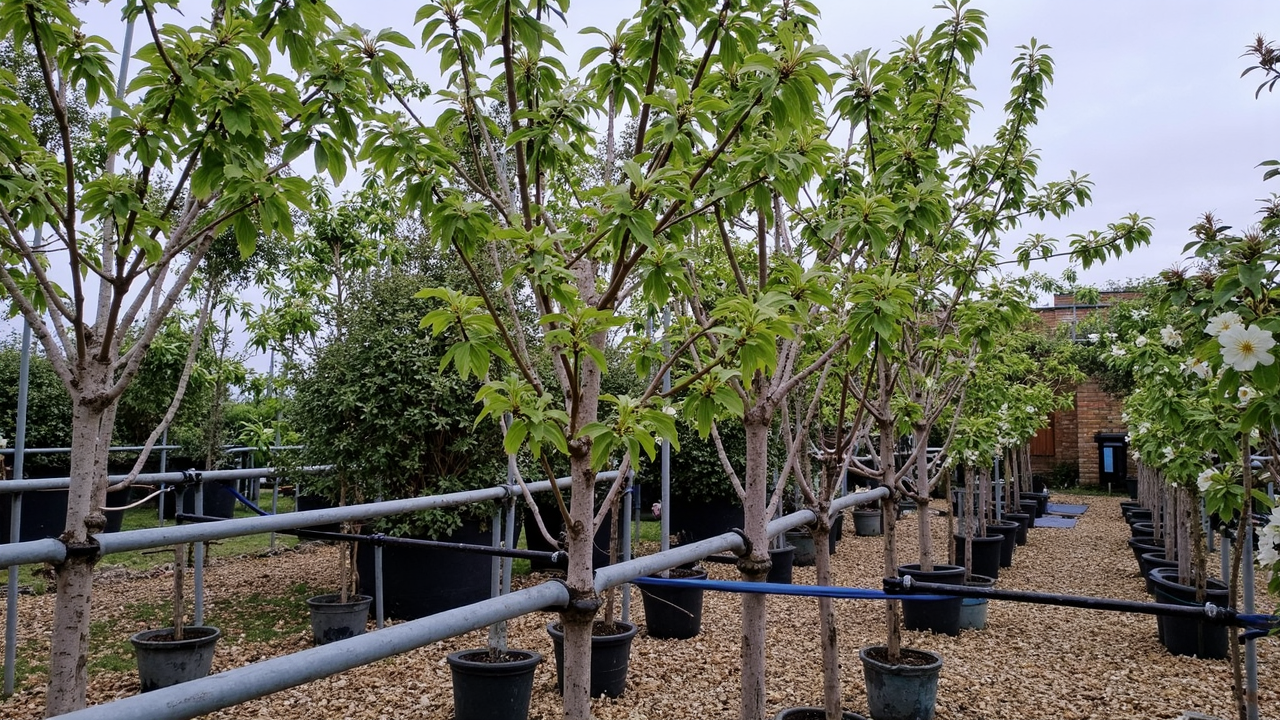
At a Glance
| Botanical name | Prunus avium |
|---|---|
| Common name(s) | Wild Cherry |
| Family | Rosaceae |
| Plant type | tree (deciduous) |
| Height × Spread | 500–2500 cm × — |
| Hardiness | — |
| Position | Full sun |
| Soil | moderately fertile soil |
| Flowering | April–May |
| Toxicity | All parts of the plant except for the ripe fruit are slightly toxic, containing cyanogenic glycosides |
| Native range | western Eurasia |
Overview
Wild Cherry (Prunus avium) is a deciduous flowering tree native to the United Kingdom and much of temperate Europe, valued in British gardens for its profuse spring blossom, vivid autumn colour, edible fruit and high-quality timber. A mature specimen is a significant feature tree, typically reaching 15 to 25 m in cultivation and 25 to 30 m in open woodland, with a broadly conical crown and a clean, straight trunk. It is the principal wild ancestor of the cultivated sweet cherry and is widely planted as an ornamental in parks, large gardens, street plantings and native hedgerow schemes. The species is fully hardy across the British Isles and is generally easy to grow provided it is given a sunny position and a well-drained, reasonably fertile soil. The quick-care table below summarises the essentials for UK growers; the rest of the article covers each point in detail.
Prunus avium belongs to the family Rosaceae, the same family as hawthorn, rowan and the orchard fruits. The wild form occurs throughout lowland Britain in ancient woodland, hedgerows and on the edges of pasture, where it is sometimes left standing as a "standard" when the surrounding hedge is laid — a tradition that gives old countryside cherries their characteristically tall, straight trunks. In gardens it is grown both as a single specimen tree and in mixed native plantings, and it remains a parent of most dessert and culinary sweet cherry cultivars. The species has a long association with the British landscape: its pale, close-grained timber has been used for centuries in cabinet-making and traditional smoking, and its spring blossom is one of the most conspicuous markers of the season in the south of England.
Appearance
In the open, Wild Cherry develops a tall, straight trunk topped by a broadly conical or pyramidal crown that broadens with age. The bark is one of its most recognisable features: a glossy, reddish-brown to mahogany, marked with prominent horizontal lenticels and peeling in thin papery strips on older trees. Young bark is smooth and polished, and even on mature specimens it remains relatively thin and shiny compared with most other broadleaves. The leaves are oval to oblong, 6 to 15 cm long, with finely but sharply serrated margins and a long drawn-out point; they emerge pale green in spring, darken to a healthy mid-green above with a paler, slightly downy underside, and turn striking shades of orange, red and crimson in autumn before falling. In mild seasons the autumn colour is one of the strongest among native trees.
The flowers appear in April or May, depending on latitude and season, in loose clusters of two to six on the previous year's wood, opening just before or with the new leaves. Each flower is 2 to 3 cm across, with five pure white petals, a small green calyx, and a prominent cluster of yellow stamens; the petals fall cleanly after pollination. The display is brief — usually two to three weeks at most — but dense enough on a well-grown tree to give the impression of a light snow. The fruit is a small, rounded drupe, typically 6 to 25 mm in diameter, ripening from green through yellow and red to a dark, almost black red in July and August. The flesh is thin and the flavour ranges from pleasantly sweet-bitter in wild forms grown in full sun to intensely bitter in shaded or hedgerow trees. Each fruit contains a single hard stone.
Growing Conditions
Wild Cherry performs best in full sun, in deep, moist but well-drained, moderately fertile soil. It is tolerant of a wide range of soil textures, including clay, loam and sandy soils, provided they do not lie waterlogged through winter; very shallow, dry chalk or compacted sites tend to produce stunted specimens. A slightly acid to neutral pH is ideal, though the species tolerates mildly alkaline conditions. Because it is a native of the UK, it is fully hardy across the country, including upland and northern sites, and it generally requires no winter protection once established. Mature trees tolerate exposed positions reasonably well, but spring blossom and young foliage can be damaged by cold easterly winds, so a sheltered but open site gives the most reliable display.
A good site gives the crown room to develop: plant at least 8 to 12 m from buildings, fences and other large trees, and avoid positions directly under the drip line of mature specimens of oak, beech or sycamore, where root competition is severe. The species is a strong tap-rooter in its early years and resents disturbance once it has settled in, so choose the planting site with the long term in mind. Mulching with well-rotted organic matter in the first two or three seasons helps conserve moisture and suppress grass competition around the root zone, both of which markedly improve establishment on drier or weedier ground. Although Wild Cherry tolerates light dappled shade, flowering and fruiting are noticeably reduced in such conditions and the autumn colour is generally less intense.
Planting and Care
Bare-root trees are best planted from November to March, while dormant, avoiding periods of frozen or waterlogged ground. Container-grown stock can be planted at any time of year provided the soil is workable and the tree is kept well watered through its first summer. Dig a hole at least twice as wide as the root spread and no deeper than the nursery soil mark on the trunk; fork the base of the hole to relieve compaction, work in a bucket of well-rotted garden compost or leaf mould, and position the tree so that the root collar sits flush with the surrounding soil. Backfill, firm gently with the heel to eliminate air pockets, water thoroughly, and stake only where the site is exposed — most young cherries establish a sturdy trunk without support.
Watering is the most important task in the first two to three years: soak the root zone thoroughly once a week during dry spells rather than sprinkling lightly, and keep the area immediately around the trunk free of grass and weeds within a circle roughly equal to the spread of the canopy. Once established, Wild Cherry is largely drought-tolerant and needs no supplementary watering except in severe droughts. Feeding is generally unnecessary on reasonably fertile soils; a light top-dressing of well-rotted compost in early spring is sufficient on poorer ground, and high-nitrogen fertilisers should be avoided as they encourage soft growth that is vulnerable to canker.
Pruning should be kept to a minimum, since the species is prone to two serious diseases that enter through wounds. Remove only dead, damaged, crossing or rubbing branches, and time any cuts for midsummer (July to August), when the cambium is least active and the risk of silver leaf infection is at its lowest. Do not prune in winter or early spring, and paint larger cuts with a fungicidal wound sealant where silver leaf is known locally. Avoid heavy crown reduction, which tends to provoke vigorous weakly attached regrowth and can shorten the life of the tree. Propagation in gardens is rarely attempted: seed requires several months of cold stratification and produces variable offspring, named cultivars are grafted on to rootstocks such as Colt or Gisela 5, and the species spreads naturally by suckers, which can be lifted and transplanted in the dormant season if desired.
Common Problems
The two most damaging diseases of Wild Cherry in Britain are silver leaf (Chondrostereum purpureum) and bacterial canker (Pseudomonas syringae). Silver leaf is a fungal pathogen that colonises wounds, producing a characteristic silver sheen on the foliage of affected branches and, on cross-section, a brown staining in the heartwood. The control is essentially preventive: prune only in summer, sterilise tools between trees, and remove and burn severely affected branches. Bacterial canker causes sunken, dark, gummy lesions on the bark, leaf spotting and die-back of young shoots, and is most prevalent on heavy or waterlogged soils and after wet winters; improving drainage and avoiding late-summer nitrogen feeds both reduce the risk. Cherry leaf scorch (Apiognomonia erythrostoma) shows as small purple-brown spots on the leaves followed by premature browning and leaf fall, and is best managed by raking up and burning infected leaves in autumn. Powdery mildew is occasionally seen in dry summers as a white bloom on the foliage, and is usually controlled by improving airflow and avoiding overhead watering.
Among pests, the black cherry aphid (Myzus cerasi) is the most widespread, feeding on the soft tips of new shoots and causing curling leaves and a coating of sooty mould; infestations are usually checked by natural predators such as ladybirds and hoverflies, with insecticidal soap used only as a last resort. Birds — particularly blackbirds, song thrushes and starlings — are enthusiastic feeders on the ripening fruit, and where a harvest is wanted, netting the canopy from late June onwards is the only reliable method. The cherry bark moth (Enarmonia formosana) can cause die-back of young branches in some years, and honey fungus (Armillaria mellea) will attack weakened or waterlogged specimens. The wilt pathogen Verticillium also affects cherries occasionally on heavier soils, causing sudden flagging of branches in summer that does not recover. All parts of the plant except the ripe fruit contain cyanogenic glycosides and are slightly toxic; this is rarely a problem in gardens but is worth noting in plantings used by livestock.
Popular Varieties
Prunus avium 'Plena' is the most widely planted ornamental form, a vigorous, sterile double-flowered selection that produces a heavier, longer-lasting display of pure white flowers in April and May. It sets no fruit, which makes it a good choice where fallen cherries on paving would be a nuisance, and it has a tidy, broadly conical habit to about 12 to 15 m. 'Hexieri', also sold as 'Pendula' in some lists, is a graceful weeping form, typically grafted on a tall straight stem so that the slender branches cascade to the ground; it is a striking specimen for larger lawns and does not grow as large as the species. 'Stella', although better known as a dessert cherry parent, traces directly back to P. avium and is the standard self-fertile sweet cherry for UK gardens, cropping reliably in July and August on a tree roughly 4 m tall on a Colt rootstock. 'Sunburst' is a similar self-fertile, late-ripening dessert selection with large, dark fruit. For wildlife and hedgerow plantings, the wild species in its natural variable form remains the most appropriate choice, as it supports the broadest range of native pollinators and berry-feeding birds.
Pests and Diseases
| Problem | Symptoms | Management |
|---|---|---|
| Cherry leaf scorch and leaf spot | Leaves turn brown, shrivel and hang on the tree in winter, or develop purple spots and drop prematurely. | Collect and destroy fallen leaves to reduce fungal spores for the following year. |
| Brown rot | Blossoms wilt and turn brown, while fruit becomes covered in grey mould and rots rapidly. | Remove all infected fruit and blossoms promptly to prevent spread, and net trees to reduce bird damage. |
| Cherry blackfly | New leaves at shoot tips become tightly curled and distorted by clusters of small black aphids. | Encourage natural predators like ladybirds, or squash infested shoots by hand in spring. |
| Silver leaf | Leaves develop a distinctive silvery sheen on the underside and branches may die back. | Prune out and burn infected wood well below the visible symptoms to contain the fungus. |
| Slugs and snails | Young seedlings are chewed at the base, and fallen fruit is eaten before it can be harvested. | Use beer traps or iron phosphate pellets around the base of the tree to protect young growth. |
Quick Care Summary
| Sunlight | Full sun |
|---|---|
| Soil | moderately fertile soil |
| Hardiness | — |
| Sow | — |
| Plant | — |
| Prune | March–August |

As an Amazon Associate, GardenWizz earns from qualifying purchases made through the links above. This does not affect the price you pay. See our disclaimer for details.