
Common Beech
Fagus sylvatica
At a Glance
| Botanical name | Fagus sylvatica |
|---|---|
| Common name(s) | Common Beech |
| Family | beech family |
| Plant type | tree (Deciduous; leaves often not abscissed in autumn (marcescence). Monoecious. Maturity attained in 30 years.) |
| Height × Spread | 2500–5000 cm × — |
| Hardiness | — |
| Position | Full sun, Partial shade |
| Soil | Any reasonable soil with good drainage; avoid waterlogged or moisture-retentive soil. |
| Flowering | — |
| Toxicity | Slightly toxic due to tannins and alkaloids |
| Native range | Europe (Sweden, Denmark, Norway, Germany, Poland, Switzerland, Bulgaria, western Ukraine, Romania, France, southern England, Spain, Italy, northwest Turkey) |
Overview
Common Beech (Fagus sylvatica) is a large, long-lived deciduous broadleaf native to much of southern and central England and widely naturalised further north. It is one of the most architectural trees a UK garden, park, or estate can grow, valued for its smooth grey bark, broad domed crown, and the rich copper-gold of its autumn foliage. Beech is equally important in the landscape as a specimen tree, an avenue planting, and a hedging plant — bare-root whips knit into dense, year-round screens that respond well to coppicing. It is hardy across all of the British Isles, tolerates a wide range of soils (including thin chalk), and is generally low-maintenance once established, though it is a thirsty tree in its early years and resents waterlogged ground. Mature specimens routinely live 200–300 years, with parkland veterans occasionally exceeding 400.
Appearance
In open ground, Fagus sylvatica develops into a broad, domed tree typically reaching 25–35 m in height and 20–30 m across, with a clean, straight bole and a wide, dense crown. The bark is one of its most recognisable winter features: smooth, thin, and a soft dove-grey at all ages, distinguishing it from the fissured, darker trunks of oak, ash, or hornbeam nearby. The leaves are oval to elliptical, 5–10 cm long, with a pointed tip, a slightly wavy or untoothed margin, and a series of fine parallel side-veins running from midrib to edge; they emerge a fresh, bright translucent green in late April or early May, darken to a deep summer green, and turn a vivid coppery gold in October before falling.
A distinctive habit of beech — particularly noticeable on young trees and on the lower branches of mature ones — is marcescence: the dead leaves are often retained on the branches well into winter, rustling in dry weather and only dropping as the new buds break the following spring. This is what makes beech hedging an effective year-round screen.
Flowers are modest and easily missed. Separate male and female catkins appear on the same tree in April or May as the new leaves expand; the male catkins are small, drooping, and tassel-like, while the female flowers develop into the familiar spiny, four-valved husk (cupule) that encloses a pair of triangular, glossy brown beechnuts, ripening in September and October. Beechnuts are eaten by squirrels, jays, wood pigeons, deer, and (in small quantities) by people; the raw kernel is mildly astringent and should not be eaten in large amounts.
Growing Conditions
Common Beech is one of the most accommodating native broadleaves for UK gardens, provided the soil does not lie wet in winter. It grows best on well-drained, fertile loam, but also thrives on chalk, limestone, and free-draining sandy soils. Very acidic peat, compacted clay that holds winter water, or permanently boggy ground should be improved before planting, or replaced with hornbeam (Carpinus betulus), which copes with heavier, damper ground.
The tree is fully hardy across the UK. It performs reliably in all RHS hardiness zones encountered in Britain and Ireland, and in exposed northern and upland sites it can be planted with confidence, though growth will be slower than in the warmer lowlands. Common Beech prefers full sun for the strongest growth and the best autumn colour, but it tolerates light, dappled shade — making it suitable as an understorey component at the edge of mature woodland or as a single specimen in a lawn. Inland wind is tolerated; salt-laden coastal wind will scorch the leaves, so maritime sites call for a more sheltered position.
A note on climate context: as a continental species at the edge of its natural range in Britain, beech flowers in spring and is sensitive to late frosts at that moment, though the tree itself is undamaged. Established trees are notably drought-tolerant on deeper soils, putting down a deep taproot, but young trees need careful watering in their first three to five summers, particularly on sandy ground or after a dry winter.
Planting and Care
Planting. Container-grown or rootballed beech can be planted at any time the ground is workable, but the conventional and best window is November to March, when the tree is dormant. For specimen trees, prepare a hole at least twice the diameter of the rootball and no deeper, fork the base, drive a short stake in at a 45° angle on the leeward side (low stakes encourage trunk taper), and backfill with the original soil improved with a little well-rotted compost. Water thoroughly to settle the soil around the roots and keep the new tree moist through its first full growing season.
Watering. Water deeply once a week during dry spells in the first and second summers; after that, an established beech generally looks after itself except in prolonged drought. For hedging, soak the whips in a bucket before planting and water through the first May–September.
Feeding. Beech is not a heavy feeder. A light annual mulch of well-rotted garden compost or leaf mould in late winter, spread over the rooting area but kept clear of the trunk, is enough on most garden soils. On thin chalk or sandy soils, an annual application of a general-purpose organic fertiliser in early spring will improve vigour.
Pruning. Mature specimen beeches need little pruning beyond the removal of dead, damaged, or crossing branches, ideally carried out in late summer (August) when cuts heal cleanly and the tree is not actively bleeding sap. Avoid hard pruning in late winter or early spring, when beech is prone to sap-bleed from larger cuts. Hedges should be trimmed once a year in late June or July after the first flush of growth, and optionally again lightly in late August to neaten the line; beech responds well to coppicing on a 7–15 year cycle, sending up vigorous straight poles from the cut stool.
Propagation. Fagus sylvatica itself comes true from seed. Collect ripe beechnuts in October, remove the husks, and sow immediately outdoors in a seedbed protected from mice and squirrels; germination follows the next spring, though a portion of the seed may sit dormant for a year. Named cultivars — particularly the purple and weeping forms — do not come true from seed and are propagated commercially by grafting onto seedling beech rootstocks in late winter.
Seasonal care. A late-winter check on stakes and ties (loosen any that are biting into the trunk), a spring mulch, an August formative prune on young specimens, and a late-autumn clearance of fallen leaves from the base if honey fungus is a concern locally is generally all that a mature beech requires.
Common Problems
Beech is largely trouble-free in the UK, but a handful of issues are worth knowing.
- Beech bark disease. A complex of the felted beech scale insect (Cryptococcus fagisuga) and subsequent infection by Nectria fungi. The scale colonises bark and the fungus then enters through the wounds, producing bleeding cankers, cracked bark, and gradual crown dieback. Inspect trunks for the tell-tale white woolly patches in summer; in severe cases consult an arborist, as the condition can take years to progress and warrants an informed diagnosis before treatment.
- Powdery mildew. A white, dusty coating on the leaves in hot, dry summers, especially on young trees under stress. Improve airflow by light thinning, water at the base rather than overhead, and clear fallen leaves in autumn. Damage is usually cosmetic.
- Aphids. Woolly beech aphid and other species may cluster on young shoots in late spring, producing sticky honeydew on leaves and anything beneath. On large trees no action is needed; on nursery stock a strong water spray or insecticidal soap is sufficient.
- Bracket fungi. Fruiting bodies of wood-decay fungi (for example Ganoderma species) at the base of older trees indicate internal decay. Their appearance is a signal to have the tree's structural condition assessed by a qualified arborist, especially if it stands near a building or path.
- Leaf scorch and drought stress. Browning of leaf margins in summer is a sign of insufficient water reaching the roots, often on shallow or sandy soils. Deep watering once a week during dry periods is the remedy on young trees; older trees usually recover the following season.
- Squirrel and grey squirrel damage. Squirrels can strip bark from young beeches and occasionally from the upper canopy of mature trees, opening wounds that admit disease. Tree guards on young plantings and population management on a local scale are the usual responses.
Beech is generally not affected by honey fungus (Armillaria) more than other native broadleaves, and it is largely unbothered by deer in most suburban UK gardens, though in rural settings new plantings may need protection from browsing.
Popular Varieties
A handful of well-established cultivars give the gardener the beech habit in different shapes and colours. The purple and copper forms are forms of Fagus sylvatica itself and are grafted onto seedling rootstocks; they are slower-growing than the species but no less hardy.
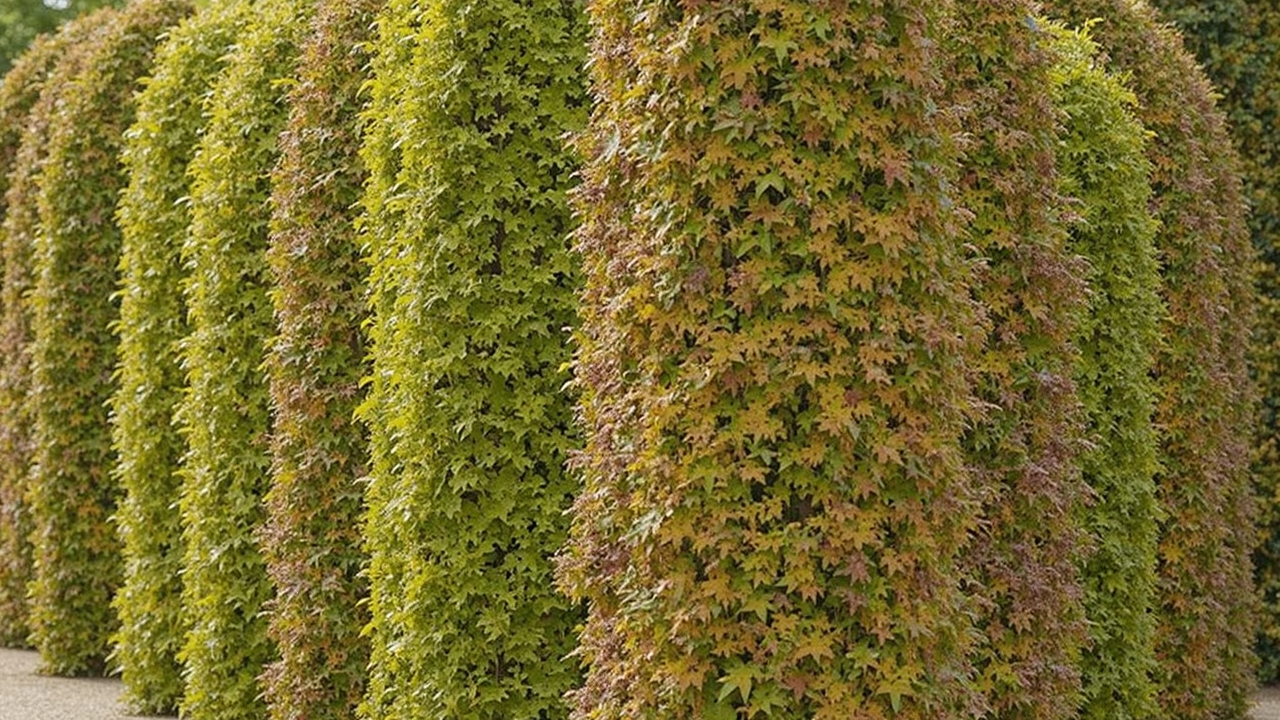
- Fagus sylvatica 'Dawyck' (Dawyck Beech). A fastigiate, narrow-columnar form raised at the Dawyck Botanic Garden in the Scottish Borders in the nineteenth century. It reaches 15–20 m in height with a spread of only 3–4 m, making it ideal for avenues, screens where space is tight, or as a strong vertical accent in a lawn. Green-leaved, with the same autumn colour as the species.
- Fagus sylvatica 'Dawyck Purple' and 'Dawyck Gold'. Columnar counterparts to the green form — 'Dawyck Purple' with deep purple-bronze foliage turning copper in autumn, and 'Dawyck Gold' with soft yellow-green spring growth that deepens in summer. Both are useful where a tight footprint and a strong foliage colour are wanted together.
- Fagus sylvatica 'Purpurea' (Copper Beech). The classic purple-leaved beech, broad-crowned like the species but with translucent dark purple-bronze leaves in spring that turn a richer reddish-copper in autumn. Slow-growing and large at maturity, so it is best given room. Tricky to underplant, as the dense canopy reduces light at ground level.
- Fagus sylvatica 'Riversii' (River's Beech). A particularly fine purple form with deep, almost black-purple spring foliage and a broadly pyramidal crown. Long established in British nursery trade and a common sight in Victorian and Edwardian estate plantings.
- Fagus sylvatica 'Pendula' (Weeping Beech). A graceful, dome-shaped cultivar with long, arching, downward-sweeping branches, often broader than it is tall. Best as a specimen tree in a lawn, where the silhouette can be appreciated. Slower-growing than the species.
- Fagus sylvatica 'Zlatia'. A rare golden-leaved form, with soft, downy yellow-green young foliage in spring maturing to a clear summer green. Best in light shade, where the spring colour is not scorched.
For hedging, the species itself is normally used — either bare-rooted whips in mixed native hedge rows, or as a single-species formal hedge. The purple form makes a striking, if sombre, alternative; for a more practical low-maintenance screen on heavier soils, hornbeam is a sensible substitute.
Pests and Diseases
| Problem | Symptoms | Management |
|---|---|---|
| Woolly beech aphid | Fluffy white patches appear on the underside of leaves in late spring, often accompanied by sticky honeydew and sooty mould. | Encourage natural predators like ladybirds; severe infestations can be treated with a systemic insecticide or horticultural oil. |
| Beech bark disease | Diamond-shaped cracks in the bark and dieback of branches caused by fungal infection entering through beetle wounds. | Remove and burn infected wood to reduce spread; maintain tree health to improve resistance as there is no cure. |
| Root rot | Wilting, yellowing foliage and stunted growth due to roots drowning in waterlogged or poorly drained soil. | Ensure planting sites have good drainage and avoid watering excessively during wet periods. |
| Late frost damage | Newly emerging young leaves turn black, shrivel and die after exposure to sudden cold snaps in spring. | Plant in sheltered locations away from frost pockets; protect young trees with fleece if severe frosts are forecast. |
| Powdery mildew | A white, dusty fungal growth appears on the surface of leaves and shoots, potentially causing distortion. | Improve air circulation around the tree and apply a fungicide if infection is severe. |
Quick Care Summary
| Sunlight | Full sun, Partial shade |
|---|---|
| Soil | Any reasonable soil with good drainage; avoid waterlogged or moisture-retentive soil. |
| Hardiness | — |
| Sow | — |
| Plant | January, February, March, October, November, December |
| Prune | January, February, March, August |


As an Amazon Associate, GardenWizz earns from qualifying purchases made through the links above. This does not affect the price you pay. See our disclaimer for details.