Field Maple
Acer campestre
At a Glance
| Botanical name | Acer campestre |
|---|---|
| Common name(s) | Field Maple |
| Family | Sapindaceae |
| Plant type | tree (deciduous) |
| Height × Spread | 1500–2500 cm × — |
| Hardiness | H6 (to -20.0 °C) |
| Position | Full sun, Partial shade |
| Soil | fertile, moist but well-drained soil; suitable for chalky soils; tolerates a range of soils including sand, clay, loam; pH neutral to alkaline, also acid |
| Flowering | March–May |
| Toxicity | — |
| Native range | continental Europe, Britain, southwest Asia from Turkey to the Caucasus, and north Africa in the Atlas Mountains |
Field maple (Acer campestre) is the only maple species native to the United Kingdom. A member of the Sapindaceae family, it grows as a medium-sized deciduous tree or large, multi-stemmed shrub, and has been part of the British landscape since the last glacial retreat. Its tolerance of chalk, clay and exposed sites, combined with dense twiggy growth and tidy autumn colour, makes it one of the most useful native trees for hedging, woodland planting and specimen use in gardens of every size.
Overview
Field maple occurs naturally across much of England and Wales, becoming scarcer in northern Scotland. It thrives on calcareous soils and is a common component of ancient hedgerows, woodland edges and chalk downland scrub. Beyond its native range it is planted widely across Europe and has naturalised in parts of North America. Gardeners value it for its adaptability: it tolerates heavy clay, drought once established, urban pollution and hard pruning, and it supports a broad community of insects, birds and lichens. The Royal Horticultural Society has long recognised it as a reliable garden plant and it is widely used in their recommended planting lists for native and hedging schemes.
Appearance
In open ground, field maple develops a rounded, domed crown on a short, often twisted trunk, typically reaching 15–20 m in height on good soils and occasionally pushing past 25 m. The bark is pale grey-brown and breaks into shallow, corky vertical fissures with age; young twigs frequently carry the corky wings that give the species its common cousins their name.
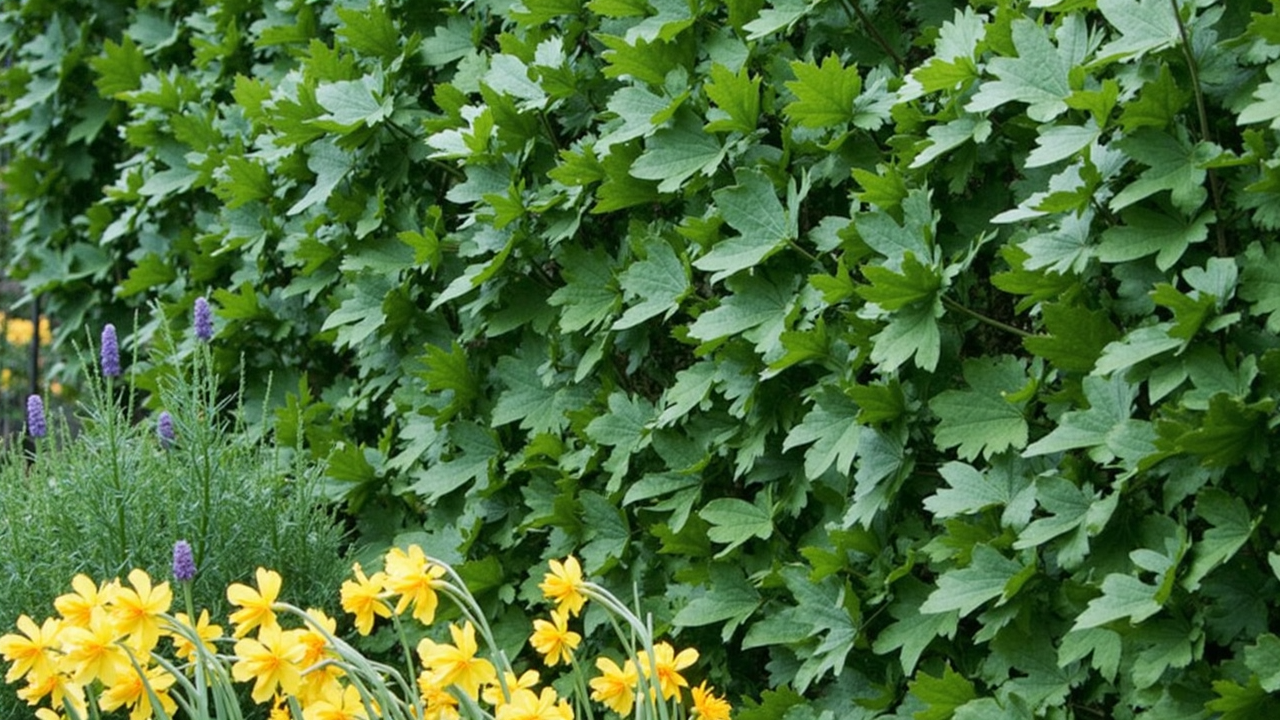
Leaves are opposite, 5–10 cm across, and have five blunt, rounded lobes separated by shallow sinuses. They are a fresh, slightly matte mid-green through summer, then turn clear butter-yellow to warm amber in autumn, occasionally flushed with a hint of orange on acid soils. The flowers are small, greenish-yellow and borne in upright to slightly pendulous clusters in late April and May, opening as the leaves emerge. They are followed by the familiar paired winged fruits, or samaras, each pair around 2–3 cm long with the wings held almost horizontally; they ripen through September and October and spin away on the wind.
Growing Conditions
Field maple grows well in full sun or partial shade. The best autumn colour develops in open positions where the canopy receives light on all sides, although it remains an attractive tree in dappled shade beneath taller species.
It prefers a moist but well-drained, moderately fertile soil and is unusually tolerant of difficult substrates. Chalk and limestone soils are ideal, and clay is tolerated provided it does not waterlog for long periods. Sandy soils are workable with a generous mulch. Soil pH is best in the neutral to moderately alkaline range; very acid conditions can lead to chlorosis and should be improved with garden lime and organic matter before planting.
The species is fully hardy throughout the UK and tolerates exposed, windswept sites once it has built up a good framework of roots. It is also notably tolerant of atmospheric pollution, which is why it is often chosen for street and avenue planting in towns. Coastal exposure is tolerated but leaves may scorch in salt-laden gales.
Planting and Care
Planting is best done between November and March, when bare-root and root-balled stock is available and the soil is workable. Container-grown plants can be put in at any time of year, avoiding periods of drought or frozen ground. Dig a hole roughly twice the width of the root ball and the same depth, loosen the base with a fork, and backfill with the original soil, firming gently to remove air pockets. Water thoroughly and apply a 5–8 cm mulch of composted bark, keeping it clear of the stem.
Watering is most important during the first two growing seasons: soak deeply once a week during dry spells rather than sprinkling lightly. Once established, field maple needs little supplemental water except in prolonged drought.
Feeding is rarely necessary on reasonably fertile soils. On thin or sandy ground, an annual spring mulch of well-rotted garden compost, or a light dressing of a balanced general fertiliser, will sustain steady growth.
Pruning requirements are modest. For specimen trees, remove dead, damaged or crossing branches in late autumn or winter, when the tree is dormant and the structure is easy to see. Avoid heavy summer cuts, which can encourage late, sappy regrowth. For hedges, trim once or twice a year: a light clip in late summer, after the main growth flush, keeps the lines tidy without stripping too much of the season's growth.
Propagation is straightforward from seed, which should be sown in autumn and left outdoors to undergo natural cold stratification through winter. Germination usually follows in the first or second spring. Semi-hardwood cuttings taken in mid to late summer, treated with a rooting hormone and kept under mist, will also root reliably. Named cultivars are propagated by grafting or by summer budding onto seedling rootstocks.
Common Problems
Field maple is generally trouble-free, but a handful of issues are worth knowing.
Acer anthracnose, sometimes called Pollaccia blight, is the most distinctive foliar disease. It causes brown to black blotches along the leaf veins and can lead to distorted, cupped foliage in wet springs. The fungus overwinters on fallen leaves, so raking up and destroying leaf litter in autumn is the single most effective control. Pruning to improve airflow also helps.
Verticillium wilt, caused by soil-borne fungi, is more serious. It produces sudden wilting, leaf scorch and die-back of individual branches, sometimes killing mature trees. There is no chemical cure; affected specimens should be removed and the debris destroyed. Avoid replanting susceptible species, including other maples and lilacs, in the same ground for several years.
Maple scale insects can colonise the bark of stressed or sheltered trees, producing a sticky honeydew and subsequent sooty mould. A late-winter application of horticultural oil smothers the overwintering stages and is usually sufficient.
Leaf scorch on young foliage is almost always a symptom of drought stress or wind; a thick mulch and deep watering during dry spells are the remedy. Superficial leaf-spot fungi are common late in the season but are cosmetic and require no treatment.
Popular Varieties
Several named forms are widely grown in the UK, offering more compact habits, stronger autumn colour or improved suitability for hedging.
'Carnival' is a slow-growing, variegated cultivar with leaves edged in creamy white; it stays below 5 m and is best planted in light shade, where the foliage is less likely to scorch.
'Compactum' (sometimes sold as 'Nanum') forms a dense, rounded shrub of around 2–3 m, ideal for small gardens or as a low, formal hedge that needs very little trimming.
'Elegant' is a Dutch selection valued for its uniform upright growth and improved autumn colour, often used in street planting and avenues.
'Queen Elizabeth' is a vigorous, more upright American-bred form with a tidy oval crown, frequently used as a street and parkland tree.
'Royal Ruby' produces young foliage that emerges a deep reddish-purple before maturing to green, providing a useful contrast in mixed planting; it is grafted, so any green reverted growth should be removed from the rootstock.
For pure hedging use, seedling-raised field maple is the most cost-effective option and produces the dense, wildlife-friendly hedgerow character of the traditional British countryside.
Pests and Diseases
| Problem | Symptoms | Management |
|---|---|---|
| Verticillium wilt | Sudden wilting and browning of leaves on individual branches or the whole tree, often with no external signs of pests. | Improve drainage and avoid planting in soil known to be infected; remove severely affected trees to prevent spread. |
| Honey fungus | General decline, dieback of branches, and white fungal growth under the bark at the base of the trunk. | Ensure good soil drainage and avoid deep planting; remove infected trees and dispose of roots carefully. |
| Tar spot | Distinctive black, tar-like spots appear on leaves, which may cause premature leaf drop but rarely harm the tree. | Rake up fallen leaves in autumn to reduce spore load; generally no chemical control is needed. |
| Powdery mildew | A white, powdery fungal growth on young leaves and shoots, particularly in dry, warm weather. | Water at the base to keep foliage dry; apply a sulphur-based fungicide if severe on young trees. |
| Gall mites | Small, wart-like swellings or galls form on leaves and twigs, causing minor distortion. | Usually cosmetic; prune out severely affected shoots in winter to reduce populations. |
| Aphids | Clusters of small soft-bodied insects on new growth, excreting sticky honeydew that attracts ants. | Encourage natural predators like ladybirds; use a strong jet of water or insecticidal soap for heavy infestations. |
Quick Care Summary
| Sunlight | Full sun, Partial shade |
|---|---|
| Soil | fertile, moist but well-drained soil; suitable for chalky soils; tolerates a range of soils including sand, clay, loam; pH neutral to alkaline, also acid |
| Hardiness | H6 (-20.0 °C) |
| Sow | March, April, May, September, October, November |
| Plant | — |
| Prune | January, February, November, December |

As an Amazon Associate, GardenWizz earns from qualifying purchases made through the links above. This does not affect the price you pay. See our disclaimer for details.