Sweet Chestnut
Castanea sativa
At a Glance
| Botanical name | Castanea sativa |
|---|---|
| Common name(s) | Sweet Chestnut |
| Family | Fagaceae |
| Plant type | tree (Deciduous; long-lived (500-600 years, up to 1000+ in cultivation); naturally self-incompatible requiring cross-pollination.) |
| Height × Spread | 2000–3500 cm × — |
| Hardiness | H6 (to -15.0 °C) |
| Position | Full sun, Partial shade |
| Soil | Moist, well-drained; intolerant of lime (acid to neutral pH preferred) |
| Flowering | June–July |
| Toxicity | — |
| Native range | Southern Europe and Anatolia |
Overview
Sweet Chestnut (Castanea sativa) is a large, long-lived deciduous tree grown in British parks, estate woodlands and larger gardens for its bold foliage, deeply furrowed bark and crop of edible autumn nuts. The following quick-care table summarises the essentials for UK growers; the full article below covers each in detail.
Castanea sativa, the Sweet or Spanish Chestnut, is a vigorous broadleaf in the family Fagaceae — the same family as oak and beech. It is native to the mountains of southern Europe, Anatolia and the Caucasus, but has been cultivated in Britain for so long that ancient specimens are sometimes described as though they were natives. Roman soldiers are traditionally credited with introducing the tree, and many of the oldest British specimens grow on the sites of Roman villas and military camps; "chestnut" itself derives from the Old French chastain and earlier Latin castanea. Mature trees are magnificent: 20 to 30 m tall, with a broad, rounded crown of stout, spreading branches carried on a single, deeply furrowed trunk. The bark is the single most distinctive feature — dark grey-brown, broken into spiralling, rope-like ridges that have been compared to a length of twisted cabling or to the coils of a giant worm. Sweet Chestnut is one of the longest-lived broadleaves planted in Britain, with documented individuals exceeding 500 years and credible reports of trees 800 to 1,000 years old. A single mature tree in good heart can produce 50 to 100 kg of nuts in a good year, and historically the species was managed in coppice rotations for nut and timber production across the south of England.
Appearance
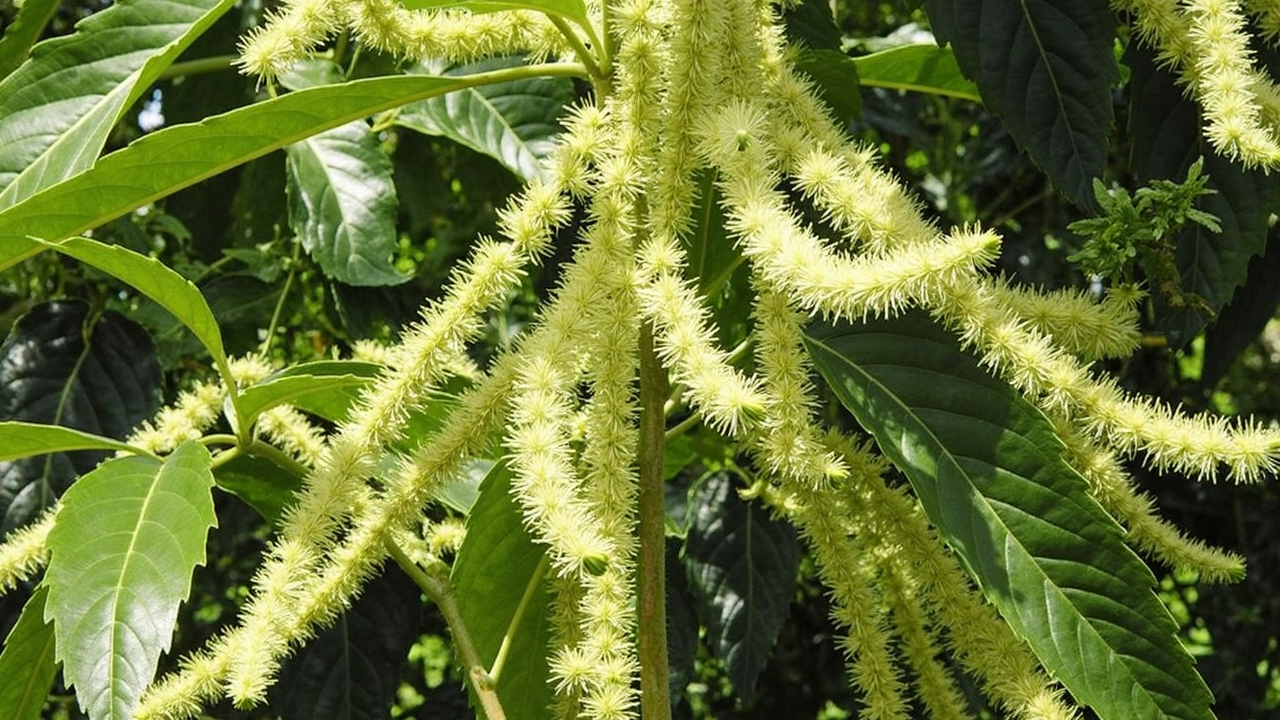
Castanea sativa is a large, broad-headed tree. The crown is rounded and spreading in open sites, more upright and drawn-up where the tree is competing for light, with heavy, sinuous branches that often arch back towards the ground at their tips. The bark is dark grey-brown, deeply fissured, and breaks into flat, vertical plates that spiral on the trunk and lower limbs with age; the pattern is quite unlike the diamond-furrowed bark of oak or the smoother grey of beech. The leaves are large and conspicuous — 16 to 28 cm long, oblong-lanceolate, with a tapering point and a strongly toothed margin bearing regular, forward-pointing teeth. They are glossy mid-green above, paler beneath, and turn a warm but briefly held yellow-brown in autumn before falling. Sweet Chestnut is monoecious: male flowers are borne in long, pale creamy-yellow catkins, 15 to 20 cm long, that open in July and release a strong, slightly musky scent; the female flowers are much less conspicuous, clustered at the base of some of the catkins. The fruit is the familiar edible chestnut: one to three glossy, mahogany-to-caramel brown nuts enclosed in a dense, bright green cupule covered in long, branched spines. The cupule splits open into two or four segments in October or November, dropping the ripe nuts. A useful identification point is the seed itself: Sweet Chestnut nuts are flat-sided where they press against their neighbours inside the cupule, giving a triangular cross-section, and the inside of the cupule is densely downy. The closely related Horse Chestnut (Aesculus hippocastanum) has inedible, glossy mahogany nuts without spines, and palmate rather than simple leaves.
Growing Conditions
Sweet Chestnut performs best in full sun, in deep, well-drained, slightly acidic to neutral soil. In the United Kingdom this makes free-draining loams over sandstone, the lighter soils of the south and east, and the acid soils of the west country and Welsh borders the most reliable sites. The tree dislikes chalk, badly drained clay, and any position where the roots sit in winter wet — on these soils it sulks, develops chlorosis, and eventually succumbs to Phytophthora. Mature specimens are exceptionally drought-tolerant once their roots have reached depth, which is one reason the species is a fixture of dry, sun-baked parkland estates in the south of England. The Royal Horticultural Society rates Castanea sativa as H6, meaning it tolerates winter temperatures down to about –20 °C and is fully hardy across the whole of the UK, including upland and northern sites. Sweet Chestnut flowers late — into July — and so usually escapes the spring frosts that damage earlier-flowering nuts such as walnut, but it does need a long, warm summer to ripen a full nut crop. In cool northern summers the nuts may be small or fail to fill, which is one reason commercial nut production in the UK is largely restricted to the south and east. A second pollinator variety planted within roughly 100 m markedly improves the size and reliability of the nut set, as the species is largely self-incompatible. Sweet Chestnut is wind-firm and tolerates exposed sites, including coastal gardens in the milder regions, and it has no serious rabbit- or deer-resistance issues once it is past sapling size, although grey squirrels can be very damaging on young trees.
Planting and Care
Plant bare-root or root-balled specimens between November and March, when dormant, taking care to keep the roots moist and to plant to the same depth as the soil mark on the trunk. Container-grown trees can be planted at any time of year, but summer planting requires diligent watering through the first season. Because the mature crown is broad and the root system is correspondingly extensive, allow at least 10 to 12 m from buildings, drains, services and other large trees — a Sweet Chestnut planted too close to a house is one of the most expensive mistakes a gardener can make. Stake young trees for the first two to three years with a short, low stake and a flexible tie, removing the stake once the trunk is self-supporting; permanent staking produces a weaker tree. Watering is needed only in the first three to five years, in prolonged dry spells; once established, the tree looks after itself. A spring mulch of composted bark or leaf mould, applied in a 5 to 8 cm layer over the rooting area but kept clear of the trunk, is beneficial on poor soils. Feeding is rarely necessary; if growth is weak, a single spring application of a slow-release, low-phosphorus fertiliser is sufficient — Sweet Chestnut is sensitive to high-phosphorus feeds. Pruning should be minimal: in late winter, remove dead, damaged or crossing branches and any epicormic growths on the lower trunk, and otherwise allow the natural form to develop. Sweet Chestnut responds well to coppicing, traditionally on rotations of 10 to 20 years, and stooled regrowth is straight, light and durable — historically valued for hop poles, fencing and chestnut paling. Propagation is from seed in autumn (sown fresh, as chestnuts lose viability quickly), or by grafting named varieties onto seedling rootstocks in late winter; the species does not come true from seed for nut quality. Seasonal care is light: a spring mulch, an eye on water in the first summers, late-winter pruning, and a harvest in October or November once the cupules begin to split and drop their nuts.
Common Problems
The most serious disease of Sweet Chestnut in Britain is ink disease, caused by the soil-borne oomycete Phytophthora cambivora (and in some cases P. cinnamomi). Symptoms are a sudden collapse of the foliage in summer, leaf loss, and a characteristic dark, inky bleeding from the bark of the lower trunk and main roots. There is no chemical cure; affected trees are usually lost within a few years. The disease is strongly associated with heavy, waterlogged or seasonally flooded soils, and the only reliable prevention is to avoid planting in such ground. Chestnut blight (Cryphonectria parasitica) is the much more aggressive American and continental threat, which kills trees by girdling cankers and is decimating the chestnut across parts of southern Europe. It is present in the UK on a limited number of sites but is not yet widespread; gardeners noticing sunken, cracking cankers with orange fruiting bodies on sweet chestnut bark should report them to the Forestry Commission or to TreeAlert. Of the routine foliar problems, powdery mildew can produce a white coating on the leaves in dry, late summers but is rarely serious, and various leaf-feeding insects — aphids, leaf hoppers, winter moth caterpillars — cause occasional cosmetic damage that the tree soon outgrows. Grey squirrels are a significant practical nuisance: they strip nuts before they ripen, chew bark from young shoots, and can ruin the crop on isolated trees; plastic tree guards on the lower 2 m of the trunk and timely harvesting are the usual defences. Two non-disease problems are common in the UK: poor or absent nut production, which usually reflects a tree grown from seed that has not yet reached cropping age (typically 8 to 15 years), a cold summer, or a single isolated tree with no pollinator partner; and autumn gales dropping heavy branches, a feature of a fast-grown, heavy-limbed tree in exposed sites and one reason to give a Sweet Chestnut a generous, open position from the start.
Popular Varieties
'Marron de Lyon' is one of the best-known nut-quality cultivars, producing large, single-kernel nuts of the type traditionally sold as marrons glacés; it needs a second pollinator for a full crop. 'Marigoule' is a vigorous, precocious French selection, widely planted in France for commercial nut production and a reliable garden choice in the warmer half of the UK, though its nuts are smaller than 'Marron de Lyon'. 'Bournette' is another French cultivar of similar parentage, with good nut size and a reputation for cropping earlier in the tree's life than the species. For ornamental use, 'Albomarginata' is a variegated form with leaves edged in cream, slower-growing and usually smaller than the species at 12 to 15 m; it is grown for its foliage rather than for nuts. 'Heterophylla' (also sold as 'Aspleniifolia') has narrow, deeply cut leaves giving a fern-like appearance; it is an old, occasionally offered curiosity rather than a commercial nut tree. Gardeners who want a known nut variety should buy grafted stock from a specialist fruit-tree nursery, as seedling sweet chestnuts are highly variable in nut size, quality and cropping reliability. Whichever form is chosen, planting at least two compatible cultivars within about 100 m is the single most effective way to ensure a reliable harvest.
Pests and Diseases
| Problem | Symptoms | Management |
|---|---|---|
| Chestnut blight | Orange cankers on stems with bright orange pustules, causing foliage to wilt and die. | Report suspected cases immediately to the relevant plant health authority as it is a notifiable disease. |
| Oriental chestnut gall wasp | Green to red galls distort leaves and growth buds, reducing nut production. | Report sightings via TreeAlert; biological control using parasitic wasps is the primary management strategy. |
| Phytophthora root rot | General decline, yellowing leaves, and dieback caused by waterlogged soil conditions. | Ensure well-drained soil and avoid planting in heavy clay or areas prone to waterlogging. |
| Honey fungus | White fungal growth at the base of the tree with darkening leaves and eventual decline. | Improve drainage and remove infected roots; avoid replanting in contaminated soil for several years. |
| Leaf spot | Small brown or black spots appear on leaves, potentially causing premature leaf drop. | Rake up fallen leaves to reduce spore load and ensure good air circulation around the tree. |
Quick Care Summary
| Sunlight | Full sun, Partial shade |
|---|---|
| Soil | Moist, well-drained; intolerant of lime (acid to neutral pH preferred) |
| Hardiness | H6 (-15.0 °C) |
| Sow | — |
| Plant | January, February, March, October, November, December |
| Prune | — |

As an Amazon Associate, GardenWizz earns from qualifying purchases made through the links above. This does not affect the price you pay. See our disclaimer for details.