Guelder Rose
Viburnum opulus
At a Glance
| Botanical name | Viburnum opulus |
|---|---|
| Common name(s) | Guelder Rose |
| Family | Adoxaceae |
| Plant type | shrub (deciduous) |
| Height × Spread | 400–800 cm × 250–400 cm |
| Hardiness | H6 (to -20.0 °C) |
| Position | Full sun, Partial shade |
| Soil | moderately fertile, humus-rich, moist but well-drained; tolerates chalk, clay, loam, sand; pH acid, alkaline, neutral |
| Flowering | May–June |
| Toxicity | Fruit are ornamental - not to be eaten. Mildly toxic if eaten in large amounts; may cause vomiting or diarrhea. |
| Native range | Europe, northern Africa, and central Asia |
Overview
Guelder Rose (Viburnum opulus) is a vigorous, fully hardy, deciduous native shrub in the family Adoxaceae, traditionally a feature of British hedgerows, woodland edges and damp scrubland. It is grown for three seasons of ornamental interest: flat-topped, creamy-white flower umbels in late spring, maple-like foliage that colours richly in autumn, and heavy clusters of translucent scarlet berries that hang on well into winter. The quick-care table below summarises the essentials for UK growers; the full article covers each point in detail.
Viburnum opulus is native across the UK and the wider temperate zone of Europe and northern Asia, and is a familiar component of the mixed lowland hedgerows of England, Wales and lowland Scotland. In the British Isles the species is equally at home in a wildlife hedge, a woodland-edge planting, a shrub border or as a specimen in a medium-to-large garden. Its tolerance of damp, heavy soils makes it particularly useful where many other flowering shrubs struggle. Mature plants develop a rounded, somewhat tiered habit, often as wide as they are tall, and carry their flowers and fruit in good quantity even on old wood.
Appearance
Viburnum opulus is a large shrub with an upright to spreading, slightly tiered habit, generally reaching 3 to 5 m in height and a similar spread over ten to twenty years. Left unpruned, mature specimens develop a short, gnarled framework of greyish-brown stems with smooth bark, the older wood becoming slightly furrowed with age. The leaves are the species' most immediately recognisable feature: broadly ovate, three- to five-lobed with a maple-like outline, 5 to 12 cm across, with serrated margins. They are fresh mid-green above and slightly paler beneath, often with a fine covering of hairs, and in autumn they turn brilliant shades of crimson, plum and purple before falling.
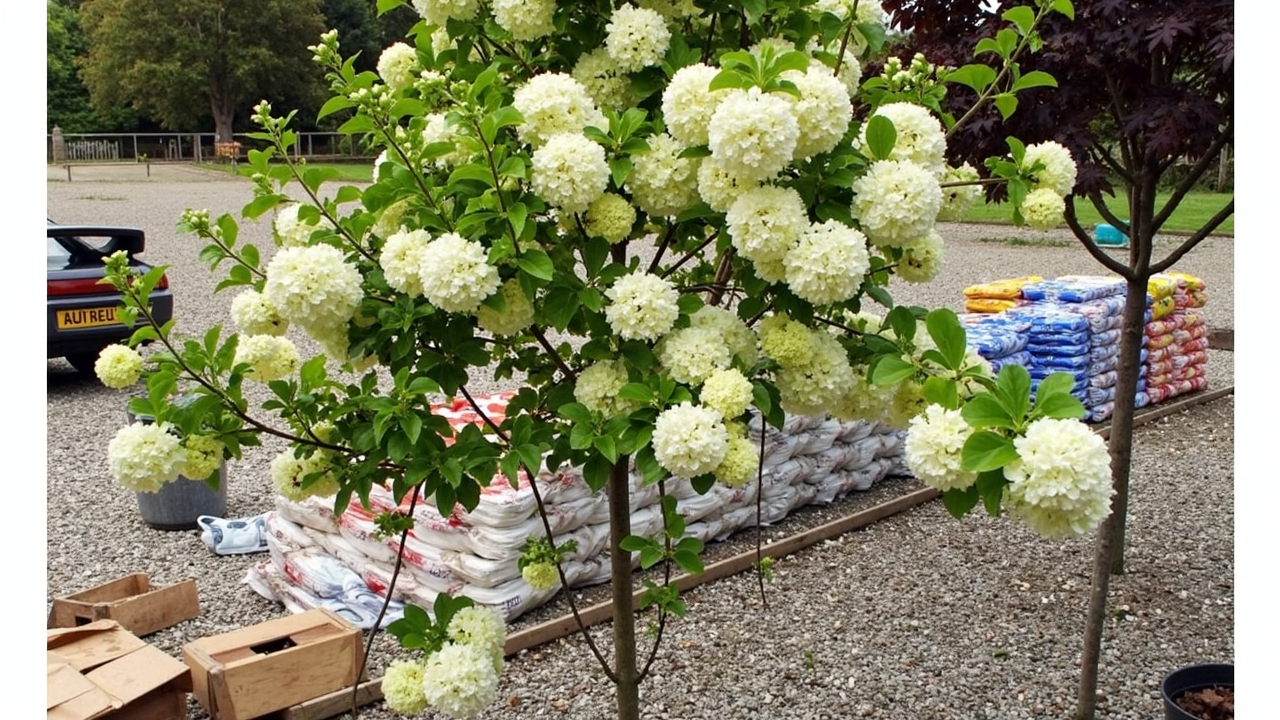
The flowers appear in late May and June, carried in broad, flat-topped umbels 5 to 10 cm across. Each umbel is a lacecap arrangement: a central cluster of small, fertile, creamy-white florets surrounded by a ring of much larger, flat, sterile ray-florets, giving the inflorescence its characteristic "wedding cake" appearance. The flowers have a light, faintly musky scent and are highly attractive to bees, hoverflies and other pollinating insects.
The fruit is a glossy, translucent red drupe, roughly 6 to 10 mm in diameter, borne in heavy, pendulous clusters from late August or September onwards. The berries remain on the plant well after leaf-fall and may persist into midwinter, although in gardens visited by large numbers of blackbirds, thrushes, fieldfares and waxwings, the display can be considerably shortened. Bare winter stems, still hung with strings of scarlet fruit, are a notable feature of the shrub in naturalistic plantings.
Growing Conditions
Viburnum opulus is one of the most accommodating of the larger garden shrubs, performing reliably on a wide range of UK soils. It prefers a moist but well-drained, moderately fertile loam of neutral to slightly acid pH, but is notably tolerant of heavier clay, of lighter sandy soils, and of sites that are periodically wet in winter. In the wild it is found along stream-sides, in damp woodland and in hedgerow bottoms, and these conditions are the ones it prefers in cultivation. The one soil type it resents is a hot, very free-draining sand in full sun, where it can scorch in a dry summer; in such situations a generous mulch and supplementary watering in the establishment phase make a considerable difference.
The plant is fully hardy across the whole of the British Isles and is rated RHS H7, the highest hardiness category, indicating tolerance of temperatures below −20 °C. Late spring frosts can occasionally damage the soft new growth and reduce flowering in an exposed year, but the shrub usually recovers well. For best results, plant in full sun or light dappled shade: flowering, fruit set and autumn colour are all at their best in an open, sunny position, although the species tolerates the deeper shade found at woodland edges. The shrub is also notably wind-firm and tolerates exposed sites, including coastal locations, better than many flowering shrubs of similar size.
Ecologically, Viburnum opulus is an excellent wildlife plant. Its flowers provide abundant nectar and pollen in late spring, when many other shrubs have yet to bloom, and the autumn berries are an important food source for thrushes, blackbirds, redwings, fieldfares and waxwings in cold winters.
Planting and Care
Plant bare-root or rootballed stock between November and March, while the plant is dormant; container-grown specimens can go in at any time of year when the soil is workable. For a screen or hedgerow, space plants 1.5 to 2 m apart; for a single specimen in a shrub border, allow at least 2.5 m of clear space on every side, as the mature canopy is as wide as it is tall. Dig a planting hole roughly twice the diameter of the rootball, loosen the base, and incorporate a spadeful of well-rotted compost or leafmould into the backfill on poorer soils. Set the plant so the nursery soil mark sits level with the surrounding ground, backfill, firm in well, and water thoroughly.
Watering is the main task during the establishment phase. Keep the soil just moist through the first two growing seasons, particularly in dry spells; after that, Viburnum opulus is largely self-sufficient and tolerates ordinary British summers without further irrigation, except in the very driest years on thin, free-draining soil. Feeding is rarely necessary on a reasonable garden soil. On thin ground, an annual mulch of well-rotted compost or leafmould in March, kept clear of the stem, is sufficient; routine fertiliser application is not recommended and can lead to soft growth at the expense of flowers and berries.
Pruning is minimal. The species flowers on the previous year's wood, so any cutting back should be done immediately after flowering if berry production is the priority; routine work is best carried out in late winter, when the structure of the plant is easy to see. Each year, remove any dead, damaged, diseased or crossing stems, and take out the oldest one or two stems at the base on a mature plant to encourage replacement growth from below. Mature, neglected specimens respond well to hard renovation: cut the whole plant back to within 30 to 60 cm of the ground in March, mulch heavily, and feed; vigorous new shoots will usually appear from the base within a few weeks and the plant will recover to flowering size in two to three seasons.
Propagation is straightforward. Semi-hardwood cuttings of 10 to 15 cm, taken in July or August and inserted into a 50:50 mix of peat-free multipurpose compost and sharp grit in a shaded cold frame, root reliably within two to three months. Layering of low shoots in autumn is also effective. Seed can be sown in autumn but requires two periods of stratification and is slow, so it is generally reserved for species work.
Seasonal care in the UK is straightforward: a late-winter tidy in February or March, a top-up mulch in spring on poor soils, and supplementary watering only in the first two summers or in prolonged drought thereafter. Guelder Rose is largely trouble-free in a normal British garden.
Common Problems
Viburnum beetle (Pyrrhalta viburni) is the most frequently reported pest. Both the creamy, spotted larvae, which feed on the undersides of leaves from late April through June, and the grey-brown adult beetles, which feed on the upper leaf surface in July and August, can skeletonise the foliage of an infested plant. Light infestations are best dealt with by squirtting the larvae off with a strong jet of water or by hand-picking; in severe cases, contact insecticides approved for ornamental shrubs may be considered, although well-established plants usually recover fully even after heavy defoliation.
Honey fungus (Armillaria spp.) is the most serious disease threat. Affected plants wilt rapidly, often in mid- to late summer, with the foliage turning yellow and red prematurely and failing to fall cleanly; whitish mycelial sheets beneath the bark at the collar and black, bootlace-like rhizomorphs in the surrounding soil are diagnostic. There is no effective chemical cure, and affected specimens should be dug up and destroyed, with as much of the root system and surrounding soil removed as is practicable, before replanting with a non-susceptible species.
Leaf spot, caused by various fungi, can produce brown or black spots on the foliage in wet summers and may be followed by minor premature defoliation. The condition is largely cosmetic and rarely warrants treatment; affected leaves can be raked up in autumn to reduce carry-over. Powdery mildew, in the form of a white, dusty coating on the leaf surface, may appear in dry, still summers, particularly on plants under stress; improving air circulation by selective thinning and avoiding drought stress are usually sufficient. Late spring frosts occasionally scorch the soft new growth on exposed sites, but the plant usually re-shoots from undamaged buds lower down the stem.
The berries are bitter and mildly toxic when eaten raw in quantity, although birds consume them without ill effect. They have historically been used, after thorough cooking with sugar, to make preserves, jellies and purées that were once a feature of late-autumn kitchens in the north of England; culinary interest in the fruit is now largely historical. The plant is not considered hazardous to dogs, cats or horses, although the consumption of large quantities of foliage or unripe fruit may cause mild gastric upset.
Popular Varieties
Viburnum opulus is most commonly grown in its native species form, which is itself an exceptionally fine garden plant, but a small number of cultivars are widely available. Viburnum opulus 'Roseum', also sold as the Snowball Tree, is by far the most familiar, producing large, rounded, globular heads of pure white, all-sterile flowers in late spring and early summer. It does not set fruit, and the foliage is less brightly coloured in autumn than that of the species, but the flower display is showy and reliable, and the plant reaches about 3 to 4 m. It is the form most often seen in older gardens and municipal plantings.
Viburnum opulus 'Compactum' is a dense, slow-growing selection reaching only around 1.5 m tall and wide, ideal for smaller gardens and the front of a shrub border. It flowers and fruits freely in proportion to its size. Viburnum opulus 'Xanthocarpum' is a yellow-fruited form, occasionally offered by specialist nurseries, in which the autumn berries are a clear, translucent golden amber rather than scarlet; the flowers, foliage and habit are otherwise those of the species.
The American cranberrybush, Viburnum opulus var. americanum (syn. V. trilobum), is sometimes offered in British gardens and is very close to our native Guelder Rose in appearance. It differs chiefly in its slightly smoother, less deeply lobed leaves and in having rather larger, more uniformly edible fruit, the basis of the North American "highbush cranberry" preserve. It is fully hardy in the UK. Any plant sold as the "guelder rose" in the UK is almost always the European V. opulus, and the two are, in any case, considered by some authorities to be regional forms of a single species.
Pests and Diseases
| Problem | Symptoms | Management |
|---|---|---|
| Viburnum beetle | Leaves are skeletonised with only veins remaining, leading to significant defoliation. | Hand-pick adults and larvae or apply a systemic insecticide if infestation is severe. |
| Aphids | Clusters of small soft-bodied insects on new growth causing leaf curling and sticky honeydew. | Squash by hand, blast off with water, or use insecticidal soap for heavy infestations. |
| Phytophthora root rot | General decline, yellowing foliage, and wilting due to waterlogged soil conditions. | Ensure well-drained soil and avoid overwatering; remove severely affected plants. |
| Honey fungus | Slow dieback of branches and white fungal growth at the base of the stem. | Improve drainage and air circulation; surgical removal of infected roots if possible. |
| Leaf spot | Small dark or brown spots appearing on leaves, potentially causing premature leaf drop. | Remove fallen leaves in autumn to reduce spores and avoid wetting foliage when watering. |
Quick Care Summary
| Sunlight | Full sun, Partial shade |
|---|---|
| Soil | moderately fertile, humus-rich, moist but well-drained; tolerates chalk, clay, loam, sand; pH acid, alkaline, neutral |
| Hardiness | H6 (-20.0 °C) |
| Sow | September–November |
| Plant | — |
| Prune | June–July |
As an Amazon Associate, GardenWizz earns from qualifying purchases made through the links above. This does not affect the price you pay. See our disclaimer for details.