Common Ash
Fraxinus excelsior
At a Glance
| Botanical name | Fraxinus excelsior |
|---|---|
| Common name(s) | Common Ash |
| Family | Oleaceae |
| Plant type | tree (Deciduous; rarely exceeds 250 years of age.) |
| Height × Spread | 1200–4300 cm × — |
| Hardiness | H6 (to -20.0 °C) |
| Position | Full sun |
| Soil | Moist but well-drained alkaline or neutral soil; particularly associated with basic soils on calcareous substrates. |
| Flowering | — |
| Toxicity | — |
| Native range | Mainland Europe east to the Caucasus and Alborz mountains, west to Great Britain and Ireland; northernmost naturally occurring location in the Trondheimsfjord region of Norway. |
Overview
Common Ash (Fraxinus excelsior) is a large, fast-growing deciduous tree native to the UK and much of Europe, and one of the most familiar broadleaf trees in the British countryside. The quick-care table below summarises the essentials for UK growers; the full article covers each point in more detail.
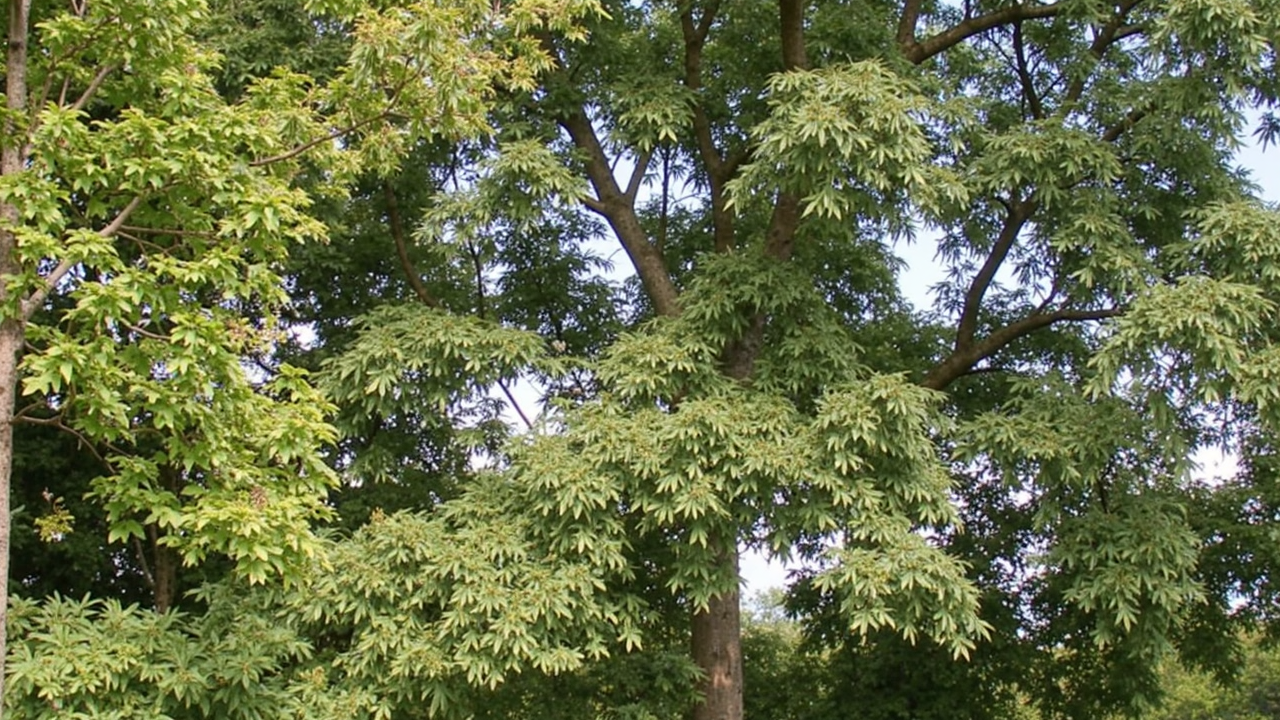
Fraxinus excelsior belongs to the family Oleaceae, which also includes olive, privet, lilac and forsythia. It is a long-lived, fast-growing tree that can reach 20 to 40 m in height with a single trunk up to 2 m in diameter and a tall, open, domed crown. The species is fully hardy throughout the British Isles, tolerates exposed and coastal sites once established, and is widely planted in parkland, large gardens, hedgerows, new woodland and farm shelter belts. It is also one of the most ecologically valuable native broadleaves, supporting a rich community of insects, lichens, fungi and birds, although in recent decades it has been severely affected by the fungal disease ash dieback (Hymenoscyphus fraxineus).
Appearance
Common Ash is a tall tree with a long, straight bole that carries well into the crown before branching. In open situations the crown becomes broad and rounded, often wider near the top than at the base, while trees grown in woodland develop a narrower, more columnar outline. Young bark is smooth and pale grey-green to grey-brown, becoming dark grey and finely fissured into narrow, diamond-shaped ridges with age. The twigs are smooth, grey to grey-green, and bear distinctive black, soot-coloured buds arranged in opposite pairs, one of the easiest features for winter identification.
The leaves are opposite and pinnately compound, 20 to 35 cm long, made up of seven to thirteen leaflets. Each leaflet is 5 to 12 cm long, lance-shaped with a finely serrated margin, tapering to a slender point, and bright fresh green above and slightly paler beneath. In a good autumn the foliage turns a clear, even yellow before falling, although in many years it drops while still green. The flowers are small, dark purple-black and inconspicuous, opening in dense clusters on the bare twigs in April or May, before the leaves expand, and are wind-pollinated. The fruits are single-seeded samaras (commonly called "ash keys"), 2.5 to 5 cm long with a long, twisted wing, hanging in dense bunches from the branches and often persisting on the tree well into winter.
Growing Conditions
Fraxinus excelsior is one of the more adaptable native broadleaves and tolerates a wide range of UK soils, performing best on deep, fertile, moist but well-drained ground. It grows happily on clay, loam and chalk, and on soils from moderately acid to alkaline (roughly pH 4.5 to 8.0). It dislikes waterlogged ground and very dry, hungry sand, although once established it copes well with summer drought. The tree prefers full sun or light, dappled shade and flowers and fruits most freely in open positions. It is tolerant of exposed, windy sites and coastal exposure, which is why it is a common sight in windswept hedgerows and clifftop shelter belts around the British coast.
The species is fully hardy across the whole of the UK and Ireland. The Royal Horticultural Society classifies it in hardiness category H6, indicating tolerance of winter temperatures down to roughly -15 to -20 °C, which covers every lowland and most upland parts of Britain. It grows naturally alongside oak, birch, hazel, hawthorn and field maple in mixed lowland woodland, and is a regular component of hedgerows on heavy clay soils in the Midlands, the South East and the Welsh borders. In the north of Scotland and at altitude in the Pennines, growth is slower and trees remain smaller, but the species is still considered native or long-naturalised throughout.
Planting and Care
Plant container-grown ash at any time of year when soil and weather allow, and bare-root stock between November and March, when dormant. For a single specimen tree, allow at least 8 to 10 m of clear space from buildings, drains and other large trees; for a row in new woodland, plant at 4 to 6 m spacing. Stake taller standards for the first two or three years, water thoroughly at planting, and keep the soil moist through the first two growing seasons. Once established, Common Ash is largely self-sufficient and rarely needs routine watering except in prolonged drought on thin, free-draining ground.
A 5 to 8 cm mulch of well-rotted bark or garden compost, applied over the rooting area in early spring, helps to conserve moisture, suppress weeds and feed the tree in its first few years. Feeding is rarely needed on reasonable garden soil; if growth is poor, a single application of a balanced general fertiliser in spring is sufficient. Pruning should be minimal and confined to late autumn or winter, when the tree is fully dormant. Remove dead, damaged, diseased or crossing branches, and remove any basal suckers or epicormic shoots as they appear. Avoid heavy pruning between late winter and early autumn, when the sap is rising and the tree can "bleed" from cut surfaces, and always inspect older trees for signs of decay or dead wood before cutting.
Propagation from seed is straightforward if slow: collect ash keys in autumn as they turn from green to pale brown, sow immediately in a gritty seed compost outdoors or in a cold frame, or stratify them in damp sand for 18 to 26 weeks before sowing. Germination is often erratic and may take two seasons. Cultivars are propagated by grafting onto seedling rootstocks in specialist nurseries, rather than from cuttings. Seasonal care is light: check stakes and ties in late winter, refresh the mulch in early spring, water young trees in summer drought, and clear fallen fruit and leaves in autumn only if hygiene is needed against disease.
Common Problems
Ash dieback (Hymenoscyphus fraxineus) is by far the most serious threat. Caused by a fungus first identified in the UK in 2012, it produces dark lesions on leaves, shoots and bark, progressive crown die-back, and eventually tree death. There is no cure, and affected trees, especially near buildings, roads or paths, should be assessed for safety and removed by a qualified arborist if they pose a risk. Government and Forestry Commission guidance should be followed before felling mature ash in any location where the tree may be subject to a Tree Preservation Order or be in a conservation area.
Other, less serious problems include the ash bud moth (Prays fraxinella), whose caterpillars feed inside buds and cause minor shoot die-back; ash yellows, a mycoplasma-like condition causing pale, sparse foliage and reduced growth with no effective treatment; bark splitting and frost cracks on smooth young bark in severe winters, usually cosmetic and healing in time; and honey fungus (Armillaria spp.), which occasionally attacks weakened or stressed trees and for which there is no chemical control. Birds, notably hawfinches and bullfinches, will sometimes take a heavy toll of ash keys in late winter, reducing natural regeneration locally. The tree is not considered toxic to humans, pets, livestock or wildlife.
Popular Varieties
Common Ash has fewer widely grown cultivars than many ornamental trees, but several well-established forms are available from UK nurseries. Fraxinus excelsior 'Jaspidea' is a vigorous selection valued for its bright golden-yellow winter shoots and butter-yellow autumn foliage, reaching around 20 m. Fraxinus excelsior 'Pendula' is a small, mushroom-headed weeping ash that rarely exceeds 8 to 10 m, often grafted on a tall clear stem and used as a specimen in larger lawns. Fraxinus excelsior 'Diversifolia' (also sold as 'Monophylla') is an unusual form with leaves reduced to a single, large leaflet, giving a much more open, almost tropical-looking canopy and growing to around 15 to 20 m. Availability varies from year to year, and named cultivars are typically sold as grafted specimens, so they are more expensive than seedling common ash.
Pests and Diseases
| Problem | Symptoms | Management |
|---|---|---|
| Ash dieback | Diamond-shaped lesions on bark, crown dieback, and leaf loss caused by the fungus Hymenoscyphus fraxineus. | No cure exists; remove dead wood to prevent falling hazards and avoid moving infected ash material. |
| Honey fungus | General decline, wilting foliage, and white fungal growth at the base of the trunk or roots. | Improve drainage and soil aeration; remove severely infected trees to prevent spread to nearby plants. |
| Ash borer | Exit holes in the bark and sawdust-like frass, often weakening branches or killing young trees. | Maintain tree health through proper watering and mulching; prune out infested branches if detected early. |
| Ash yellows | Yellowing leaves in summer followed by premature leaf drop and eventual dieback of the crown. | No specific cure; focus on maintaining overall tree vigor and removing dead wood to reduce stress. |
| Slugs and snails | Irregular holes chewed in young leaves and seedlings, often leaving slimy trails. | Use physical barriers like copper tape or organic pellets around young plants during damp weather. |
Quick Care Summary
| Sunlight | Full sun |
|---|---|
| Soil | Moist but well-drained alkaline or neutral soil; particularly associated with basic soils on calcareous substrates. |
| Hardiness | H6 (-20.0 °C) |
| Sow | — |
| Plant | — |
| Prune | — |

As an Amazon Associate, GardenWizz earns from qualifying purchases made through the links above. This does not affect the price you pay. See our disclaimer for details.