Yew
Taxus baccata
At a Glance
| Botanical name | Taxus baccata |
|---|---|
| Common name(s) | Yew |
| Family | Taxaceae |
| Plant type | tree (evergreen) |
| Height × Spread | 1000–2800 cm × 2000 cm |
| Hardiness | H7 (to -20.0 °C) |
| Position | Full sun, Partial shade, Full shade |
| Soil | well-drained soil; tolerates nearly any soil type including humus, base-rich, rendzina, sand, chalk, and heavy soil if planted on a ridge; dislikes waterlogged soil |
| Flowering | March–May |
| Toxicity | All parts of the plant except the fleshy aril are poisonous; seeds inside fruits are extremely toxic. Toxic to humans and animals. |
| Native range | Europe (except Iceland), Caucasus, Turkey eastwards to northern Iran, Morocco, Algeria, Azores, Madeira |
Yew is one of Britain's oldest and most enduring garden plants. A native evergreen conifer, it has clothed churchyards, country estates and formal gardens for centuries, valued as much for its deep green winter colour as for its tolerance of shade, drought and pruning. Slow-growing and remarkably long-lived, individual specimens can exceed 400 years, and a handful of ancient yews in British churchyards are believed to be well over a thousand. Despite its usefulness in the garden, every part of the plant except the fleshy red aril is highly toxic to humans, livestock and most pets — a fact that has shaped both its folklore and its modern horticultural use.
Overview
Taxus baccata is the only yew species native to the British Isles, found wild on chalk and limestone in southern England and Wales. It belongs to the ancient family Taxaceae, a group of conifers that differs from pines and firs in bearing single seeds partly enclosed in a brightly coloured cup rather than a woody cone.
In cultivation yew is exceptionally versatile. It is the classic hedging plant of British topiary and parterre gardens, forms dense formal hedges as low as 60 cm or as tall as 4 m, and is frequently grown as a specimen tree or large shrub. It is also the traditional choice for churchyard planting, partly for its associations with immortality and partly because its dense evergreen shelter benefits wildlife through the winter.
The Royal Horticultural Society has awarded Taxus baccata the Award of Garden Merit (AGM), confirming its reliability in UK garden conditions. It is hardy across virtually the whole of the British Isles and tolerates a wide range of soils provided drainage is reasonable.
Appearance
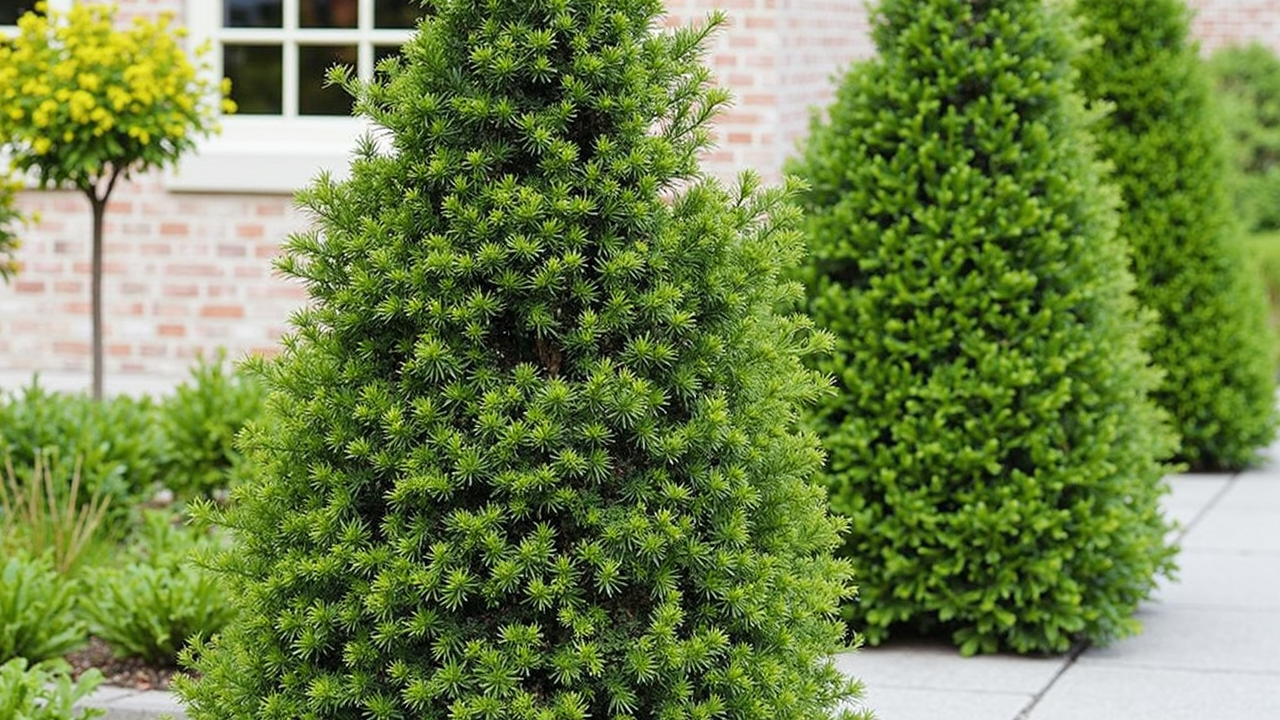
Yew is an evergreen conifer with a broadly conical or domed crown in the open, easily shaped by pruning into flat-topped hedges, cones, spirals or animal-shaped topiary. Mature trees in parkland commonly reach 10–20 m in height with a similar spread, although exceptional ancient specimens can be considerably larger.
The foliage is dark, glossy green above and paler yellowish-green beneath. Each needle is flattened, linear and slightly curved, typically 1.5–3 cm long, with a soft but distinctly pointed tip. Unlike most conifers, yew needles are not borne in tufts but are arranged spirally along the shoots, giving the foliage a distinctive two-ranked, comb-like appearance on horizontal branches. Yew is dioecious: male and female flowers are borne on separate plants. The male flowers appear in early spring as small, yellowish, scaly catkins that release clouds of pollen on mild days in March and April.
Female plants, if a male is nearby, produce the familiar yew "fruits". These are not true fruits but bright scarlet, fleshy, cup-shaped arils, each surrounding a single dark brown seed. The aril is the only part of the plant that is not toxic, although the seed inside it is. The arils ripen in late summer and autumn and remain on the plant through winter, providing a useful (if dangerous) food source for thrushes, blackbirds and other birds, which disperse the seeds.
The bark of mature trees is thin, reddish-brown and flakes off in irregular plates. The wood is hard, dense and elastic — qualities that once made it the preferred material for the English longbow.
Growing Conditions
Yew performs best in deep, well-drained loam but is famously tolerant of a wide range of conditions. It will grow on chalk, limestone, clay (provided it does not waterlog), sandy soils and most neutral to alkaline substrates. It dislikes sitting in saturated ground, particularly in winter, and on very acidic peaty soils growth is generally poor without substantial improvement.
The plant thrives in full sun or deep shade, making it one of the few evergreens suitable for north-facing borders and the dry shade beneath mature trees. In heavy shade yew grows more openly and is best given space as a specimen rather than tightly clipped.
The RHS rates Taxus baccata as hardy throughout the UK (H7 in the older classification, equivalent to the "hardy in the severest European continental climates" category under the new system). It tolerates exposed sites in most of lowland Britain, although in very cold inland parts of Scotland and the north-east of England late spring frosts can scorch the new flush of growth. Coastal gardens suit yew well; it tolerates salt-laden winds better than most conifers.
In the UK, the practical growing season is broadly March to October. Yew is relatively drought-tolerant once established but appreciates watering in its first two or three years and during prolonged dry spells in summer.
Planting and Care
Planting. Container-grown yew can be planted at any time of year when the ground is not frozen or waterlogged, but autumn and early spring are ideal. Bare-root plants, much cheaper for hedging, must be planted between late October and late March. For a single specimen, prepare a hole at least twice the width of the rootball and the same depth; for a hedge, dig a trench and incorporate well-rotted garden compost. Set plants at the same depth they were growing previously, backfill, firm in well and water thoroughly. Mulch with bark or composted bark in late spring to suppress weeds and conserve moisture.
Watering. Water young plants regularly through their first two growing seasons — typically once a week in dry weather, more on free-draining soils. Once established, yew is notably drought-tolerant and rarely needs supplementary watering except in prolonged heatwaves.
Feeding. A single annual application of a general-purpose fertiliser such as growmore or blood, fish and bone in March, scattered over the root area and watered in, is sufficient. On poor soils an autumn top-dressing of garden compost or well-rotted manure will improve growth. Avoid high-nitrogen lawn feeds close to the root zone, which can cause soft, floppy growth.
Pruning. Yew responds exceptionally well to pruning and is the classic conifer for formal work. The key rule is never to cut into old bare wood with no green growth, as yew rarely regenerates from such wood. Trim hedges and topiary once or twice a year: a light tidy in early summer after the first flush of growth, and a final trim in late August or early September. Specimen trees generally need little pruning beyond the removal of dead, damaged or crossing branches in mid-spring.
Propagation. Yew is easily raised from semi-ripe cuttings taken in late summer or early autumn. Use 8–10 cm heel cuttings of current-season growth, insert them into a free-draining cuttings compost, and keep them in a cold frame or unheated greenhouse. Rooting is reliable but slow, often taking 6–12 months. Pot on rooted cuttings individually and grow on for at least two years before planting out. Seed propagation is also possible but slow: the seeds require a period of warm stratification followed by a cold period, typically 18 months or more, before germination.
Seasonal care. Yew requires little seasonal intervention. In late winter, clear fallen leaves from the base of specimen plants to reduce the risk of fungal leaf diseases, and check hedges for birds' nests before any early-spring trim. Mulch in spring and renew stakes on young trees.
Common Problems
Yew is generally healthy, but a few issues recur in UK gardens.
Phytophthora root rot. The most serious disease of yew, caused by soil-borne Phytophthora species. Symptoms include sudden yellowing and browning of the foliage, dieback of branches and a blackened, rotted root system. It is most common on poorly drained or compacted soils. There is no effective chemical cure; affected plants should be removed and the soil improved before replanting. Avoid planting yew where the disease is known to have occurred.
Yew scale. A small sap-sucking insect that colonises the underside of needles and along the shoots, leading to yellowing foliage, sooty mould on the honeydew it excretes, and reduced vigour. A winter wash of plant oil, applied in December or January, helps, and a summer application of a suitable systemic insecticide may be needed for heavy infestations.
Conifer spider mite. Hot, dry summers favour this pest, which causes a fine yellow speckling and bronzing of the foliage. Increase humidity by spraying the foliage with water and, in severe cases, apply a miticide.
Winter yellowing. Mild yellowing or browning of foliage in late winter, particularly on exposed plants, is usually a response to cold and drying winds rather than disease. New growth in spring usually restores the colour.
Toxicity. Every part of yew except the fleshy red aril is highly toxic, containing taxine alkaloids. Ingestion of even a small quantity of needles or clippings can be fatal to horses, cattle, dogs and humans. Gardeners should wear gloves when handling clippings in quantity, dispose of prunings safely away from livestock, and never plant yew in paddocks or within reach of grazing animals.
Popular Varieties
A surprising number of yew cultivars are available in British nurseries, ranging from tall, fastigate forms for architectural use to compact, spreading clones for ground cover and topiary. The following are widely grown and reliably available.
Taxus baccata 'Fastigiata', the Irish yew, is a narrowly columnar female form with very upright branches. It is the classic accent plant for formal entrances and the corner of a border, eventually reaching 4–8 m tall but only 1–1.5 m wide. It was first found in County Fermanagh in the 18th century and is known only as a female clone, so it sets fruit only when a male yew is nearby.
Taxus baccata 'Standishii' is a slower-growing, narrowly columnar form with bright golden-yellow foliage, particularly vivid in spring and early summer. It is best in full sun and typically reaches 2–3 m in height, making it a popular choice for small gardens and containers.
Taxus baccata 'Repandens' is a low, spreading female form, useful for ground cover in shade. It typically grows 60 cm tall and 2–3 m wide and carries the usual red arils freely when pollinated.
Taxus baccata 'Semperaurea' is a dense, broad-spreading shrub with golden foliage that holds its colour through the winter. It grows more slowly than common yew and is often used as a specimen plant in mixed borders.
Taxus baccata 'David' is a narrowly columnar male form, useful for topiary work and for pollinating the fruit-bearing female clones such as 'Fastigiata'.
Many of these cultivars, along with common yew, hold the RHS Award of Garden Merit; specific ratings should be checked against the current RHS plant finder, as the list is updated periodically.
Pests and Diseases
| Problem | Symptoms | Management |
|---|---|---|
| Vine weevil | Notches on leaf margins and root damage causing wilting or collapse. | Apply nematodes to soil in autumn or use biological controls. |
| Yew scale | Small brown bumps on stems with black sooty mould on leaves. | Tolerate light infestations; prune heavily affected branches if necessary. |
| Phytophthora root rot | General decline, yellowing foliage, and eventual death of the plant. | Ensure well-drained soil and avoid waterlogging around the roots. |
| Tortrix moth | Webbing binding leaves together with caterpillars feeding inside. | Prune out affected shoots or use biological controls for severe cases. |
| Bronzing foliage | Leaves turn bronze or red-brown, often due to drought stress. | Water regularly during dry spells and mulch to retain moisture. |
Quick Care Summary
| Sunlight | Full sun, Partial shade, Full shade |
|---|---|
| Soil | well-drained soil; tolerates nearly any soil type including humus, base-rich, rendzina, sand, chalk, and heavy soil if planted on a ridge; dislikes waterlogged soil |
| Hardiness | H7 (-20.0 °C) |
| Sow | — |
| Plant | January, February, March, December |
| Prune | June–August |


As an Amazon Associate, GardenWizz earns from qualifying purchases made through the links above. This does not affect the price you pay. See our disclaimer for details.