Gorse
Ulex europaeus
At a Glance
| Botanical name | Ulex europaeus |
|---|---|
| Common name(s) | Gorse |
| Family | Fabaceae |
| Plant type | shrub (Evergreen shrub; young seedlings produce normal trifoliate leaves for the first few months, which are replaced by spines. Seeds remain viable for 30 years.) |
| Height × Spread | 250–450 cm × 250 cm |
| Hardiness | H6 (to -20.0 °C) |
| Position | Full sun |
| Soil | Poor sandy soil; well drained; light; acidic to neutral pH. Becomes leggy in rich soils. |
| Flowering | January–June |
| Toxicity | — |
| Native range | Western Europe |
Overview
Gorse (Ulex europaeus), also known as whin or furze, is one of the most familiar evergreen shrubs of the British countryside, carpeting heathland, coastal cliffs and moorland in a vivid sheet of yellow for much of the year. The following quick-care table summarises the essentials for UK growers; the full article below covers each in detail.
Ulex europaeus is an evergreen shrub in the legume family Fabaceae and is one of a small genus of spiny shrubs native to western Europe and North Africa. In the United Kingdom it is one of the defining plants of the lowland heath landscape, particularly across the south and west, in Wales, in the Scottish Highlands and on the western seaboard of Ireland. It forms a dense, dome-shaped shrub, typically 1 to 2.5 m tall, with rigid branching stems and an armoury of sharp green spines that discourage grazing and give the plant its common name. The leaves on young seedlings are small and trifoliate, but on mature growth they are reduced to scales and the photosynthetic work is done by the spines themselves, an adaptation to exposed, drought-prone sites. The flowers are the familiar bright yellow, pea-shaped blooms that smother the plant in spring and produce a strong, sweet coconut scent on warm days. As a legume, gorse forms root nodules that fix atmospheric nitrogen, which is one reason it thrives on the poorest, most leached soils where little else will grow, and why it has long been valued in land-reclamation and habitat-restoration schemes.
Appearance
Gorse is a dense, rounded, much-branched shrub with a woody framework and a covering of rigid, sharp spines along virtually every green stem. The spines are modified leaves, 1 to 3 cm long, deeply furrowed and tipped with a fine point, arranged in whorls along the young growth and persisting for several years. True leaves are present only on seedlings and on the youngest shoots; on a mature plant they are reduced to small, narrow scales. The overall colour of the foliage is a deep, slightly greyish green that darkens further in winter. The bark on older wood is grey-brown and becomes deeply fissured with age, particularly on plants that have been allowed to grow for many years.
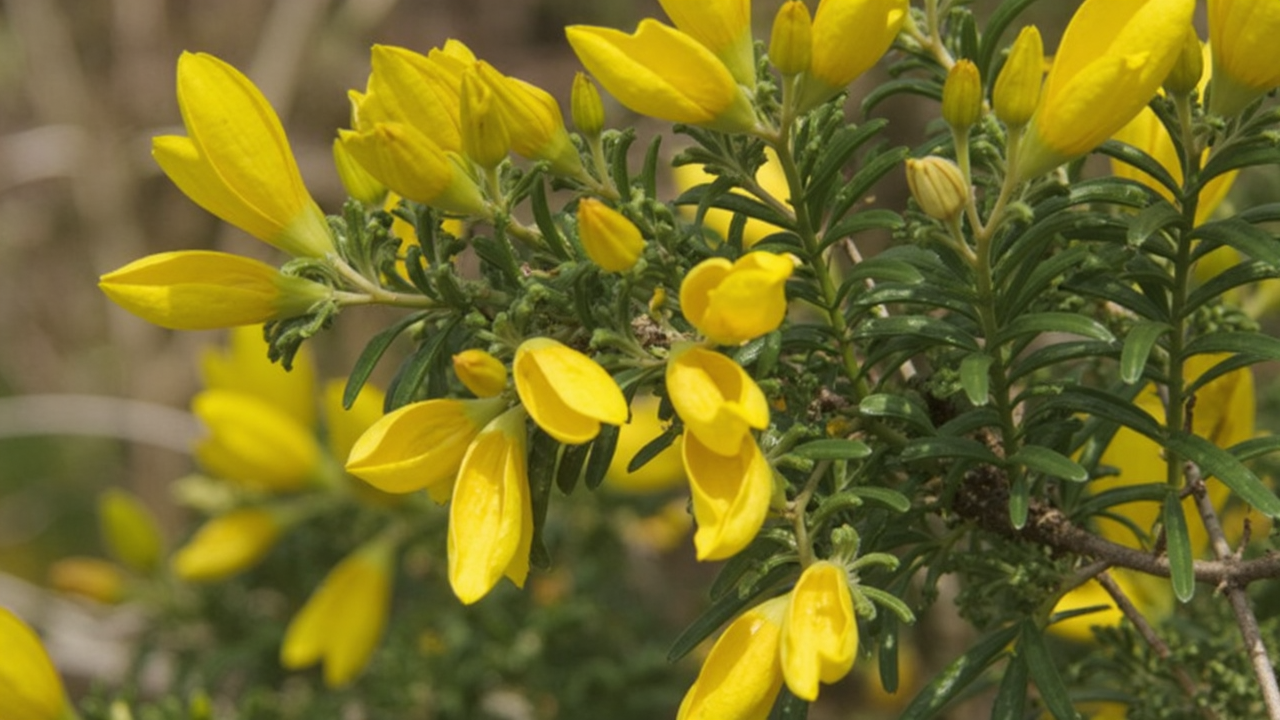
The flowers are borne singly or in small clusters along the previous season's wood. Each flower is pea-shaped, around 1.5 to 2 cm across, with the typical legume structure of a broad standard, two wing petals and a curved keel. Colour is a clear, slightly golden yellow in the species, and a single plant in full flower can carry many thousands of blooms at once. The scent, often described as coconut or vanilla, is strong enough on a sunny day to be detected several metres from the plant and is the source of the old country saying that gorse is never out of bloom — while not strictly true, the main spring flush from March to June is often followed by a useful secondary flowering in late summer and autumn, particularly after warm, dry weather. After pollination, the flowers develop into short, downy seed pods, 3 to 5 cm long, which ripen from green to black and split explosively in warm sunshine, scattering the seeds a metre or more from the parent plant.
Mature size depends on exposure and soil. On a sheltered, deeper soil a single plant can reach 2.5 m in height and form a thicket several metres across, while on a windswept cliff top the same species may stay under a metre and develop a low, gnarled, almost bonsai-like habit. The root system is deep and extensive, which is one reason mature plants transplant poorly.
Growing Conditions
Gorse is adapted to the poorest, most free-draining ground the UK has to offer. It thrives on acidic, sandy, gravelly or rocky soils and is a defining species of lowland heath on the acidic sands of Surrey, Hampshire, Dorset, the New Forest, the Breckland of East Anglia and the dune systems of the west coast. It will not tolerate heavy, waterlogged clay or strongly chalky ground; on rich, fertile soil it grows lush and soft and is more vulnerable to wind-rock and to fungal disease. For most gardens, the best site is the sunniest, leanest, best-drained piece of ground available — a south- or west-facing slope, a raised bed, a gravel garden, or a coastal or exposed position where little else prospers.
The plant is fully hardy across the United Kingdom, tolerating exposed coastal sites, salt-laden winds, frost down to well below -10 °C and prolonged summer drought. It flowers most freely in full sun; light shade reduces the display significantly and encourages an open, leggy habit. The leguminous root nodules fix atmospheric nitrogen and, over time, improve the soil in their immediate vicinity, which is why old gorse stands are often followed by a rich growth of grasses, heather and, eventually, birch and pine.
In a garden context, gorse is best treated as a specimen for a wild, naturalistic or wildlife planting rather than as a tidy ornamental. It is not suitable for planting close to paths, seats or children’s play areas because of the severity of the spines, and it should be sited well away from buildings and stored timber because the foliage, the woody stems and the oily seed pods are all highly flammable.
Planting and Care
Plant container-grown gorse in autumn or in early spring, when the soil is workable and the plant is not in active growth. For a single specimen, allow a spread of at least 1.5 m; for an informal hedge or wildlife barrier, set plants 60 to 90 cm apart in a single, staggered row. Dig a hole roughly twice the width of the rootball, position the plant so the top of the rootball sits level with the surrounding soil, backfill with the same soil — there is no need to add compost or other organic matter, which can hold too much moisture around the roots — and water in well. On heavier soils, work coarse grit into the planting area to improve drainage, or plant on a low mound.
Once established, gorse needs very little routine care. Watering is only required in the first summer after planting and during prolonged drought on the very lightest soils. Feeding is generally unnecessary and undesirable on already fertile ground, as it produces soft growth prone to wind damage. Pruning is the most important task: cut the plant back hard immediately after the main flush of flowers in late May or June, before the seed pods ripen, removing up to a third of the current season's growth and shaping the shrub into a neat dome. Avoid cutting into the old, leafless wood at the base, which rarely regenerates. Plants left unpruned for many years become leggy and bare at the centre, and are best replaced rather than renovated.
Propagation is straightforward from seed. Collect ripe black pods in midsummer, dry them until they split, and sow immediately in a gritty compost or store dry and sow the following spring. Pre-treatment improves germination: pour just-boiled water over the seeds and soak for 12 to 24 hours before sowing, a technique that mimics the heat of a heathland fire. Semi-ripe cuttings, 8 to 10 cm long, can be taken in late summer and rooted in a 50:50 mix of peat-free compost and sharp sand under a propagator; success is less reliable than with seed but useful for named clones. Seed-raised plants vary slightly in habit and flower power, which is one reason gorse is most often sold as a species rather than by cultivar.
Common Problems
Gorse is largely free of serious pest and disease problems in the United Kingdom, which is one of the reasons it has been planted so widely in land-reclamation work. The most significant invertebrate pest is the gorse spider mite (Tetranychus lintearius), a small mite that was originally confined to a limited area of Cornwall and Devon but has spread to many other gorse-growing regions. Heavy infestations cause fine pale mottling on the green spines and a distinct webbing along the younger stems in hot, dry summers; well-grown plants usually tolerate the damage and recover the following year, and chemical control is rarely warranted in a garden setting. The usual disorders are cultural rather than pest-driven.
Root rots, in particular Phytophthora species, are the most common cause of sudden collapse. They occur almost exclusively on poorly drained, waterlogged or compacted ground and present as yellowing, dieback and the death of one or more main stems; affected plants cannot be cured and should be removed along with as much of the surrounding soil as practicable. On rich, damp ground, gorse is also prone to wind-rock, as the soft, leafy growth does not anchor the plant as firmly as the wiry stems of a stressed, free-draining specimen.
Invasiveness is a legitimate concern in certain regions, particularly on open heathland and in upland forestry, where gorse can dominate large areas through its explosive seed dispersal and its ability to regenerate after cutting or burning. It is listed as an invasive non-native species in parts of the world such as New Zealand, Australia and Chile, and in the United Kingdom it is a species of conservation concern in some protected heathland sites. The most serious practical hazard, however, is fire: the foliage, the woody stems and especially the oily seed pods burn with great intensity and throw embers, so gorse should never be planted close to buildings, stored timber, vehicles or other flammable materials.
Popular Varieties
Ulex europaeus is most often grown as the species, since seed-raised plants are vigorous, variable and well adapted to typical British conditions. The double-flowered form Ulex europaeus 'Flore Pleno' is the most widely planted cultivar. It carries dense, packed rosettes of yellow petals in place of the normal pea-shaped flowers, holds its display for several weeks longer than the single-flowered species, and sets little or no viable seed, which makes it a more responsible choice where naturalising is a concern. It typically reaches 1.5 to 2 m and is fully hardy.
For smaller gardens, Ulex europaeus 'Compacta' is a tighter, more contained selection that usually stays under 1.2 m tall while still producing a heavy spring show of the typical coconut-scented flowers. The dwarf form sometimes sold as Ulex minor (dwarf gorse) is, strictly, a different species within the same genus: it stays 30 to 60 cm tall, with a lower, more spreading habit, and flowers in late summer and autumn rather than spring. It is useful as a groundcover on dry, acidic banks where the common gorse would be too large.
For gardeners interested in late-season scent and pollinator value, the closely related Western gorse, Ulex gallii, is a smaller, more compact species that flowers from August into November. The prostrate, mat-forming form sometimes sold as Ulex gallii 'Nanus' or 'Prostratus' rarely exceeds 30 cm in height and spreads slowly across well-drained, acidic soil, making it suitable for the top of a retaining wall or a sunny rock garden where the spines are well out of the way of passing feet. The RHS has awarded the Award of Garden Merit to several forms of gorse, recognising their reliability in typical British garden conditions; specific AGM ratings for individual cultivars should be checked against the current RHS plant finder before purchase, as these are revised periodically.
Pests and Diseases
| Problem | Symptoms | Management |
|---|---|---|
| Honey fungus | Wilting, yellowing foliage and dieback of branches, often with white fungal growth at the base. | Improve drainage and avoid planting in soil known to be infected; remove severely affected plants. |
| Vine weevil | Notched edges on leaves above ground and root damage or rot below ground caused by grubs. | Check roots when purchasing new plants and apply biological nematodes to the soil in autumn. |
| Slugs and snails | Irregular holes chewed into young shoots, leaves, or flower buds, often accompanied by slime trails. | Use physical barriers like copper tape or apply iron phosphate-based pellets around the base. |
| Root rot | General decline, yellowing leaves, and wilting despite adequate moisture due to waterlogged soil. | Ensure planting in well-drained, sandy or acidic soil and avoid overwatering. |
| Nutrient deficiency | Yellowing between leaf veins or pale foliage indicating poor uptake of essential nutrients. | Avoid adding rich fertilizers which cause leggy growth; rely on natural soil nutrients in poor soils. |
Quick Care Summary
| Sunlight | Full sun |
|---|---|
| Soil | Poor sandy soil; well drained; light; acidic to neutral pH. Becomes leggy in rich soils. |
| Hardiness | H6 (-20.0 °C) |
| Sow | — |
| Plant | January–December |
| Prune | May–June |

As an Amazon Associate, GardenWizz earns from qualifying purchases made through the links above. This does not affect the price you pay. See our disclaimer for details.