Wych Elm
Ulmus glabra
At a Glance
| Botanical name | Ulmus glabra |
|---|---|
| Common name(s) | Wych Elm |
| Family | Ulmaceae |
| Plant type | tree |
| Height × Spread | 4500 cm × — |
| Hardiness | H6 (to -20.0 °C) |
| Position | Full sun, Partial shade |
| Soil | any well drained soil |
| Flowering | March–May |
| Toxicity | — |
| Native range | Ireland eastwards to the Ural Mountains, and from the Arctic Circle south to the mountains of the Peloponnese and Sicily; also native to the Caucasus region and parts of Western Asia (Turkey, Syria and Iran) |
Overview
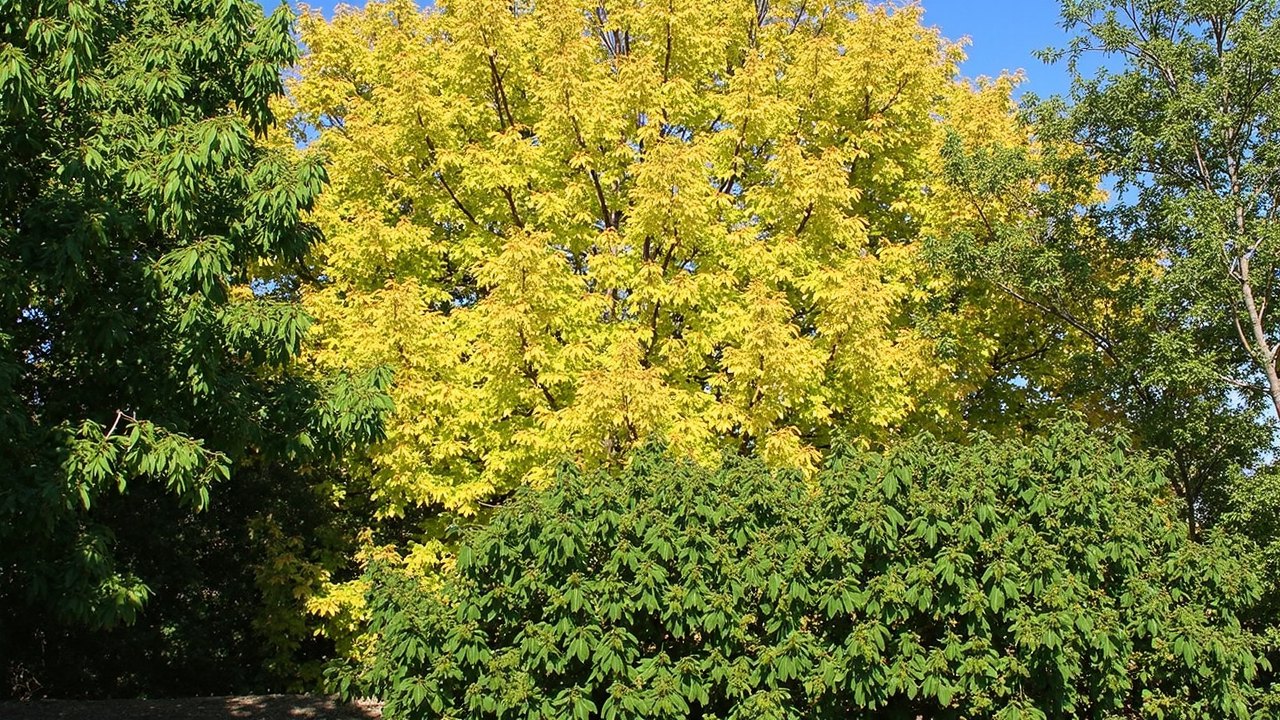
Wych Elm (Ulmus glabra) is a large, broad-canopied deciduous tree native to much of the British Isles and northern Europe. The species is most often used as a specimen tree in parks, large gardens and woodland edges, where its broad crown and yellow autumn colour can be appreciated at distance.
It is the only elm species that is truly indigenous to the whole of the UK, occurring naturally from the Scottish Highlands south to the Welsh borders and into northern England, with scattered populations further south on suitable soils. Mature trees reach 25–30 m in height and develop characteristically wide, arching crowns that often spread as far as they are tall. The species has been heavily depleted by Dutch elm disease since the 1960s, and although mature specimens survive, regeneration in many areas is sparse. Gardeners planting a Wych Elm today should treat it as a long-term specimen tree rather than a quick landscape fill, and be prepared to source from disease-resistant stock where possible.
Appearance
Wych Elm is most easily recognised by its very large, asymmetric leaves. The leaf blade is broadly oval to obovate, typically 8–16 cm long and 5–10 cm wide, with a distinctly unequal base (one side of the leaf base extends noticeably further down the stalk than the other) and a short, tapering point. The upper surface is rough to the touch, the underside downy. Margins are sharply and often doubly serrate. In spring the foliage emerges pale green, darkens through summer, and turns a clear butter-yellow in autumn before falling.
The bark is smooth and grey-brown on young trees, becoming fissured and coarsely ridged with age. Winter twigs are dark brown and finely downy, with small, blunt, dark buds. The flowers are small, reddish-purple and appear in dense clusters on bare twigs in late February and March, well before the leaves emerge. They are wind-pollinated and not ornamental. The fruit is a pale green, winged samara, roughly 2 cm across, ripening in late spring; each samara is notched at the tip and contains a single seed sitting centrally in the wing — a useful field character that separates Wych Elm from some related elms where the seed sits closer to the notch.
The overall habit is rounded to broadly spreading, often with several heavy, ascending limbs arising from a short, stout bole. Mature crown spread of 15–20 m is typical on open-grown trees.
Growing Conditions
Wych Elm is hardy across the UK and tolerates cold winters, exposed sites and short summer droughts once established. The Royal Horticultural Society has historically rated Ulmus glabra H7 (hardy throughout the UK, tolerating temperatures below −20 °C); specific named cultivars may carry their own ratings. Gardeners should note that RHS hardiness ratings are revised periodically, and it is worth checking the current RHS entry before purchasing.
The species prefers deep, moist but well-drained loam, but it is notably tolerant of a wide pH range, growing on mildly acidic upland soils as well as on chalk and limestone. It does not thrive in compacted, waterlogged or very thin soils, and on shallow chalk it tends to remain smaller and shorter-lived. Although it grows in light shade, the finest specimens develop in full sun on sheltered but open sites.
In UK terms, Wych Elm is suitable for gardens from the Highlands of Scotland down to the south of England, with the proviso that coastal exposure in the far north and west can check growth. It is not a tree for very small plots; a single specimen needs space of roughly 12–15 m radius to develop its natural habit without constant pruning.
Planting and Care
Plant bare-root Wych Elm between November and March, when dormant, and container-grown stock at any time the ground is workable. Prepare a planting pit at least twice the width of the rootball and no deeper, and tease out circling roots on container-grown trees. Set the root collar flush with the surrounding soil, backfill with the original topsoil, firm in well and water thoroughly. Stake only where the site is exposed, using a low, flexible tie that allows the trunk to sway; remove the stake after two growing seasons at most.
Watering: water deeply once a week during the first two growing seasons in dry spells. After establishment Wych Elm is drought-tolerant and needs no routine irrigation in average UK summers.
Feeding: an annual mulch of well-rotted garden compost or leafmould in late winter, spread over the rooting area but kept clear of the trunk, is usually sufficient. On very poor soils a single spring application of a balanced slow-release fertiliser (such as a 10-10-10 formulation) in March can be used for the first three years. Excessive nitrogen produces soft growth that is more attractive to aphids.
Pruning: Wych Elm is best pruned in late summer (July to early September), outside the sap-rising spring period and outside the main elm bark beetle activity window. Remove dead, crossing or damaged wood, and any suckers arising from the base. Formative pruning on young trees should establish a single leading shoot and a well-spaced scaffold of main limbs. Wounds larger than 5 cm in diameter are best avoided on mature trees, as large cuts can be slow to callus over.
Propagation: from seed, sown fresh in autumn; seed loses viability quickly when dried. Named cultivars are propagated by grafting onto Ulmus glabra seedling rootstocks, or by softwood cuttings taken in early summer under mist with bottom heat. Home gardeners will find grafted named cultivars the more reliable option.
Seasonal care: in February and March check for aphid colonies on the undersides of emerging leaves. Rake up and destroy fallen leaves in autumn to reduce overwintering inoculum of leaf spot diseases. From late May onwards, inspect the upper crown weekly for early signs of dieback (flagging, yellowing of upper shoots) and act promptly if Dutch elm disease is suspected — local authority tree officers or a qualified arborist should be consulted.
Common Problems
Dutch elm disease (DED), caused by the fungi Ophiostoma novo-ulmi and O. ulmi and spread by elm bark beetles (principally Scolytus species), remains the dominant threat. Symptoms typically appear in early to mid summer as wilting, curling and yellowing of leaves on a single branch, the leaves then turning brown and dying while the branch remains bare. There is no reliable cure for an infected tree; in the UK confirmed cases should be reported, and affected trees are usually removed promptly to reduce inoculum. Gardeners in DED-active areas should consider only disease-resistant elm cultivars rather than seedling U. glabra.
Elm leaf aphid (Tetraneura ulmi and related species) can cause puckering and premature leaf drop on isolated trees; infestations are usually kept in check by natural predators and rarely justify treatment in mature specimens.
Wych Elm is also subject to coral spot (Nectria cinnabarina), which enters through wounds and produces pink pustules on dead twigs, and to a range of leaf-spotting fungi in damp seasons. Neither is usually fatal on its own; routine hygiene — removing dead wood and avoiding unnecessary cuts — is the main defence.
Galls on the leaves (erinea, small blister-like patches caused by eriophyid mites) are common but cosmetic only. Powdery mildew may appear in dry summers on young trees but rarely needs treatment.
Squirrels and grey squirrels can strip bark from younger trees in late spring; plastic tree guards or proprietary spiral guards will prevent this until the bark thickens.
Popular Varieties
The species itself (Ulmus glabra) is the form most commonly offered, and is the appropriate choice where a large native canopy tree is wanted. The following named forms are well documented in horticultural literature and have been grown in UK collections; where a Royal Horticultural Society Award of Garden Merit (AGM) was awarded it is noted, but gardeners should verify current status with the RHS, as awards are reviewed periodically and may have been amended since this article was written.
- Ulmus glabra ‘Camperdownii’ — Camperdown Elm. A naturally occurring weeping form, found in Scotland in the 1840s, grafted onto a tall straight stem of U. glabra to produce a mushroom-headed specimen with strongly pendulous branches and a dense, cascading outline. Usually 4–6 m tall and broader than tall. Widely planted as a focal point in larger gardens. (RHS AGM, H7; status to be verified with current RHS listings.)
- Ulmus glabra ‘Lutescens’ — Golden Wych Elm. Foliage opens bright yellow in spring and gradually greens through summer; broadly conical when young, rounding with age. Noted for its early-season colour and useful in larger landscape plantings. (H7; AGM status to be verified.)
- Ulmus glabra ‘Pendula’ — a generic pendulous form, less tightly weeping than ‘Camperdownii’ and used as a specimen lawn tree.
- Ulmus glabra ‘Exoniensis’ (Exeter Elm) — narrowly fastigiate when young, broadening somewhat with age; useful where a tall, narrow elm is required, for example as a vertical accent in a large border.
Where Dutch elm disease is a serious local concern, gardeners may also wish to consider resistant hybrid elms developed from crosses involving Ulmus glabra and Asiatic species — for example clones from the Dutch and Italian breeding programmes marketed under names such as ‘Columella’, ‘Lobel’ and ‘Sapporo Autumn Gold’. These carry some U. glabra parentage but should be regarded as hybrids rather than pure Wych Elm, and their AGM status and current UK availability vary; check with a reputable specialist nursery before ordering.
Pests and Diseases
| Problem | Symptoms | Management |
|---|---|---|
| Dutch elm disease | Wilting and yellowing leaves on individual branches, often with brown streaks in the sapwood. | Remove and burn infected wood immediately to prevent spread by bark beetles. |
| Honey fungus | General decline, dieback of branches, and white fungal growth under the bark at the base. | Improve drainage and avoid wounding roots; severe cases may require tree removal. |
| Coral spot | Bright orange-red fruiting bodies appearing on dead or dying branches. | Prune out affected wood to improve air circulation and reduce fungal load. |
| Phytophthora root rot | Rapid wilting, leaf drop, and dark staining of the roots in waterlogged soil. | Ensure well-drained planting sites and avoid overwatering to prevent root suffocation. |
| Aphids | Clusters of small soft-bodied insects on new growth causing sticky honeydew and curled leaves. | Wash off with a strong jet of water or apply horticultural oil if infestations are heavy. |
| Elm gall mites | Small, wart-like galls forming on the undersides of leaves. | Generally cosmetic; prune out severely affected branches to reduce populations. |
Quick Care Summary
| Sunlight | Full sun, Partial shade |
|---|---|
| Soil | any well drained soil |
| Hardiness | H6 (-20.0 °C) |
| Sow | — |
| Plant | — |
| Prune | — |
As an Amazon Associate, GardenWizz earns from qualifying purchases made through the links above. This does not affect the price you pay. See our disclaimer for details.