Rowan
Sorbus aucuparia
At a Glance
| Botanical name | Sorbus aucuparia |
|---|---|
| Common name(s) | Rowan |
| Family | Rosaceae |
| Plant type | tree (deciduous) |
| Height × Spread | 500–1500 cm × — |
| Hardiness | H6 (to -20.0 °C) |
| Position | Full sun, Partial shade |
| Soil | moderately fertile, humus-rich soil; moist but well-drained; prefers acidic to neutral pH |
| Flowering | May–June |
| Toxicity | Fruit are ornamental, not to be eaten. Wear gloves and other protective equipment when handling. |
| Native range | most of Europe and parts of Asia, as well as northern Africa; from Madeira, the British Isles and Iceland to Russia and northern China |
Overview
Rowan (Sorbus aucuparia) is a hardy, deciduous broadleaf tree native to most of the United Kingdom and a familiar sight in gardens, streets, hedgerows and upland woods. It is grown chiefly for its three-season display: creamy spring flowers, finely cut leaves that colour well in autumn, and bright clusters of red berries that carry the tree through winter. The following quick-care table summarises the essentials for UK growers; the full article below covers each in detail.
Sorbus aucuparia belongs to the family Rosaceae and is the most familiar member of a genus that also includes the whitebeams and several other small British natives. The species occurs naturally across upland Britain, from the Scottish Highlands south to Devon, growing on rocky slopes, woodland margins, cliffs and ravines, and it has long been planted as an ornamental and street tree. A medium-sized tree with a broadly conical to oval crown, it reaches roughly 10 to 15 m at maturity in cultivation, with a relatively fast growth rate when young that slows with age. Its tolerance of exposure, pollution and acidic soils, combined with an RHS hardiness rating of H7, makes it one of the most reliable small trees for gardens in the north and west of the UK, and a popular choice for street planting in towns and cities. The berries are a critical winter food for fieldfares, redwings, waxwings and other thrushes, and the spring flowers support bees, hoverflies and other pollinating insects. Rowans have a long folk tradition in the British Isles: they were commonly planted near houses and crofts as protective trees, and the wood has historically been used for tool handles and small turnery.
Appearance
Sorbus aucuparia is a graceful, medium-sized tree with an open, broadly conical to oval crown and a short, often slightly leaning trunk. Bark on young trees is smooth and pale grey-brown, becoming darker, more fissured and flaking in vertical plates with age. The branches are slender and slightly arching, with pale grey winter shoots that carry prominent purple-brown buds.
The leaves are pinnate, typically 15 to 25 cm long, with five to eight pairs of oblong to lance-shaped leaflets arranged opposite one another and a single terminal leaflet. Each leaflet is roughly 3 to 6 cm long, with a finely serrated margin and a slightly downy underside. The foliage is mid-green in summer, turning yellow, orange and russet-red in autumn before falling. In the cut-leaved cultivar 'Asplenifolia' the leaflets are deeply and irregularly lobed, giving the foliage a fern-like appearance.
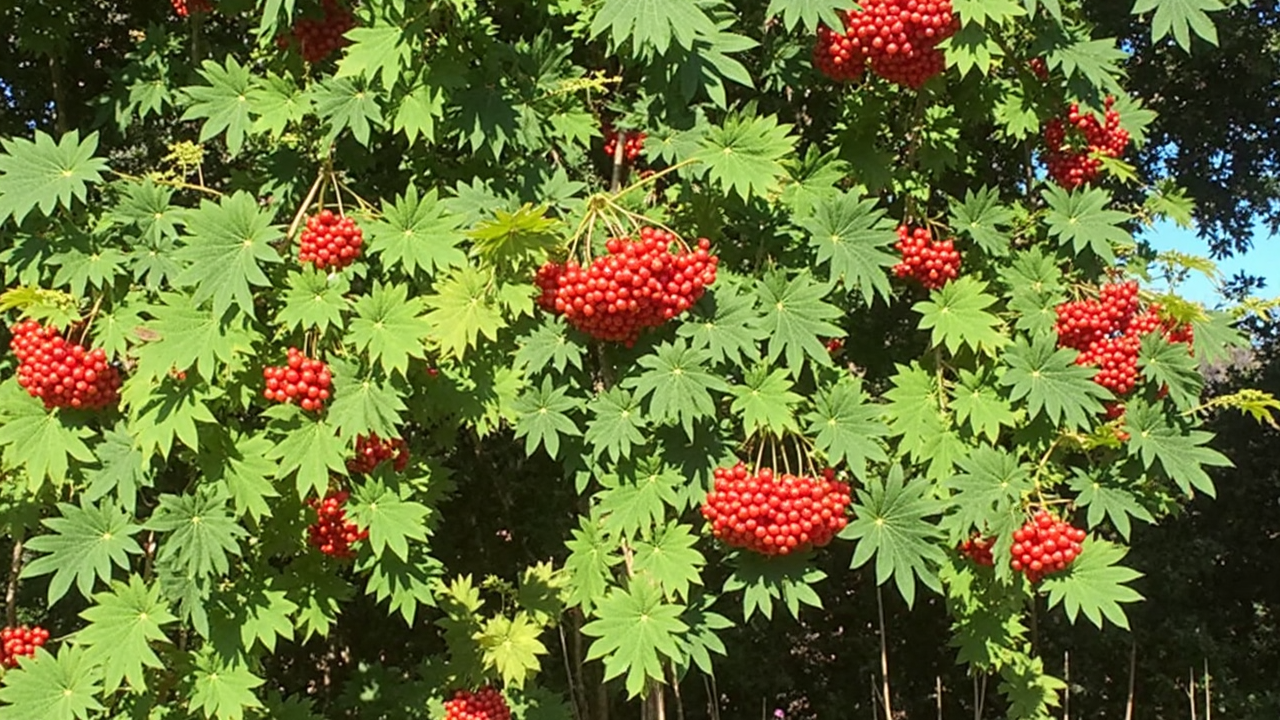
Flowers appear in late April, May and into early June, depending on latitude and season, in dense flat-topped clusters (corymbs) 8 to 15 cm across. Each individual flower is small, creamy-white and five-petalled, with a faint, slightly musky scent. They are followed by rounded pomes 6 to 9 mm across, which ripen from green through yellow-orange to bright scarlet in late summer and persist, often in heavy bunches, well into winter. The berries are borne on reddish stalks and may remain on the tree from August through to December or even February in mild winters, providing a long period of winter interest. Yellow-fruited forms occur naturally and have given rise to several named cultivars. The overall habit is taller and more open in woodland, shorter and broader in the open ground, where the crown is often as wide as the tree is tall.
Growing Conditions
Rowan is a notably unfussy tree in British conditions. It grows in full sun or light dappled shade, with the heaviest berry crops carried in open, sunny positions. Soil should be moist but well-drained; the species is happy on acid and neutral loams, sands and peaty ground, including the kind of thin, stony soils found in upland gardens. It dislikes shallow chalk soils and heavy, waterlogged clay, where growth is often stunted and the tree is more prone to canker. Once established, it tolerates a wide range of conditions including exposed sites, salt-laden coastal winds, and the polluted air of town streets, which is why it is so widely planted as a roadside and urban tree.
In UK terms, the species is fully hardy. The RHS rates it H7, the highest hardiness rating used in the RHS system, indicating tolerance of temperatures below -20 °C and suitability for the whole of the British mainland, including upland Scotland and the colder inland parts of northern England. Young trees grow quickly, often 30 to 60 cm a year in their first five years given reasonable soil, before slowing as the crown fills out. The natural lifespan in gardens is typically 60 to 100 years, though some park and street specimens live considerably longer.
Planting sites should be chosen with the mature size in mind. Although young rowans look compact, even modest garden forms reach 6 to 8 m, and full-size trees on vigorous rootstocks will reach 12 to 15 m, casting shade over a wide area and casting roots into neighbouring borders. They are not suitable for very small gardens close to a house wall, where their eventual size causes problems with drains, gutters and overhanging branches.
Planting and Care
Plant bare-root rowans between November and March, while dormant, and container-grown trees at any time of year provided the ground is not frozen or waterlogged. Dig a hole roughly twice the width of the root ball and the same depth, loosening the base and sides with a fork. On poor soils, work a spadeful of well-rotted garden compost or leafmould into the backfill; on already reasonable garden soil, plain excavated soil is usually adequate. Position the tree at the same depth it was growing previously, backfill, firm gently with the heel, and water in thoroughly. Stake young trees with a low, short stake and a flexible tree tie for the first two to three years, removing both stake and tie once the trunk has thickened. A 5 to 8 cm mulch of bark, compost or leafmould over the root area suppresses weeds and conserves moisture, but should be kept clear of the trunk itself.
Watering is most important in the first two growing seasons. Water deeply once a week during dry spells, rather than little and often, to encourage roots to grow down into the soil. Once established, the tree generally looks after itself except in prolonged drought on very free-draining ground. Feeding is rarely necessary; on reasonable garden soil the tree will perform well with no supplementary fertiliser. On thin, poor soils a single light top-dressing of a general-purpose fertiliser in early spring will help establishment.
Pruning is minimal. Remove dead, damaged or crossing branches in late autumn or winter, when the tree is fully dormant and the structure is easy to see. Any shaping or reduction should also be done in the dormant season; rowans do not respond well to hard pruning in summer, which can encourage re-growth that is then damaged by winter cold. Avoid cutting back into old wood unless removing a whole branch; the tree is naturally tidy in habit and heavy pruning is seldom needed.
Propagation is straightforward from seed. Collect ripe berries in late summer or early autumn, mash them and wash the seed clean, then stratify it for around 16 weeks in damp sand at about 4 °C before sowing in spring. Alternatively, take semi-ripe cuttings in midsummer and root them in a gritty, free-draining compost under a cold frame. Named cultivars are propagated almost exclusively by grafting onto Sorbus aucuparia rootstocks, which is a job for a specialist nursery.
Seasonal care through the year is light: check ties and stakes in spring, water young trees during summer drought, and remove any suckers from the base in autumn if they appear.
Common Problems
Rowan is generally a healthy tree in the UK, but a few problems are worth watching for. Fireblight (Erwinia amylovora) is the most serious. Caused by a bacterium, it produces wilting, blackening blossom clusters and shepherd's-crook curling of young shoots, often with a sticky ooze from infected bark. It is notifiable in the UK under plant health legislation; affected growth should be cut out at least 30 cm below visible symptoms, ideally in dry weather, with tools disinfected between cuts. Badly affected trees may need to be removed.
Canker and dieback, often associated with fungi such as Nectria, can cause sunken, discoloured lesions on the bark and die-back of upper branches, particularly on stressed trees on heavy or chalky soils. Prune back to healthy wood, dispose of infected material (do not compost it), and improve growing conditions to reduce stress.
Powdery mildew can coat the leaves in a white fungal film during warm, dry summers with humid nights, and is most common on young trees in sheltered sites. Improving air circulation around the tree, avoiding overhead watering, and removing severely affected leaves are usually sufficient.
Aphids may cluster on the soft young shoots in late spring, sometimes causing leaf curl and sticky honeydew; they rarely damage established trees and are easily controlled with a strong jet of water or by leaving them to natural predators. Sawfly larvae, in particular the rowan leaf-rolling sawfly, may roll and skeletonise leaves in early summer; hand-picking on small trees is the simplest control.
Grey squirrels occasionally strip bark from young rowans in spring, which can girdle and kill them. Tree guards or plastic spirals around the lower trunk are the usual remedy. The berries are a critical winter food for birds rather than a pest problem, though fallen fruit can be slippery on paths and paving.
Popular Varieties
Sorbus aucuparia 'Asplenifolia' is a distinctive cut-leaved form in which the leaflets are deeply and irregularly divided, giving the foliage a soft, fern-like texture. It makes a more spreading tree than the species, typically reaching 8 to 10 m, and is valued for its unusual leaf shape as much as for its flowers and berries.
Sorbus aucuparia 'Fructu Luteo' is a yellow-fruited selection, identical to the species in habit and foliage but bearing heavy crops of amber-yellow berries in autumn. It is useful in planting schemes where a softer colour note is wanted, and the yellow fruit shows up well against dark evergreens.
Sorbus aucuparia 'Edulis' is a large-fruited form, selected on the continent for heavier, less bitter berries that are useful in country cooking and preserves. It makes a broadly conical tree of around 10 to 12 m and is a good choice where berries are wanted for the kitchen as well as for ornament. The closely related whitebeams Sorbus aria and Sorbus 'Joseph Rock' are often grouped with rowans in UK garden centres, carrying similar flowers and fruits on simple rather than pinnate leaves, and are good alternatives where chalky soil rules out the true rowan.
Pests and Diseases
| Problem | Symptoms | Management |
|---|---|---|
| Fireblight | Shoots and branches suddenly wilt, turn black, and curve into a shepherd's crook shape. | Prune out infected wood well below the visible symptoms during dry weather, disinfecting tools between cuts. |
| Apple canker | Sunken, discoloured lesions appear on stems and branches, often oozing sap or producing fungal spores. | Cut out affected areas with a sharp knife down to healthy wood and seal the wound with pruning paint. |
| Aphids | Clusters of small soft-bodied insects gather on new growth, causing leaf distortion and sticky honeydew. | Encourage natural predators like ladybirds or blast off infestations with a strong jet of water. |
| Pear blister mite | Leaves develop raised, blister-like patches that may turn brown and cause premature leaf drop. | Apply an appropriate miticide in early spring before bud burst if infestations are severe. |
| Silver leaf | Wood beneath the bark takes on a silvery sheen, leading to dieback of branches and poor growth. | Prune out infected branches immediately and burn them; avoid planting susceptible species near infected trees. |
| Honey fungus | White fungal threads appear at the base of the tree, accompanied by wilting foliage and eventual decline. | Improve drainage and soil aeration; severe cases may require removal of the infected plant. |
Quick Care Summary
| Sunlight | Full sun, Partial shade |
|---|---|
| Soil | moderately fertile, humus-rich soil; moist but well-drained; prefers acidic to neutral pH |
| Hardiness | H6 (-20.0 °C) |
| Sow | — |
| Plant | — |
| Prune | — |


As an Amazon Associate, GardenWizz earns from qualifying purchases made through the links above. This does not affect the price you pay. See our disclaimer for details.