
Blackberry
Rubus fruticosus
At a Glance
| Botanical name | Rubus fruticosus |
|---|---|
| Common name(s) | Blackberry |
| Family | Rosaceae |
| Plant type | shrub |
| Height × Spread | 100–250 cm × 100–400 cm |
| Hardiness | — |
| Position | Full sun |
| Soil | rich, well-drained soil |
| Flowering | March–June |
| Toxicity | — |
| Native range | European |
The blackberry is a deciduous, scrambling bramble native to the British Isles and much of temperate Europe. Long gathered from hedgerows for its late-summer fruit, it has been cultivated for well over a century, and modern varieties offer larger, sweeter berries and more manageable growth than their wild relatives. It is one of the easiest soft fruits to grow in the UK, succeeding in most soils and cropping reliably from late July into October.
Overview
Blackberries belong to the genus Rubus in the rose family (Rosaceae), a large and taxonomically complex group in which many closely related microspecies are grouped under the aggregate name Rubus fruticosus. The cultivated forms sold for fruit are selections and hybrids bred from European and North American brambles, chosen for vigour, larger berries, and in many cases spineless canes.
In the UK garden a single well-tutored plant can yield 4–8 kg of fruit per year once established, and a row of three or four plants is usually enough for a household. Blackberries are self-fertile, so a lone plant will set fruit on its own, though bumblebees and solitary bees noticeably improve yields. The plants are also valuable for wildlife: the flowers feed pollinators and the fruit feeds blackbirds, thrushes, foxes and small mammals well into autumn.
Appearance
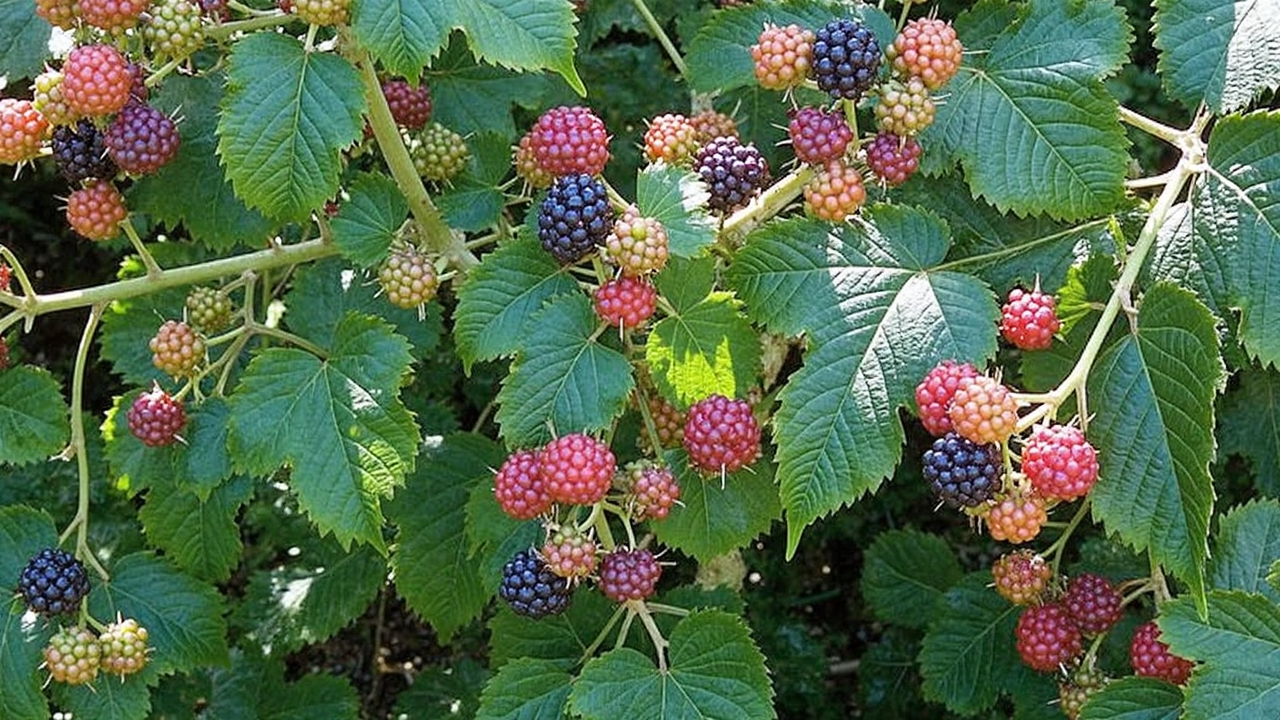
A blackberry plant is a thicket of long, arching canes (called "primocanes" in their first year and "floricanes" in their second, fruiting year). The canes are usually armed with sharp, hooked prickles, though modern varieties are increasingly spineless. Leaves are palmate, divided into three or five leaflets with serrated edges, mid-green above and paler beneath, often persisting until late autumn.
Flowers appear in early summer on short side-shoots of the previous year's canes. Each is around 2–3 cm across with five white or faintly pink petals and a cluster of yellow-tipped stamens. The fruit is an aggregate of small drupelets, technically a cluster of tiny stones embedded in fleshy receptacle tissue; it ripens from green through red to a deep glossy black, by which stage it detaches easily from the receptacle (unlike a raspberry, where the receptacle stays on the plant).
Habit varies with cultivar. Vigorous types can throw canes 4 m or more in a season; more compact modern varieties stay around 1.8–2.5 m. Wild brambles in the hedge make dense, impenetrable scrub; in the garden they are best constrained against a post-and-wire system or a wall.
Growing Conditions
Blackberries are undemanding and will grow almost anywhere in the UK except waterlogged or strongly alkaline soil. They crop best in a sunny, sheltered position, ideally against a south- or west-facing wall or fence, but they tolerate light dappled shade, especially in the south of England. Cold, exposed sites in northern England and Scotland slow ripening and reduce yield.
The ideal soil is a moisture-retentive loam with a pH of around 5.5 to 6.5, but established plants cope with clay, sandy ground, and even thin chalky soils provided drainage is reasonable. On very poor or very dry soils, mulching and irrigation in the first two summers make a real difference to establishment.
The RHS recognises blackberries as generally hardy across the UK. The most compact, modern cultivars are well suited to smaller gardens and even large containers, while traditional vigorous types need a dedicated fruit frame. Plants are reliably hardy once their canes have ripened in autumn, though flowers can be damaged by late spring frosts in cold sites, costing the early part of the crop.
Planting and Care
Plant bare-root blackberries between November and March, and container-grown plants at any time the ground is workable. Space vigorous cultivars about 2.5–3 m apart along a post-and-wire support, with two or three horizontal wires at 60 cm, 1.2 m and 1.8 m. More compact thornless varieties can be set 1.5–2 m apart. Improve the planting hole with a bucket of garden compost and water in well.
Watering. Water thoroughly during dry spells in the first growing season. Established plants are reasonably drought-tolerant but produce larger, juicier fruit if given a soak every ten days during fruit swell in July and August.
Feeding. A generous mulch of garden compost or well-rotted manure in late winter is usually enough. On poor soils an extra potash-rich feed (such as sulphate of potash, or a tomato fertiliser) in spring improves fruiting. Avoid high-nitrogen feeds, which promote lush cane growth at the expense of fruit.
Pruning. Blackberries fruit on one-year-old canes. The standard method is to train new (this year's) canes to one side of the support as they grow, then after fruiting cut the old canes that carried fruit down to ground level and tie in the new canes for next year's crop. In late winter, shorten the tips of the new canes by a few centimetres to encourage fruiting side-shoots. Wear thick gloves when handling prickled varieties.
Propagation. Easy by tip-layering in summer: peg the tip of a new cane to the ground and it will root within a few weeks. Hardwood cuttings of 30 cm taken in winter also root reliably.
Seasonal care. Tie in new canes through summer as they grow. Net the plants once fruit begins to colour, or blackbirds will take the lot. Apply a winter mulch after leaf fall, and check ties and wires in late winter before new growth starts.
Common Problems
Blackberries are largely trouble-free, but a few problems are worth knowing.
Raspberry beetle (Byturus tomentosus) is the most widespread pest. Adult beetles lay eggs in the flowers, and the small grubs feed inside the developing fruit. Pick overripe and fallen fruit promptly, and consider a pheromone trap in small plantings. The same pest affects raspberries and loganberries.
Spur blight and cane spot are fungal diseases that cause dark lesions on canes and premature leaf drop. Improve air circulation by thinning overcrowded growth, prune out and burn affected canes after fruiting, and avoid overhead watering.
Grey mould (Botrytis cinerea) can ruin ripening fruit in damp summers. Pick fruit regularly, keep the row open to airflow, and clear any mouldy berries from the plant.
Birds, especially blackbirds and song thrushes, can strip a row just before the fruit is fully ripe. Drape fruit netting over the row once berries start to turn pink, securing it at ground level.
Cane death in waterlogged soil. Brambles dislike sitting in winter wet. If a plant suddenly dies back, check the drainage and consider replanting on a raised bed or ridge.
Blackberries are not significantly toxic to humans or pets, though the prickles can scratch. Always wash picked fruit before eating.
Popular Varieties
Choosing the right cultivar is mostly a balance of flavour, thorniness, and cane vigour. The following are widely grown and widely available in the UK; where an RHS Award of Garden Merit is well established it is noted, but ratings change over time and local nurseries may stock equally good regional selections.
'Loch Ness' (syn. 'Nessy') – A compact, thornless variety reaching around 1.8 m, with large, glossy black fruit of good flavour from mid-August to late September. Excellent for smaller gardens and one of the most widely planted modern blackberries.
'Oregon Thornless' – A vigorous, thornless selection, well suited to training along a fence or pergola. Fruit is smaller than modern hybrids but flavour is reliably good; it crops from late July.
'Bedford Giant' – A traditional, vigorous, thorned variety producing heavy crops of large fruit. Best for a large fruit frame; tougher to handle than thornless types.
'Karaka Black' – A New Zealand-raised hybrid with very long, cylindrical, almost seedless fruit and an intense, slightly wine-like flavour. Needs a long warm summer to crop at its best; better in southern and central England.
'Reuben' – A primocane-fruiting variety that crops on the current year's wood from late August, useful for short-season sites in northern England and Scotland.
'Waldo' – A thornless, compact type similar to 'Loch Ness' but earlier to ripen; often used as a pollinator partner for less self-fertile varieties.
For most UK gardens, a well-ripened thornless variety such as 'Loch Ness' or 'Oregon Thornless' is the easiest starting point, with a more flavour-led choice like 'Karaka Black' added once the basics are in place.
Pests and Diseases
| Problem | Symptoms | Management |
|---|---|---|
| Birds | Fruits are pecked, damaged, or entirely stripped from the canes during ripening. | Cover the crop with bird netting or horticultural fleece once fruits begin to colour. |
| Grey mould | Fruits and flowers become covered in a fuzzy grey spore mass and rot rapidly. | Improve air circulation by pruning and ensure good drainage to reduce humidity around the plants. |
| Powdery mildew | A white, dusty fungal growth appears on young leaves, shoots, and developing fruit. | Prune for open habit and apply a suitable fungicide if infection is severe in hot weather. |
| Slugs and snails | Irregular holes are eaten into young leaves and soft, ripening fruit. | Use physical barriers like copper tape or apply slug pellets around the base of plants. |
| Rust | Orange or yellow pustules develop on the undersides of leaves, causing them to yellow and drop. | Remove and destroy infected leaves to reduce spore spread and improve air circulation. |
Quick Care Summary
| Sunlight | Full sun |
|---|---|
| Soil | rich, well-drained soil |
| Hardiness | — |
| Sow | — |
| Plant | January–December |
| Prune | January–December |

As an Amazon Associate, GardenWizz earns from qualifying purchases made through the links above. This does not affect the price you pay. See our disclaimer for details.