Snowdrop
Galanthus nivalis
At a Glance
| Botanical name | Galanthus nivalis |
|---|---|
| Common name(s) | Snowdrop |
| Family | — |
| Plant type | bulb (Perennial, herbaceous plants which grow from bulbs.) |
| Height × Spread | 7–15 cm × — |
| Hardiness | — |
| Position | Partial shade |
| Soil | moist, but well-drained soil with leafmould or garden compost incorporated |
| Flowering | January–April |
| Toxicity | — |
| Native range | Europe, from Spain in the west, eastwards to Ukraine. Native to Albania, Armenia, Austria, Bosnia and Herzegovina, Bulgaria, Croatia, the Czech Republic, France, Georgia, Germany, Greece, Hungary, Italy, Poland, Macedonia, Moldova, Montenegro, Romania, Serbia, Slovakia, Slovenia, Spain, Switzerland, Turkey, and Ukraine. |
The common snowdrop is one of the earliest bulbous plants to flower in the British garden, often pushing through frozen ground in January and continuing into March. Native to a wide swathe of continental Europe and naturalised in parts of the British Isles for centuries, Galanthus nivalis belongs to the family Amaryllidaceae. It is a staple of the winter garden, valued for its pure white, pendant blooms and its willingness to colonise damp woodland edges, lawns, and shrub borders. Across the UK it is associated with the close of winter and the traditional date of Candlemas (2 February), around which flowering peaks in most seasons.
Note on hardiness: RHS hardiness ratings are not formally published for every bulb species. Galanthus nivalis is widely treated as fully hardy across the UK and is commonly assigned an RHS H7 rating in horticultural literature, but the official RHS plant finder entry for the species should be consulted for the most current designation.
Overview
Galanthus nivalis is a small, bulbous geophyte that grows from a modest bulb roughly 1.5–2 cm in diameter. Each bulb typically produces two or three narrow, glaucous (blue-grey) leaves and a single flower scape bearing one nodding, white flower. The plant increases slowly by offsets of the parent bulb and, where conditions allow, by self-seeding.
Snowdrops have been recorded in British gardens since at least the sixteenth century, and many venerable clumps in old gardens, churchyards, and estate woodlands are thought to be centuries old. The species has become so familiar in the UK that it is sometimes treated as a native, although it is generally regarded as an ancient naturalised introduction. It holds a particular place in British horticultural tradition, and "snowdrop days" held at gardens such as Colesbourne Park (Gloucestershire) and Ben Lawers (Perthshire) attract thousands of visitors each February.
Beyond its ornamental value, the common snowdrop contains alkaloids, notably galanthamine, which is of pharmacological interest. The plant is, however, mildly toxic if ingested and can cause skin irritation in sensitive individuals — gardeners handling large numbers of bulbs are advised to wear gloves.
Appearance
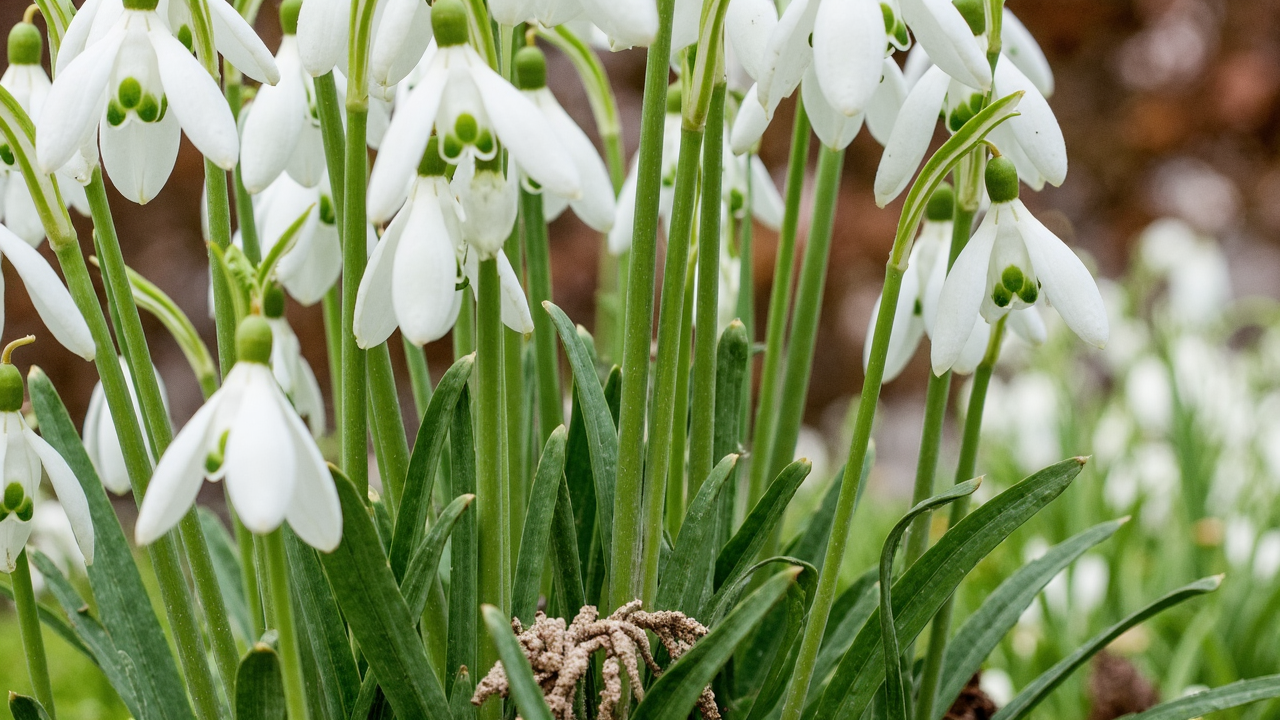
The flower of Galanthus nivalis is small but intricately formed. Each bloom hangs from a slender, arching stem and consists of six tepals arranged in two whorls of three. The three outer tepals are pure white, longer, and slightly convex; the three inner tepals are shorter, notched at the tip, and bear a characteristic green marking on the outer face. This inner green mark is a key diagnostic feature that distinguishes the common snowdrop from related species such as Galanthus elwesii (the greater snowdrop), in which the green covers a larger proportion of the inner tepal.
The leaves are linear, strap-shaped, and a soft grey-green, folding together at the base to form a sheath around the flower stem. They typically reach 8–15 cm in length and are present from autumn through late spring, dying back as the bulbs enter summer dormancy.
At maturity a single bulb forms a small clump; over many years this can expand into broad drifts of many hundreds of bulbs. Established drifts are most striking when viewed in low winter light, when the massed white flowers stand out against dark soil and bare twigs.
Growing Conditions
Snowdrops thrive in conditions that mimic their native woodland habitats — cool, moist, and partially shaded. They perform best in light dappled shade cast by deciduous shrubs or trees, where they receive winter and early spring sun before the canopy leafs out. Full sun is tolerated, particularly while the plant is in active growth, but hot, dry positions in summer are unsuitable, as the bulbs require cool, moist conditions during their growing season.
Soil should be humus-rich and moisture-retentive but free-draining, as bulbs will rot in waterlogged ground. Loamy soils with good organic content are ideal. Snowdrops tolerate a range of soil pH, from mildly acidic to mildly alkaline, and grow well over chalk — a useful trait in much of southern and eastern England. A yearly mulch of leaf mould or well-rotted garden compost in autumn helps to maintain soil structure and moisture.
In the UK, snowdrops are hardy across all regions. They grow successfully from the Scottish Highlands to the south coast, flowering slightly later in colder northern and upland sites. They are not generally affected by late frosts; the flowers and foliage tolerate several degrees of frost without damage.
Planting and Care
Planting. Snowdrop bulbs are best planted "in the green" — that is, immediately after flowering, while the leaves are still green and the bulbs are actively growing. This is widely held to give a much higher success rate than planting dry bulbs in autumn, which can fail to establish if they desiccate. Bulbs should be set at a depth of roughly 8–10 cm and spaced 5–8 cm apart in drifts of irregular shape. If dry bulbs must be used, they should be planted as soon as possible after purchase in early autumn and not allowed to dry out.
Watering. Snowdrops in the ground rarely need supplementary watering in the UK, as winter and spring rainfall generally meets their needs. During prolonged dry spells in late winter or early spring, occasional watering will help to prolong flowering. Container-grown snowdrops should be kept just moist whenever in growth and allowed to dry off gradually as the foliage yellows in late spring.
Feeding. Snowdrops are not heavy feeders. An annual top-dressing of leaf mould, well-rotted compost, or a slow-release general fertiliser applied in late autumn, before the new roots emerge, is generally sufficient. Bone meal has traditionally been recommended and remains a useful source of phosphorus for bulbs.
Pruning. No pruning is required. The foliage should be allowed to die down naturally in late spring, as the leaves continue to photosynthesise and replenish the bulb for the following year. Tying or cutting back the leaves before they have yellowed will weaken the bulbs.
Propagation. The simplest method is by division of established clumps immediately after flowering. Lifts should be broken apart by hand into small groups of bulbs and replanted at the same depth. Snowdrops also set seed in favourable conditions, and colonies will gradually self-seed in undisturbed soil, though named cultivars will not come true from seed and must be propagated vegetatively.
Seasonal care. In the UK, little routine care is needed. In autumn, mulch clumps with leaf mould. In late winter, watch for slugs on emerging shoots. In late spring, allow foliage to die back naturally. Bulbs can be left undisturbed for many years; lifting is only required for propagation or when clumps become overcrowded and flowering declines.
Common Problems
Snowdrops are generally trouble-free, but a small number of issues may be encountered.
Bulb rot. Waterlogged or poorly drained soils can lead to rotting of dormant bulbs in summer. Affected bulbs turn soft and brown and fail to emerge the following year. Improving drainage and avoiding fresh manure in planting sites reduces the risk.
Snowdrop grey mould (Botrytis galanthina). This fungal disease is the most serious disorder of snowdrops and can devastate clumps in damp seasons. Symptoms include distorted shoots, grey fungal growth on leaves and flowers, and black resting structures (sclerotia) on affected tissue. Infected plants should be lifted and destroyed (not composted), and the site should be rested from snowdrops for several years. Purchasing bulbs from reputable suppliers and avoiding congestion helps to limit outbreaks.
Lack of flowering. Mature clumps that flower poorly usually indicate overcrowding, drying out in summer, or premature removal of foliage. Lifting and replanting divisions in fresh soil with added organic matter usually restores flowering within a season or two.
Pests. Slugs and snails can damage emerging shoots in mild winters but rarely cause serious harm. Birds occasionally peck at flowers but seldom cause lasting damage.
No serious toxicity to humans has been widely documented beyond mild gastrointestinal and dermal effects, and claims about more severe toxicity should be treated with caution. Pets that ingest bulbs may show mild symptoms; if ingestion is suspected, veterinary advice should be sought.
Popular Varieties
Several real, widely available cultivars of Galanthus nivalis and closely related snowdrops are grown in British gardens. The species itself remains the most commonly planted, but the following are well-established in UK trade.
- 'Flore Pleno' — a robust, fully double-flowered form of G. nivalis, in cultivation since at least the early eighteenth century. The inner tepals are multiplied and tipped with green, giving a fuller, longer-lasting flower. It increases readily and is the form most often sold as dried bulbs.
- 'Viridapice' — a tall, vigorous form with a distinct green mark at the tip of each outer tepal as well as on the inners. Useful in mixed snowdrop plantings for the additional green colouring.
- 'S. Arnott' — often considered a hybrid rather than a pure G. nivalis, but a classic garden snowdrop of Scottish origin. Larger-flowered and more strongly scented than the typical species, with a rounded, substantial bloom.
- 'Atkinsii' — another tall, early-flowering snowdrop, frequently listed alongside G. nivalis cultivars and widely available in UK bulb catalogues in late winter.
For gardeners wishing to explore the genus further, Galanthus elwesii (greater snowdrop), G. plicatus, and their hybrids offer larger flowers and a slightly earlier or later season. Specialist snowdrop nurseries — many of which open during snowdrop season for plant sales — are the best source for the full range of named cultivars.
Pests and Diseases
| Problem | Symptoms | Management |
|---|---|---|
| Snowdrop grey mould (Botrytis galanthina) | Fuzzy grey mould appears on shoots and leaves, potentially spreading down to the bulb. | Remove infected material promptly and ensure good air circulation around plants. |
| Narcissus bulb fly | Leaves turn yellow and wither prematurely while the bulb rots inside. | Apply a granular insecticide to the soil in early spring or lift bulbs to check for larvae. |
| Slugs and snails | Irregular holes chewed into emerging leaves and flower stems, often accompanied by slime trails. | Use slug pellets, beer traps, or hand-pick pests at night to protect young foliage. |
| Vine weevil | Notched edges on leaves above ground and root damage causing plant collapse below. | Apply a systemic insecticide drench in autumn or use nematodes to control larvae in the soil. |
| Bulb rot | Bulbs become soft, mushy, and discoloured, often failing to produce healthy growth. | Plant in well-drained soil and avoid waterlogging to prevent fungal infection. |
Quick Care Summary
| Sunlight | Partial shade |
|---|---|
| Soil | moist, but well-drained soil with leafmould or garden compost incorporated |
| Hardiness | — |
| Sow | — |
| Plant | May, June, September, October, November |
| Prune | — |



As an Amazon Associate, GardenWizz earns from qualifying purchases made through the links above. This does not affect the price you pay. See our disclaimer for details.