Avens
Geum · Geum
At a Glance
| Botanical name | Geum |
|---|---|
| Common name(s) | Avens, Geum |
| Family | Rosaceae |
| Plant type | perennial (Herbaceous perennials, often rhizomatous and sometimes stoloniferous. Evergreen except where winter temperatures drop below -18 °C.) |
| Height × Spread | 10–120 cm × — |
| Hardiness | — (to -18.0 °C) |
| Position | Full sun, Partial shade |
| Soil | Fertile, moisture retentive soil; tolerant of dry soils, acidic or alkaline. Alpine species prefer free-draining soil. |
| Flowering | June–August |
| Toxicity | — |
| Native range | Europe, Asia, North and South America, Africa, New Zealand, Australia |
Overview
Avens (Geum) is a genus of hardy herbaceous perennials in the rose family (Rosaceae), widely grown in British gardens for their long season of brightly coloured, rounded flowers held on wiry stems above clumps of lobed, slightly hairy foliage. The following quick-care table summarises the essentials for UK growers; the full article below covers each in detail.
Avens (Geum) is a genus of around 50 species of herbaceous perennials distributed across temperate regions of Europe, Asia, the Americas and Australasia, with a long history of cultivation in British gardens. Two species are native to the United Kingdom: Geum urbanum (wood avens, also known as herb bennet), a modest yellow-flowered plant of woodland edges, hedgerows and shaded walls, and Geum rivale (water avens), a damp-meadow plant with nodding, bell-shaped, dusky pink to apricot flowers. The showy border hybrids widely sold in British nurseries under collective names such as G. × cultorum or "chiloense types" descend largely from South American and European species and have been grown in UK gardens since the early nineteenth century. The plant forms a low, evergreen-to-semi-evergreen rosette of pinnate leaves, from which arise tall, wiry, branched stems carrying rounded, five-petalled (or semi-double) flowers in shades of red, yellow, orange and apricot. Modern cultivars are valued for their extended flowering period, often producing a strong first flush in early summer and a useful secondary flush into late summer if spent stems are removed. Avens are popular in cottage-garden plantings, mixed herbaceous borders, wildlife gardens and gravel gardens, where they supply reliable colour during the high-summer lull between the main flushes of roses and the late-season daisies. Several cultivars hold the Royal Horticultural Society's Award of Garden Merit, reflecting their reliability in typical British garden conditions.
Appearance
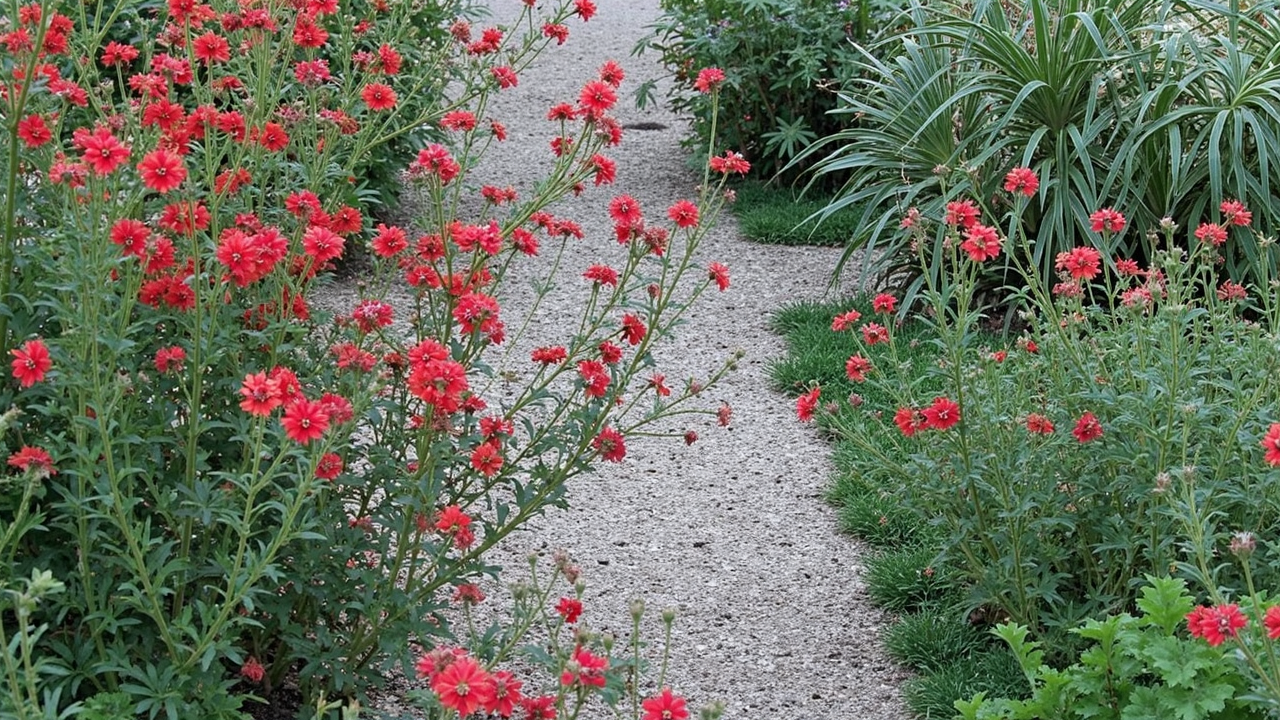
Avens forms a basal rosette of soft, fresh-green, pinnately divided leaves with a large terminal lobe and several smaller lateral lobes; the foliage is lightly hairy and remains semi-evergreen through mild winters, dying back cleanly in colder parts of the UK. From this rosette rise branched, wiry stems, often tinted red at the base, which carry the flowers well above the foliage. Each stem typically branches into three to five buds, and the open flowers are saucer- to bowl-shaped, around 3 to 4 cm across, with five overlapping, broadly rounded petals arranged around a prominent central boss of yellow, green or burgundy stamens. In single-flowered forms the petals are flat and open; in semi-double and double forms they are more numerous, often slightly ruffled, and give a fuller, longer-lasting head. Colours range from the clear scarlet of 'Mrs J. Bradshaw' and the warm gold of 'Lady Stratheden' through the soft apricot-pink of modern cultivars such as 'Mai Tai' to the saturated tangerine of 'Totally Tangerine'. The rounded, slightly cupped shape of the flower, the prominent central boss and the branching wiry stems give the plant a loose, airy character that combines well with grasses, geraniums and early-flowering perennials. After flowering, the spent heads develop into decorative, burr-like seed clusters that are attractive in their own right and are sometimes left on the plant for late-season interest, although most gardeners remove them to encourage further flowering. Established clumps broaden steadily into well-filled mounds 30 to 60 cm tall, with flowering stems commonly reaching 45 to 60 cm in most cultivars and 75 to 90 cm in the most vigorous.
Growing Conditions
Avens performs best in full sun or very light dappled shade, in a moist but well-drained, moderately fertile soil with a near-neutral pH. It is less fussy about soil type than many rock-garden or Mediterranean plants and tolerates loam, clay (provided drainage is reasonable) and sandy soils, as long as the ground does not dry out completely in summer or sit waterlogged in winter. In the United Kingdom the most reliable sites are open, sunny borders where the soil retains some summer moisture, the cooler end of a gravel garden, the edge of a woodland garden in light shade, or any border where other reliable perennials such as geraniums and astrantias thrive. Avens is fully hardy across the UK, including most lowland and upland areas of Scotland, northern England and Northern Ireland, with established clumps surviving prolonged frosts and snow cover; the writer has not, however, verified a single RHS hardiness rating that covers the genus as a whole, and ratings for individual cultivars may vary. The plant is intolerant of two extremes: hot, parched root runs in pure sand or against a south-facing wall in full sun with no supplementary watering, and boggy ground that remains saturated through winter, which can rot the crown. In practice the most common cause of failure in British gardens is summer drought on thin, free-draining soil, followed by winter wet on heavy clay. Light midday shade in the south of England, and a mulch of garden compost in spring to conserve moisture, address the first problem; incorporating grit and organic matter at planting time, or growing on a slight slope, addresses the second.
Planting and Care
Plant container-grown avens in spring or early autumn, setting the crown at soil level and spacing plants 30 to 45 cm apart for a flowing drift, or 45 to 60 cm apart where each clump is to develop into a distinct mound. Water in thoroughly after planting and keep the soil evenly moist through the first growing season; once established, the plant needs little routine watering except during prolonged dry spells in summer. Feeding is light: a single application of a balanced general-purpose fertiliser in early spring, or a top-dressing of garden compost, is sufficient, and over-rich feeding produces lush, floppy foliage at the expense of flowers. Pruning is largely a matter of deadheading: cutting spent flowering stems back to the basal rosette as the last flowers fade in midsummer not only tidies the plant but, in modern repeat-flowering cultivars, encourages a strong second flush from late July into September. At the end of the season, leave the foliage in place over winter as light protection for the crown, then cut away any damaged or tired leaves in early spring as new growth emerges. Division is the simplest method of propagation: lift and split established clumps in autumn or early spring, replanting the vigorous outer sections and discarding the woody centre; most cultivars come true from division. Seed can be sown in autumn or spring, but cultivars do not come true and named forms must be propagated by division. Semi-ripe basal cuttings taken in early summer also root readily in a gritty, free-draining compost under a cold frame. Seasonal care in the UK follows a straightforward rhythm: light spring tidy and feed, deadhead through summer to extend flowering, lift and divide congested clumps every three to four years in autumn, and apply a thin mulch of compost in late winter or early spring on lighter soils.
Common Problems
Avens is generally healthy and largely free of serious pest or disease problems in the UK, but a small number of issues recur. The most frequent complaint is a clump that fails to flower well, or that flowers once and then produces only leaves: this is almost always a sign of one of three causes, namely drought stress in summer, overcrowding in an ageing undivided clump, or shade that is too dense for reliable bud formation. Dividing the clump in autumn, watering through dry spells, or moving the plant to a sunnier position usually restores flowering. Powdery mildew can affect the foliage in dry summers, particularly on plants grown in shallow, poor soil; improving soil moisture and removing affected leaves is usually sufficient, and resistant cultivars are increasingly available. Vine weevil grubs occasionally attack the crowns of container-grown specimens; pots should be inspected in late summer and treated with a biological control if grubs are found. The plant is not generally listed by major references as toxic to humans, dogs or cats, and is not recorded as poisonous to livestock, though, as with any ornamental plant, ingestion of material quantities may cause mild gastric upset. Slugs and snails can damage the new spring growth in damp sites, and blackbirds sometimes shred the foliage when lining nests in spring, although neither causes lasting harm to a mature clump.
Popular Varieties
Geum 'Mrs J. Bradshaw' is one of the oldest and most widely planted border avens, raised in the early twentieth century and still a staple in British nurseries; it carries semi-double, bright scarlet flowers on stems to about 60 cm and holds the Royal Horticultural Society's Award of Garden Merit. 'Lady Stratheden' is its yellow counterpart, with semi-double, rich golden flowers on similar stems, also AGM-rated, and the two are often planted together for a classic hot-coloured pairing. 'Totally Tangerine' is a modern, vigorous, sterile cultivar raised in the United Kingdom and widely sold since the 2010s; it produces large, single, warm apricot-orange flowers over an exceptionally long season from late May to September on stems reaching around 90 cm, and it is the most widely planted avens in contemporary UK plantings. 'Mai Tai' is a slightly more compact selection with soft apricot-pink, semi-double flowers that fade gently with age, well suited to the front of a border and to container plantings, and it has become a standard in many British garden-centre ranges. Other reliable AGM forms include the dusky pink, double-flowered 'Bell Bank' and the compact red 'Blazing Sunset'; the native wood avens (Geum urbanum) and water avens (Geum rivale) are also widely available for wildlife and wildflower plantings, although their flowers are smaller and less showy than those of the border hybrids.
Pests and Diseases
| Problem | Symptoms | Management |
|---|---|---|
| Geum sawfly | Larvae shred foliage, causing extensive damage that can be hard for the plant to recover from. | Monitor from spring onwards and remove any larvae by hand, then destroy them. |
| Slugs and snails | Irregular holes in leaves and flower buds, often accompanied by silvery slime trails. | Use physical barriers like copper tape or organic slug pellets to protect young growth. |
| Powdery mildew | A white, dusty fungal coating appears on leaves and stems, particularly in humid conditions. | Improve air circulation by thinning crowded plants and water at the base to keep foliage dry. |
| Root rot | Foliage turns yellow and wilts despite moist soil, indicating poor drainage or waterlogging. | Ensure soil is well-drained and avoid overwatering, especially for alpine species like G. montanum. |
| Leaf scorch | Leaves develop brown, crispy edges due to exposure to intense direct sunlight. | Plant in partial shade or position behind other low-growing plants to soften summer sun. |
Quick Care Summary
| Sunlight | Full sun, Partial shade |
|---|---|
| Soil | Fertile, moisture retentive soil; tolerant of dry soils, acidic or alkaline. Alpine species prefer free-draining soil. |
| Hardiness | — (-18.0 °C) |
| Sow | March–May |
| Plant | March, April, May, September, October, November |
| Prune | January, February, September, October, November, December |
As an Amazon Associate, GardenWizz earns from qualifying purchases made through the links above. This does not affect the price you pay. See our disclaimer for details.